
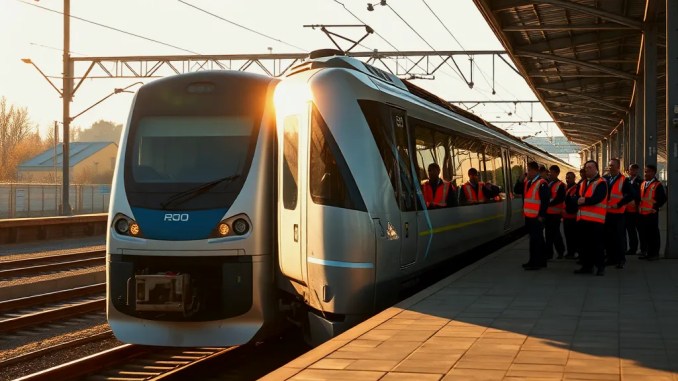
Pesa completes RegioFox program: final unit delivered to ČD
Pesa Bydgoszcz delivered the last of 106 RegioFox diesel multiple units (DMUs) to Czech national operator České dráhy (ČD) on 10 November 2026, when the final 847-class unit entered service from the Trutnov depot in the Hradec Králové Region. That delivery closes four orders placed under a 2021 framework agreement and brings the total Pesa-built RegioFox fleet for Czechia to 106 units.
How this completed delivery modernizes regional services in Hradec Králové
The final train completes a targeted fleet-replacement program launched in 2024. The program replaced aging stock with 33 RegioFox and seven RegioPanter units, pushing the region’s investment above CZK 4 billion. The new fleet standardized low-floor, step‑free access across regional routes, immediately improving boarding times, accessibility for passengers with reduced mobility, and operational reliability on single-track lines.
Which lines now operate RegioFox trains and what does that change?
RegioFox DMUs now run on six primary regional corridors: Kolín–Chlumec nad Cidlinou–Stará Paka–Trutnov; Hradec Králové–Letohrad; Hradec Králové–Rychnov nad Kněžnou–Solnice; Choceň–Týniště nad Orlicí–Náchod–Hronov; Hradec Králové–Náchod–Meziměstí–Broumov; and Hradec Králové–Trutnov–Svoboda nad Úpou. Operators use automatic coupling systems to join and split sets, enabling flexible capacity management and through-running between regional centers and small towns without forced transfers on single-track, capacity-constrained segments.
Key technical and passenger features of two-car RegioFox units
Two-car RegioFox units seat about 115 passengers and include a first-class section and onboard Wi‑Fi. They use twin Rolls-Royce diesel engines and reach a top service speed of 120 km/h. These units combine low-floor accessibility with modular interior layouts that operators can tailor (eg, bicycle racks, accessible toilets, commuter seating). The result: faster dwell times, higher perceived comfort, and operational flexibility for mixed-stop regional timetables.
Framework agreement: capacity for up to 160 units and procurement context
ČD and Pesa signed a framework agreement on 26 February 2021 that allows procurement of up to 160 two‑car diesel units. Pesa stated the framework’s potential value at PLN 2.5 billion. The Hradec Králové Region order for 33 RegioFox units constituted the framework’s second call; Deliveries were planned for 2024–2026. A fourth ČD order in November 2023 increased the fleet to 106 units. Across all orders, the total value of these latest deliveries exceeded CZK 10 billion.
Production notes and the 847-class program assessment
Pesa moved a new carbody production technology into series manufacture with the 847-class RegioFox program and focused on weight reduction during design. The trains meet EU Stage V emissions limits and extensive homologation testing. Pesa reported that, despite pandemic-related disruptions, deliveries over the last two years averaged about one month ahead of contract dates.
How many more RegioFox units could still be ordered?
The framework’s 160-unit upper limit leaves room for 54 additional vehicles beyond the 106 delivered. Public statements have not confirmed a fifth call under the framework. Pesa indicated the Czech order could rise internally to 121 units—an incremental 15 vehicles—depending on future operator decisions and regional needs. If Czech and potential Polish orders combine, Pesa projects total production of RegioFox-family trains could approach 200 units in coming years.
Operational impact: daily mileage and modal share
In the Hradec Králové Region, the modernized fleet (including five three-car RegioPanter sets on the Pardubice–Hradec Králové–Jaroměř line) now covers 11,700 km per day and accounts for about 75% of regional passenger-train kilometers. This concentration of modern rolling stock yields measurable improvements: reduced energy consumption per passenger-km through lighter carbody design, more consistent on-time performance from newer propulsion systems, and simplified maintenance supply chains from a fleet standard base.
Examples and step-by-step of coupling flexibility in service planning
Example use case: morning peak on a mixed-demand corridor. Step 1: dispatch two two‑car RegioFox sets coupled to form a four‑car train from the regional hub to the commuter-dense intermediate station. Step 2: at the intermediate station, automatic couplers decouple the rear two-car unit to continue on a branch line with lower demand while the front unit proceeds to the mainline destination. Step 3: return services mirror the operation, allowing operators to match capacity with time-varying demand without additional crews or complicated shunting. This coupling flexibility reduces empty-seat kilometers and optimizes driver rostering.
Related rolling stock in ČD service and lifecycle context
ČD also operates 31 Pesa-built RegioShark DMUs (class 844), which entered service in autumn 2012. The new 847 class complements the older fleet by offering updated emissions compliance, modular interiors, and production efficiencies. Over a typical 30-year lifecycle, operators expect lower whole-life costs from newer units due to reduced energy use, fewer mid-life overhauls, and improved diagnostics that shorten workshop downtime.
What to watch next: procurement signals and regional take-up
Watch for three indicators that will determine further orders: (1) regional ridership recovery and growth trends after timetable changes, (2) budget allocations from regional authorities for rolling stock renewals, and (3) ČD’s operational assessment of the 106-unit fleet’s reliability and maintenance costs over the next 12–24 months. A confirmed fifth order would convert the remaining framework capacity into firm demand; absent that, expect incremental purchases focused on network bottlenecks or modal-shift projects that prioritize low-floor accessibility.







Be the first to comment