
Mobile Suica hands-free gates: what JR East will roll out and when
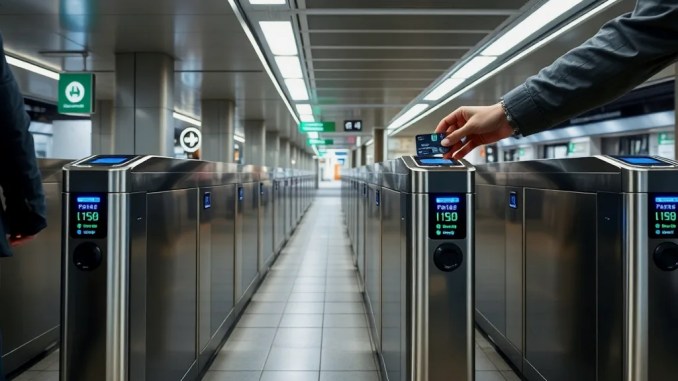
JR East plans to install hands-free pedestrian gates at 40 Tokyo-area stations beginning spring 2028. The rollout targets Yamanote Line stations, Narita Airport links, Tokyo Monorail stops serving Haneda and Hamamatsucho, and additional major terminals. JR East aims to extend the system to every station that currently has staffed ticket gates by the end of fiscal 2031 (March 2032).
How the system works and why Ultra Wideband (UWB) matters
The gates authenticate passengers via compatible smartphones running Mobile Suica, using UWB radio for precise position and proximity detection. Because UWB measures distance and direction more accurately than Bluetooth or NFC alone, JR East expects passenger throughput to remain high during peak commuter periods. Users will keep existing Mobile Suica accounts, season passes, and stored balances — the backend data remains unchanged; the new interface only changes how the gate recognizes a passenger’s device.
Who builds what: roles of Sony, FeliCa Networks and JR East Mechatronics
Sony will design and manufacture the gate readers and printers. FeliCa Networks will create security software for compatible smartphones to ensure credential integrity and secure communications. JR East Mechatronics will design and install the physical gates. This division of labor reduces single-vendor risk and lets each company leverage existing expertise in hardware, mobile security, and gate engineering.
Interoperability with existing gates and passenger flows
The roll-out maintains backward compatibility. Traditional card readers will remain in service: a passenger who enters via a hands-free pedestrian lane can exit later at a conventional gate, and vice versa. That ensures continuity for multi-leg trips and pre-paid card usage outside commuter-subscription zones. The design also preserves fare validation and transfer logic across existing ticketing systems.
Accessibility and luggage handling: real benefits for specific passengers
Passengers with large luggage, strollers, or wheelchairs will no longer need to fish out a transport card while passing through gates. Because the system recognizes the phone in a pocket or bag, door timing and gate width adjustments can reduce dwell time and awkward maneuvers that currently slow accessible travel. JR East expects this to cut friction for family travel and passengers with reduced mobility — measurable benefits during station crowding and event surges.
Trial program: April 10, 2027 to February 29, 2028 — stations, participants, and scope
JR East will run a controlled trial at 14 stations from April 10, 2027 to February 29, 2028. The trial covers five Shinagawa-area stations (Hamamatsucho, Tamachi, Takanawa Gateway, Shinagawa, Oimachi) and nine major terminals (Tokyo, Ueno, Shinjuku, Shibuya, Ikebukuro, Akabane, Kita-Senju, Nakano, Osaki). About 400 registered public-transport cardholders will use a Sharp-developed test app on loaned compatible smartphones. Trial gates will operate within the passenger-card zone only and will support both entry and exit, plus contactless payment.
What the trial will measure and how results will shape rollout
The trial will evaluate: throughput per minute during peak and off-peak, false-positive and false-negative recognition rates, security incident metrics, user error frequency, accessibility outcomes for luggage and mobility-aid users, and system interoperability with legacy gates. JR East will adjust gate software, LED indicators, and lane geometry based on measured congestion, then expand participant numbers and areas in staged phases.
Device compatibility, security, and privacy considerations
JR East has not yet published the list of compatible smartphone models. FeliCa Networks will supply device-side security software to preserve existing Mobile Suica credentials without transferring stored balances. UWB improves proximity detection but does not itself determine credential validity; the system still checks Mobile Suica account data during gate crossing. Operators must address potential spoofing vectors, relay attacks, and device loss through layered security: UWB ranging, cryptographic challenge-response, and session timeouts. Riders should expect opt-in trial enrollment, device whitelisting during tests, and later public guidance on secure usage.
Phased expansion: from 40 stations to every staffed JR East station by March 2032
After the initial 40-station deployment in spring 2028, JR East intends to phase in additional stations across Tokyo and the surrounding region, including both conventional lines and selected Shinkansen stations. The company targets full inclusion of all stations that currently staff ticket gates by the end of fiscal 2031 (March 2032). This schedule allows hardware upgrades, backend centralization, and incremental staff training.
How this ties into the Suica Renaissance program and centralized ticketing
The hands-free gates form one part of JR East’s Suica Renaissance program, which moves ticketing and stored-value data toward a centralized server model. The company plans to complete centralization and unify multiple Suica domains by March 2027, enabling consistent credential checks across regions. That centralized architecture simplifies adding new access modalities like hands-free gates and makes future changes — such as integrating other transport operators or adding temporary event passes — operationally easier.
Comparison with other technologies: facial recognition and alternative approaches
Other Japanese operators have used different approaches. Osaka Metro deployed facial-recognition gates across many stations in 2025 using digital tickets tied to registered face images. JR East’s UWB-based approach deliberately avoids facial biometrics and relies on device proximity instead. This reduces privacy risk vectors tied to centrally stored biometric templates while still enabling contact-free passage. The trade-offs: face systems can identify a person without a device but raise privacy and consent issues; UWB requires a compatible device but keeps identification tied to the Mobile Suica credential.
Operational impacts for station staff and customer service
Staff roles will shift from manual ticket inspection to exception handling: assisting passengers whose phones fail to register, resolving billing exceptions, and supporting accessibility needs. Customer-service scripts and signage will need updating to guide travelers through mixed lanes. Maintenance teams will integrate gate firmware updates and UWB calibration into regular station checks to maintain recognition accuracy.
Potential challenges and mitigation strategies
Key challenges include device fragmentation, signal interference in dense station environments, onboarding of tourists and occasional riders, and security hardening. Mitigations include phased device compatibility lists, UWB calibration trials, continuing traditional gates for non-compatible travelers, multi-language signage, and public tests to gather real-world failure modes. JR East’s staged trial and ongoing expansion will surface these issues early and permit incremental fixes.
What passengers should know and do now
Passengers should keep their Mobile Suica accounts current, watch for announcements on supported phone models, and enroll in trial programs if invited. During the transition, carry a physical or virtual backup mouse option and follow station instructions. Accessibility travelers should test gates during the trial window to confirm specific lane geometries and staff assistance availability.
Questions people also ask (quick answers)
Will I need to change my Suica card? No — existing Mobile Suica accounts, season passes, and stored balances remain valid.
When will my station get hands-free gates? Initial 40 stations in spring 2028; full rollout to all staffed stations by March 2032 is the target.
How secure is UWB-based recognition? UWB improves proximity detection, and combined with Mobile Suica cryptographic checks, provides layered security. Operators will still need to mitigate relay and spoofing attacks.
Can tourists use the system? Tourists will need compatible phones and Mobile Suica or continue using existing ticket options; JR East will publish compatibility details before wide rollout.
Examples and scenarios
Example 1 — Commuter with a season pass: a commuter keeps the phone in a jacket pocket, passes through a pedestrian lane during rush hour; UWB detects proximity and the gate opens without slowing the queue, while the backend validates the season pass.
Example 2 — Family with stroller and luggage: a traveler pushing a stroller and pulling a suitcase passes the lane without pausing to extract a card, reducing blockages and assistance calls.
Example 3 — Interchange trip: a passenger enters through a hands-free lane at Station A and exits at Station B using a legacy gate; the system reconciles the journey against the Mobile Suica account as usual.
Takeaway
JR East’s hands-free Mobile Suica gates combine UWB proximity detection, device-side security, and legacy-gate compatibility to reduce friction for many travelers while preserving existing mouse management. A year-long trial beginning April 2027 will shape the final design before the 2028 spring deployment and multi-year expansion to all staffed stations by March 2032.






Be the first to comment