
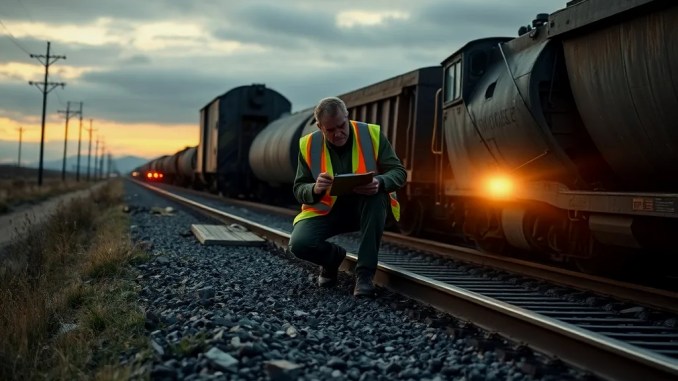
Summary of the Incident and Immediate Findings
The National Transportation Safety Board (NTSB) released a preliminary report on the October 15 Union Pacific derailment near Greensburg, Kansas. The westbound ZG2LC-14 train, operating with five locomotives (three at the head and two distributed mid-train), carried 171 loaded cars. Crew members reported two distinct braking events; afterward 37 cars in positions 17–53 derailed. The weather was cloudy with light rain and an ambient temperature near 11°C. No injuries or hazardous-material releases occurred, and estimated damage stands near $2.4 million.
What the Data Recorders Showed: Sequence of Brake Events
Data recorder logs show the train approaching Greensburg at roughly 56 mph with Positive Train Control (PTC) and the energy management system both active. Locomotive throttle settings were at notch 8. First, a locomotive safety system initiated an automatic penalty brake that brought the train to a complete stop. After the engineer confirmed distributed power telemetry and recharged the brake pipe, the train started again. Shortly after resuming motion, an unintended emergency brake application occurred when the brake-pipe pressure dropped unexpectedly. The conductor observed and alerted the engineer to the derailed cars during that emergency stop.
How Positive Train Control and Energy Management Interact with Braking
PTC enforces signal and speed compliance, while energy management modulates horsepower and dynamic braking to protect couplers and reduce in-train forces. In both the Greensburg and a March Richmond, Texas derailment, NTSB notes PTC and energy management were active yet an undesired emergency brake still occurred. That combination can produce complex interactions: an automatic penalty brake can reset dynamic modes, change trainline pressures, and require coordinated distributed power responses. Investigators are examining how these automated and manual actions affected longitudinal forces and wheel-rail dynamics immediately before the derailment.
Key Technical Terms and Why They Matter
Energy management system: Automatically limits in-train drawbar forces by adjusting throttle and dynamic braking, which reduces coupler stress and wear on mechanical components.
Throttle notch 8: Maximum tractive power setting on modern locomotives; sustained use increases in-train buff forces during braking events.
Penalty brake: A safety-triggered automatic application initiated by locomotive protection systems when they detect a rule violation or unsafe parameter.
Brake-pipe pressure restoration: Air replenishment required to release brakes after an automatic application; delayed or uneven recharge across the train can leave portions braked while others remain unreleased, increasing in-train stress.
Unintended emergency application: Sudden brake-pipe depressurization caused by mechanical failure, hose separation, or other faults that forces full emergency braking.
Step-by-Step Reconstruction of the Probable Operational Timeline
1. Train approaches Greensburg with PTC and energy management on; locomotives at notch 8.
2. Locomotive safety system triggers a penalty application and the train stops under automatic braking.
3. Crew verifies distributed power telemetry and recharges the brake pipe; air pressure equalizes sufficiently to release brakes.
4. Train departs under distributed-power control; longitudinal forces resume according to throttle and rail conditions.
5. Brake-pipe pressure unexpectedly drops again, triggering an automatic emergency brake application.
6. Emergency forces and potential transient in-train compressive/buff loads lead to derailment of cars in the mid-train block (positions 17–53).
What Investigators Are Examining Next
Investigators focus on mechanical evidence and data streams to establish root causes and sequence causation: physical inspection of derailed cars and couplers for fractures or pre-existing defects; integrity tests on brake hoses, angle cocks, and cut-out valves; analysis of locomotive event recorder files and distributed power telemetry for communications anomalies; track geometry and rail-wear measurements at the derailment site; and interviews with crew and dispatch to reconstruct operational choices. The NTSB’s final determination will rely on correlating physical damage patterns with high-resolution event data.
Comparison With the Richmond, Texas Derailment and Shared Patterns
On March 18, 2026, a Union Pacific train near Richmond, Texas (MEWEG-18) experienced an undesired emergency brake and derailed 24 cars; that event occurred with PTC and energy management active and at roughly comparable speeds. The Richmond derailment released about 120,000 gallons of ethanol from seven breached tank cars, whereas Greensburg reported no hazardous-material release. Similarities include undesired emergency braking while automated systems were engaged and mid-train derailment patterns—suggesting researchers should consider systemic interactions among PTC, energy-management logic, distributed power communications, and brake-pipe integrity.
Operational and Mechanical Scenarios Under Review (Examples)
– Distributed-power telemetry interruption: Loss of mid-train locomotive control or telemetry can change braking response time and create uneven brake-pipe pressures.
– Brake hose separation or valve failure: A mechanical breach in the brake line produces immediate pipe depressurization and an emergency application.
– Coupler or center-sill failure under transient buff loads: If an automatic penalty or emergency application creates sudden compressive forces, weaker couplers or structural defects can permit car-to-car misalignment and lifting of wheelsets.
– Energy management timing mismatch: Abrupt transitions between dynamic braking and full-air emergency braking can generate transient forces beyond design thresholds for certain car types.
Evidence Already Collected and Preliminary Constraints
Investigators have examined derailed equipment, track, recorder data, signaling logs, and operating records. They continue to test components in laboratories. The NTSB’s preliminary report emphasizes that early findings do not identify a probable cause and that conclusions can change as lab results and metallurgical examinations complete.
How This Affects Railroad Operations and Safety Practices
Short-term, railroads may review distributed-power communications health checks, reinforce inspection protocols for brake hoses and angle cocks, and re-evaluate energy-management parameter settings in mixed consists. Longer-term, regulators and operators could consider additional monitoring for brake-pipe integrity, redundancy in distributed-power telemetry, and refined automatic-response logic that reduces abrupt transitions between dynamic and air-brake states to limit transient in-train forces.
Practical Takeaways for Crew and Maintenance Teams
– Verify distributed-power telemetry and brake-pipe continuity during setout and after penalty or emergency applications.
– Inspect mid-train and tail-end air lines and couplers after any automatic brake application before resuming movement.
– Record and preserve event recorder data immediately; establish chain-of-custody for electronic downloads.
– Prioritize metallurgical and component testing for any fractured couplers or failed brake hardware to determine whether fatigue, defect, or overload caused the failure.
What to Expect from the NTSB Final Report
The final report will combine laboratory analyzes (metallurgy, component testing), detailed event-data timelines, track and car inspections, and operational interviews to assign causal and contributing factors. The probable cause statement will likely reference specific mechanical failures, procedural issues, or systemic interactions among automated systems and human actions if the evidence supports those linkages.



Be the first to comment