

Thales has agreed to accelerate delivery of two Ground Master 200 MM/A radars ordered by Romania, moving one delivery forward by several weeks and the other by several months to strengthen Romania’s air surveillance and threat-detection timeline. Company representatives confirmed the revised schedule after meeting with Romanian Defense Minister Ștefan Radu Oprea. Romania contracted Thales for 12 systems in a €247 million program, initially planned for phased deliveries through 2030 and financed under the EU SAFE defense initiative. The accelerated deliveries allow Romanian forces to field advanced low- and medium-altitude detection capabilities sooner.
How will earlier radar deliveries change Romania’s air defense posture?
Delivering two Ground Master 200 MM/A radars earlier than planned shortens the time Romania operates with coverage gaps between long-range sensors and point-defense systems. These radars specialize in detecting low-altitude threats—small aircraft, cruise missiles and a wide range of unmanned aerial systems (UAS)—that often fly below the horizon of long-range radars. By plugging critical sensor gaps sooner, Romania will:
• Improve layered detection: Radars will provide mid- and low-altitude tracks that feed into an integrated air picture, enabling faster cueing of interceptors and surface-to-air systems.
• Reduce reaction time: Earlier detection of fast, low-flying threats compresses the sensor-to-shooter timeline, allowing command centers and weapons systems to react more rapidly.
• Increase resilience: Distributing capable radars across multiple sites reduces single-point failures and complicates adversary suppression efforts.
What capabilities do Ground Master 200 MM/A radars provide?
The Ground Master 200 MM/A is designed as a mobile, range 3D radar medium optimized to detect and track low-observable and small targets in complex clutter environments. Key capabilities include:
• 3D air picture: Simultaneous range, azimuth and elevation data enable accurate altitude estimation and track continuity for maneuvering targets.
• Gap-filling role: Positioned to cover sectors under long-range radars’ horizon, delivering continuous coverage across altitudes and ranges.
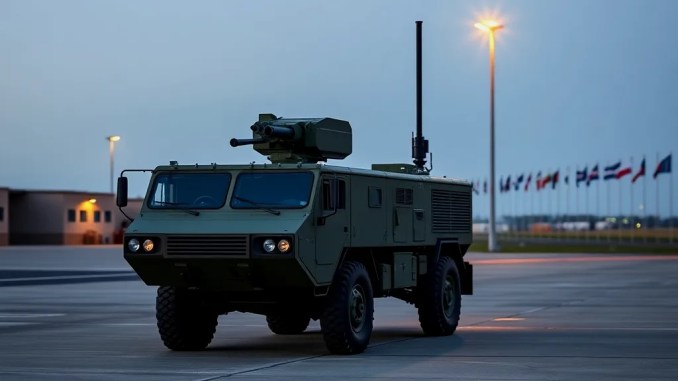
• Mobility and quick deployability: Systems mount on tactical vehicles or trailers for rapid emplacement and re-location, which supports operational flexibility during crises.
• Multi-target tracking: The radar tracks numerous targets concurrently, from small UAS to high-speed cruise missiles, while maintaining low false-alarm rates through adaptive signal processing.
Why are low-altitude radars critical today?
Modern threats increasingly exploit low flight profiles and small signatures to evade detection. Examples include miniaturized UAS swarms used for reconnaissance and attack, and low-flying cruise missiles that use terrain masking. Low-altitude-capable radars:
• Detect small, slow or low-signature threats: Specialized processing distinguishes true targets from environmental clutter (sea, urban terrain, foliage).
• Support layered defenses: By feeding mid- and low-altitude tracks to command-and-control systems, they enable optimized use of interceptors, point defenses and electronic measures.
• Provide tactical flexibility: Rapidly deployable units can be relocated to cover gaps or protect high-value assets during operations.
How will the accelerated schedule be implemented operational fleetly?
Operational implementation of earlier radar deliveries typically follows a stepped approach:
1. Site selection and preparation: Identify priority locations where earlier capability will yield the largest benefit—near critical infrastructure, airbases or known coverage gaps. Prepare power, communications and hardened emplacement if required.
2. Rapid deployment and integration: Move the mobile radar to the site, perform a short validation and connect to national air picture networks using secure datalinks and standardized message formats (eg, ASTERIX or NATO STANAG-compatible protocols).
3. Calibration and testing: Conduct empty-airspace calibration, then progressive integration with existing sensors and command centers to verify track handover, cueing, and engagement timelines.
4. Operational handover and training: Deliver hands-on operator training and maintenance briefs so crews maximize uptime and exploit sensor capabilities from day one.
What program context and financing support the acquisition?
Romania signed a contract for 12 Ground Master 200 MM/A radars with Thales worth €247 million. The program plans phased deliveries beginning around April 2027 for the first system and concluding by 2030 for the remainder. The European Union’s SAFE defense financing instrument supports the procurement to reinforce collective and national defense. The revised plan brings two systems forward from that timeline to address immediate operational needs.
Are there complementary acquisitions or contracts?
Separately, Romania and Thales concluded an additional contract to procure four radars to support combined civil and military airspace surveillance and to assist approach and landing operations. That agreement emphasizes dual-use capabilities—helping air traffic management while strengthening national defense—by enabling coordinated civil-military situational awareness and reducing equipment redundancy.
What are practical examples and likely short-term effects?
Example scenarios where earlier radar arrival has measurable impact:
• Border and coastline protection: A radar deployed to a coastal headland fills low-altitude approaches used by sea-skimming cruise missiles or small maritime UAS, enabling early warnings to coastal defense batteries.
• Airbase defense: Rapid emplacement near an airbase improves interception timelines for inbound threats and enhances protection of aircraft on the ground during increased tensions.
• Festival or critical-event security: Temporary deployment for a high-profile event provides layered detection against low-flying UAV threats and supports civil authorities with airspace monitoring.
Key takeaways
Accelerating the delivery of two Ground Master 200 MM/A radars helps Romania close critical low- and medium-altitude sensing gaps sooner, strengthens layered air defense, and increases operational resilience. The systems’ mobility, gap-filling role and multi-target tracking capabilities will produce immediate tactical benefits once site selection, integration and training are complete.







Be the first to comment