
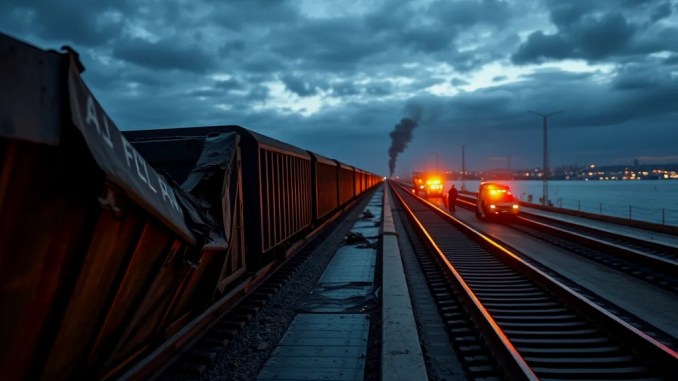
Kerch Bridge struck on 16 November 2026: what happened and immediate effects
On 16 November 2026 an unmanned aerial vehicle (UAV) attack targeted the Kerch (Crimean) Bridge, temporarily halting road traffic and delaying passenger rail services to Crimea. Russian authorities reported no immediate fatalities or injuries at the bridge site while starting structural inspections and repairs. Stations and operators placed contingency procedures into action to manage passengers and reroute services where possible.
Which passenger trains were delayed and by how long
Four Tavriya passenger trains bound for Kerch experienced measurable delays: St. Petersburg–Kerch and Adler–Kerch services were delayed about 4.5 hours; a Moscow–Kerch departure dated 14 November was delayed about 3.5 hours; and a Moscow–Kerch departure dated 15 November was delayed about 2 hours. Train staff provided rolling updates and passenger assistance. Operators emphasized that delays could change as inspections and repair work progressed.
How did authorities respond and restore services
Transport and emergency agencies implemented multi-step response protocols: immediate traffic stoppage across the bridge, visual and technical inspections of the structure, localized repairs where safe, and phased reopening of lanes. Rail operations resumed sooner than road traffic after engineering checks cleared the rail bed, while road lanes reopened only after additional structural assessments. Crisis centers coordinated information flow, directed emergency services, and issued travel advisories to minimize risk to civilian movement.
Claims about 1,336 UAVs: what the numbers mean and verification limits
The Russian Defense Ministry claimed air defenses intercepted 1,336 Ukrainian UAVs over a broad time window spanning parts of 15–16 November. That figure—if taken at face value—would represent one of the largest single-day tallies publicly reported by Russian authorities during the conflict. Independent verification of that aggregate number is lacking; open-source imagery, third-party trackers and international observers have not corroborated the full count. Analysts caution that ministry figures can aggregate systems, sensor detections, and multiple engagement reports, producing higher headline totals than independently verifiable losses.
Secondary incidents in southern Russia: fires and industrial damage
Officials reported several industrial fires in southern Russian regions following related security events: four industrial facilities burned in Azov (Rostov region) and additional incidents appeared in Krasnodar Krai. Local authorities reported multiple non-fatal injuries. Fire suppression and industrial safety teams prioritized stopping fires from spreading to critical energy and production infrastructure; damage assessments remained preliminary and locally reported impacts varied in detail and scale.
Why the Kerch Bridge holds strategic importance
The roughly 19-kilometer Kerch Bridge directly links mainland Russia to the Crimean Peninsula by both road and rail. That direct connection creates a logistical corridor for civilian transport, trade and military supply. Disruptions on the bridge amplify supply-chain fragility for goods, personnel and heavy equipment moving to and from Crimea. Past incidents—such as the 2022 and 2023 attacks that caused mixed road and rail interruptions—show that even localized damage can produce outsized operational effects across regional transport networks.
Structural integrity concerns: what engineers will check next
Engineering teams follow a methodical inspection sequence after an attack: visual surface checks for spalling, cracking and visible deformation; ultrasonic and magnetic scanning of primary load-bearing components; alignment surveys of rail and road decks; underwater inspections of piers and substructures; and load-testing under controlled conditions. Key points of interest include whether protective elements (expansion joints, bearings), the box-girder deck, or sub-pile connections sustained residual damage that could affect fatigue life and long-term load-bearing capacity. Full reopening to heavy road convoys requires conservative verification of these systems.
Practical effects for travelers and freight operators
Travelers and freight companies face layered impacts: immediate delays and rerouting costs, increased journey times when road lanes close, and schedule uncertainty for rail passengers. Freight operators with oversized or hazardous cargo follow special permitting and may be diverted to sea or longer land routes. Companies mitigate disruption with contingency planning: pre-positioned stock, alternate routing through ports or other land corridors, and staggered scheduling to reduce peak congestion during phased reopenings.
How to interpret official claims and independent reporting
Different sources report events through distinct lenses: military statements emphasize defensive successes and aggregate interdiction figures; local administrations provide operational details about transport and emergency response; Independent journalists and open-source investigators seek corroborating visual evidence, sensor logs and eyewitness accounts. Cross-referencing these sources—satellite imagery, rail operator service notices, local hospital and fire service logs—provides a clearer, evidence-based picture of damage and impact. Analysts advise skepticism when single-source large-figure claims lack corroboration.
Likely short-term and medium-term consequences for regional logistics
Short-term consequences include disrupted passenger timetables, delayed freight shipments to Crimea, and increased congestion at alternative ports and overland routes. Medium-term outcomes hinge on inspection results: limited structural damage produces short closures and rapid recovery; significant substructure damage forces prolonged repair windows, higher reconstruction costs and potential long-term shifts in logistical patterns (greater use of sea transport and alternative overland routes). Strategic planners monitor repair timelines, replacement part supply chains and seasonal weather windows that affect repair complexity.
What to watch next: indicators of escalation or normalization
Key indicators to monitor over the coming days and weeks: official engineering reports on substructure and deck integrity; verified satellite or drone imagery showing damage and repair work; rail operator published timetables returning to prior schedules; transport ministry advisories lifting road restrictions; and corroborated claims from combatant parties about responsibility. A return to stable, scheduled rail and road service—backed by independent confirmation—will indicate de-escalation of immediate transport risk. Continued high-alert defense activity or repeated strikes suggests persistent operational threats to the corridor.
Summary of reliable, actionable points for stakeholders
– Passengers: expect rolling timetable updates; Prioritize flexible tickets and check operator notices.
– Freight managers: model alternate routes, engage port options, and prepare extended lead times for delivery to Crimea.
– Infrastructure planners: prioritize non-destructive testing on piers and bearings, schedule targeted temporary repairs clearing light traffic, and plan for layered long-term reinforcement if inspections reveal fatigue or blast effects.
– Analysts and journalists: corroborate official tallies with independent imagery and operational notices before treating large aggregate numbers as confirmed.






Be the first to comment