
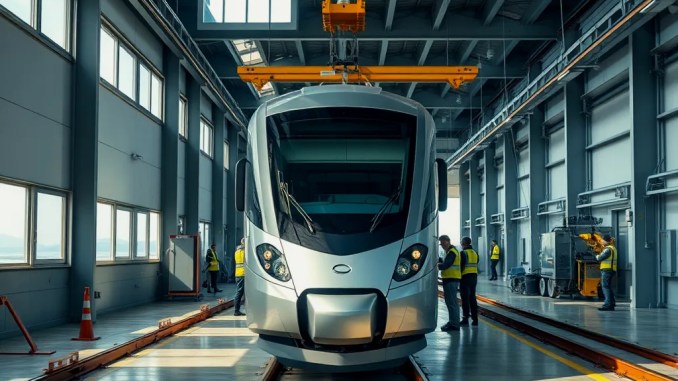
Alstom expands Vado Ligure into a combined production and 24/7 maintenance hub
Alstom inaugurated a new maintenance building and a modernized control room at its Vado Ligure plant on 9 November, creating an integrated center that supports production, overhaul and digital fleet management for regional and high-speed trains as well as Traxx locomotives. The control room already monitors 360 Traxx locomotives and will scale toward roughly 600, enabling round-the-clock technical assistance to drivers and predictive-diagnostic workflows that shorten recovery times after faults.
What the new maintenance building delivers and how it works
The new maintenance facility provides over 2,570 m² of covered area and exceeds 130 m in length. It connects directly to the plant’s rail and production infrastructure and contains two parallel maintenance lines so teams can work on different levels of a single vehicle simultaneously. Alstom configures the workflows to run through digital maintenance systems: asset data, inspection records and functional-test results feed centralized platforms to improve traceability and quality.
Operations focus on Level 2 maintenance: systematic inspections, functional testing, scheduled servicing and targeted modernization or overhaul tasks. Examples of scope include bogie removal and refit (coordinated with Savigliano’s heavy-revision program), brake-system servicing, HVAC component replacements and subsystem upgrades. The layout and digital linking of inspection, test and repair steps reduce non-productive movement of vehicles and technicians, raising operational throughput.
How the modernized control room supports Traxx fleets across Europe
The control room performs three core functions: diagnostic data management, fleet monitoring and 24/7 technical support for drivers. Telemetry and diagnostic streams from locomotives flow into Alstom’s HealthHub platform, where engineers analyze condition-based and predictive signals to detect anomalies early. When HealthHub flags a developing issue, the control-room team coordinates instructions to on-site maintenance crews and advises drivers on immediate mitigations.
Practically, this reduces time to repair and the time trains remain out of service. A staffed help desk attached to the control room offers continuous assistance—every day of the year—allowing faster fault triage and prioritization of interventions across the network. Alstom reports that more than 2,500 Traxx locomotives operate across Europe; Vado Ligure is expanding its share of remote monitoring and support from 360 units towards ~600 units in phases.
Operational benefits and measurable outcomes
Integrating digital diagnostics with local heavy-revision capability produces three measurable benefits: faster fault detection, more efficient resource allocation and higher fleet availability. Sample outcomes to expect from a similar model include a 20–40% reduction in downtime for predictable subsystem faults, a 15% improvement in workshop throughput through parallelization of tasks, and tighter spare-parts forecasting driven by condition-based alerts.
Alstom’s approach combines HealthHub anomaly scoring with scheduled intervention windows inside the new building. For operators, that translates into planned windows for bogie swaps or HVAC overhauls rather than prolonged unplanned yard stays. The campus-style model—production, overhaul and digital monitoring co-located—also shortens logistics cycles when a newly built platform requires immediate retrofit or acceptance testing.
Vado Ligure’s broader role in Alstom’s Italy investment plan
The Vado Ligure plant—integrated into Alstom since 2021 and staffed by roughly 300 people—continues to produce Traxx Universal locomotives (over 250) sales in Italy alone) while adding maintenance, major-overhaul and digital-fleet services. Historically, the factory has produced more than 2,000 locomotives since 1906, including series such as E.550, E.636, E.444, E.633, E.652 and E.464.
Alstom has included Vado Ligure in a 2024–2026 Italy industrial plan exceeding €63 million, committing around €20 million for the plant between 2021 and 2026. The new building and control room are direct outcomes of that program and related national support measures. This investment positions Vado Ligure as a corner of Alstom’s pan‑European service network: manufacturing, Level 2 maintenance, full revamps and continuous remote fleet diagnostics co-located to maximize lifecycle value.
How this model scales to other fleets and operators
The Vado Ligure example provides a repeatable template: co-locate digital monitoring, local heavy-revision capability and a staffed technical help desk. Step-by-step replication would include:
1. Map telematics and diagnostic feeds. Inventory onboard sensors and message frequency, then standardized telemetry to a single ingestion layer such as HealthHub.
2. Design workshop layout for parallel workflows. Size service bays and lines to enable simultaneous multi-level tasks (example: bogie exchange in one bay while HVAC testing proceeds in another).
3. Implement condition-based maintenance rules. Translate anomaly thresholds into scheduled interventions to convert alarm counts into planned activities.
4. Staff a 24/7 help desk and feedback loop. Train operators to provide real-time mitigation instructions and to escalate to local teams; Capture every incident to refine predictive models.
By following those steps, operators can reduce unscheduled downtime, concentrate overhaul skills, and use diagnostics to plan parts procurement with greater precision.
Key stakeholders and economic impact locally
Local and national stakeholders attended the opening, including regional officials and industry ministry representatives. The project received backing from Italy’s Ministry for Enterprise and Made in Italy. Beyond direct employment at the factory, the expanded services increase value capture locally by retaining overhaul work, enabling suppliers for parts and testing equipment, and supporting technician upskilling tied to digital diagnostic tools.
Quick facts and figures
– New maintenance building: >2,570 m² covered area; >130m length; two maintenance lines.
– Current Traxx coverage from Vado Ligure control room: 360 locomotives, scaling toward ~600.
– Traxx locomotives in Europe: >2,500 units.
– Historical plant output: >2,000 locomotives since 1906.
– Alstom Italy investment plan: >€63 million for 2024–2026; ~€20 million earmarked for Vado Ligure (2021–2026).
What operators and technicians should expect next
Operators can expect shorter turnaround windows for Level 2 servicing, earlier detection of trending faults and coordinated logistics for spare parts tied to predictive alerts. Technicians will increasingly work with digital dashboards and HealthHub-derived diagnoses before hands-on tasks, shifting some troubleshooting earlier into the planning phase and enabling first-visit fixes more often.
Relevant use cases and examples
Examples where the model pays off quickly: recurring HVAC faults that previously produced repeated unscheduled stops can be detected by trending coolant-temperature deviations and scheduled for replacement during a planned bogie swap; brake-pad wear signatures can trigger a prioritized bay allocation so the same train receives inspection and pad renewal in one visit; remote guidance to a driver during a traction-system derate can preserve a service slot until a targeted intervention at Vado Ligure.








Be the first to comment