
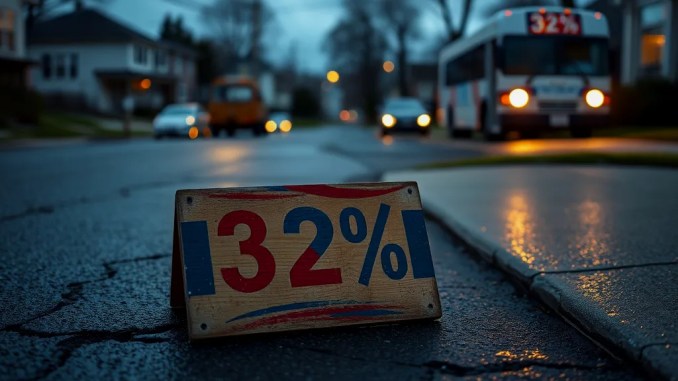
Only 32% of Americans currently approve of President Donald Trump’s job performance, according to a Reuters/Ipsos poll completed Monday. That figure matches support measured in late October and early November and sits just above the October mid-month low of 31%. The poll points to persistent, economy-centered concerns as the primary driver behind weak public backing.
How inflation and everyday cost increases translate to political fallout
Voters perceive price increases in core categories—groceries, gasoline, rent and utilities—as immediate, measurable reductions in household purchasing power. When those costs rise rapidly, they create concrete, repeatable moments of friction (eg, higher checkout totals, larger gas bills, budget rebalancing) that voters attribute to national economic stewardship. In numerical terms, a sustained two- to three-point drop in approval is common when a majority of households report worsening affordability month-over-month.
What the Reuters/Ipsos poll specifically reveals
The poll’s headline — 32% approval — conceals underlying segmentation: approval is stronger among older, higher-income and rural voters, while younger, lower-income and suburban voters report bulkier declines. Geographic spreads show tighter margins in swing states where day-to-day price sensitivity is amplified by local wage dynamics and housing costs. Turnout-weighted models using this poll indicate Republicans face a narrowed base advantage when perception rises above a voter-specific threshold.
Concrete examples: households feeling the squeeze
Consider a two-income household: a $50 weekly grocery increase, $40 monthly additional inflation fuel spend, and a $100 rise in rent or insurance combine to reduce discretionary spending by hundreds of dollars per month. Those changes change voting calculus quickly—especially among independent voters balancing taxes, wages and cost of living. Small business owners report similar pressure via higher input costs, which can translate into price pass-throughs that further accentuate voter complaint streams.
How economic signals influenced the midterm outcomes
On November 3, with economic concerns prominent, voters shifted enough seats that Republican control of both chambers of Congress loosened. Where inflation was top-of-mind in local media and campaign messaging, Democrats saw gains among suburban and working-class voters who connected daily cost trends to national policy direction.
Step-by-step: how rising prices depress presidential approval
1. Price shock: Noticeable month-to-month increases in staples create visible stress for households.
2. Narrative formation: Opposing parties and local media link those price trends to incumbent policies.
3. Perception shift: Undecided and swing voters re-evaluate incumbency competence on economic stewardship.
4. Voting behavior: Those perception shifts consolidate into turnout and vote-choice changes at the margin.
5. Institutional feedback: Election results reshape policy emphasis and campaign messaging for subsequent cycles.
What to watch next — signals that could reverse or deepen the trend
Key indicators to track include core readings, wage growth relative to inflation, energy prices, and housing cost trajectories. If real wages begin to outpace inflation for multiple consecutive months, approval numbers can stabilize or rebound. Conversely, renewed commodity price shocks or rent spikes would likely push approval further downward, particularly in competitive districts.
Practical takeaways for campaigns and policymakers
Campaigns that want to blunt the political impact of higher prices must pair observable relief (targeted subsidies, short-term tax relief, or rapid administrative fixes to supply chokepoints) with clear, repeated messaging that ties policy actions to immediate relief. Policymakers can reduce volatility by focusing on supply constraints—energy, food logistics, and housing supply—where targeted interventions can lower prices without long lags.









Be the first to comment