
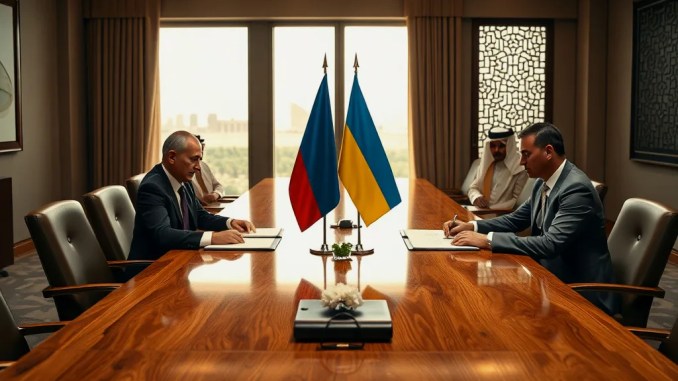
Background and current status of the Abu Dhabi talks
The United States convened negotiations in Abu Dhabi aimed at ending the war approaching its fifth year. Delegations from Ukraine, Russia and the US — together with European partners — began closed-door sessions focused on territorial adjustments and the architecture of post-war security. Participants signaled limited private flexibility on contested lands, while public positions remain far apart. The negotiation track emphasizes sequencing: negotiators say territory disputes are unlikely to be resolved until credible security guarantees for Ukraine are defined and agreed.
What territorial demands are on the table and why they matter
Moscow has publicly demanded recognition of Russia’s control over Crimea and the four occupied regions it annexed — Donetsk, Luhansk, Zaporizhia and Kherson — and the withdrawal of Ukrainian forces from those territories. Kyiv rejects formal acceptance of those claims. If Russia’s core demands were accepted as a settlement, the resulting map would represent significant changes to Ukraine’s internationally recognized borders and would reshape strategic balances across Europe, affecting NATO posture, energy transit routes and regional defense planning.
How security guarantees could unlock territorial compromise
US officials and negotiators describe a step-by-step framework that could allow movement on territory only after binding security arrangements are specified. Practical elements under discussion include:
Multilayered guarantees: formal treaties or international guarantees involving the US, European powers and NATO-affiliated mechanisms without immediate membership for Ukraine;
Demilitarized zones and force-limits: phased withdrawal timelines, monitored buffer zones, and caps on force posture backed by third-party observers;
Verification and dispute resolution: on-site inspection regimes, an impartial adjudication mechanism for alleged violations, and predefined escalation-control procedures.
Negotiators argue this sequencing builds trust: security architecture reduces the incentive to use territorial concessions as a pretext for renewed coercion.
Zelensky’s proposal for a trilateral summit and de-escalation steps
President Volodymyr Zelensky announced that Ukraine will present measures to lower tensions and seeks a trilateral leaders’ summit with the presidents of the US and Russia. His team proposes actionable de-escalation steps to be negotiated in Abu Dhabi and formalized at leader-level if technical progress is achieved. Concrete items Ukraine is prepared to table include phased local ceasefires, humanitarian corridors with third-party oversight, and timelines for lifting some economic constraints tied to verification milestones.
European role: why EU and NATO members are in the room
European countries — notably the UK, France, Germany and Italy — along with NATO and European Commission representatives, participated in preparatory meetings. Their objectives are practical: ensure any settlement preserves European security, coordinate sanctions exit strategies tied to compliance, and prepare rapid economic and reconstruction assistance contingent on verified steps. European involvement also aims to reduce the risk of a bilateral deal that neglects continental defense cohesion.
Negotiation dynamics: sequencing, leverage and incentives
Successful bargaining requires matching credible incentives to enforceable commitments. Key negotiation tactics seen in Abu Dhabi include:
Phased reciprocity: small, verifiable steps by each side unlock subsequent concessions.
Third-party enforcement: involving neutral observers and legal instruments to reduce cheating incentives.
Economic carrots and sticks: calibrated sanctions relief and reconstruction aid tied to verifiable compliance; conversely, pre-committed re-imposition clauses for violations.
These tactics attempt to convert hard security concerns into transactional trade-offs where risk can be mitigated by monitoring and international backing.
Possible outcomes and probabilities
Predicting an exact outcome is speculative, but realistic scenarios include:
Limited territorial compromise with robust guarantees: moderate if verification mechanisms are credible and backed by major powers.
Frozen conflict with localized autonomy: a higher-probability outcome if parties agree to stop major hostilities but retain unresolved sovereignty claims, creating long-term instability.
No deal and continued war: remains possible if public maximalist positions outweigh incentives to compromise. External events, battlefield changes or domestic politics could quickly shift probabilities.
Immediate policy implications and next steps for stakeholders
For Ukraine: preserve negotiating flexibility while securing guarantees that enable reconstruction and political stability. For Russia: assess how international enforcement mechanisms affect long-term control over occupied areas. For the US and Europe: prepare conditional assistance packages, verification capacity (monitors, sensors, legal frameworks) and contingency plans for rapid reinstatement of measures if violations occur.
Questions likely to appear in search snippets and quick answers
Q: What is being negotiated in Abu Dhabi? A: Territorial arrangements for occupied regions and a binding post-war security architecture for Ukraine.
Q: Will Ukraine give up territory? A: Kyiv publicly rejects ceding territory, but negotiators are exploring trade-offs where security guarantees and phased measures might permit limited adjustments.
Q: Who enforces any agreement? A: Proposals rely on third-party monitors, legal enforcement clauses and guarantees from major powers and regional organizations.
Data points and examples that clarify feasibility
Examples from past conflicts show the importance of sequencing: the Good Friday Agreement combined political steps with international monitoring; the Dayton Accords paired territorial settlement with external military presence and verification. Applied to Ukraine, mixes of on-the-ground monitors, legal guarantees and phased reconstruction financing could materially reduce incentives to violate terms.
What to watch next — timeline and indicators
Key short-term indicators of progress include: publicized agreement on verification teams, a joint statement on phased withdrawals, preliminary similar timelines for any leader-level summit, and a coordinated European package for reconstruction contingent on compliance. Watch statements from chief negotiators and confirmations of neutral monitor deployments as signals of movement off zero-sum positions.









Be the first to comment