
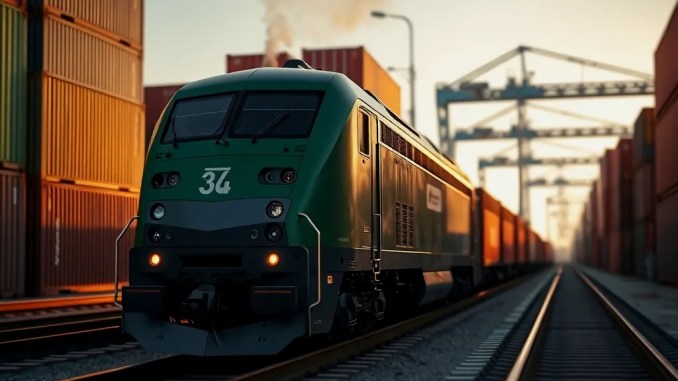
Alameda Belt Line to Take Over Rail Operations Under New Long Beach Agreement
Long Beach Harbor Commission approved a contract on November 9 that awards Alameda Belt Line (ABL) the short line operating rights through December 31, 2036, subject to federal clearance and other conditions. The agreement requires ABL to field 24 Tier 4 or zero‑emission switching locomotives when operations begin, to implement a rapid pathway to battery charging infrastructure, and to coordinate with both harbor authorities on an emissions‑reduction roadmap. The contract also preserves sizeable labor protections and commits the operator to capital contributions and grant‑funded equipment purchases.
How and when will Pacific Harbor Line’s responsibilities transfer?
Pacific Harbor Line (PHL), which has run Long Beach and adjacent Los Angeles annual terminal rail operations since 1998, will see an earlier-than-expected handoff of maintenance and train control duties. Harbor staff directed PHL to end those specific responsibilities on December 2, 2026, and to have ABL assume them on December 3, 2026, provided regulatory and contractual conditions are satisfied. PHL’s full operating agreement remains in force until December 31, 2026, but the phased transition lets ABL begin critical operational control sooner while STB (Surface Transportation Board) review and other approvals proceed.
What worker protections and staffing commitments did ABL accept?
ABL committed to offer employment to all PHL employees who belong to the Brotherhood of Locomotive Engineers and Trainmen (BLET) and to honor the existing collective bargaining agreement through September 30, 2027. The new operator also indicated it will absorb most non-union PHL staff. These specific guarantees reduce disruption risk at the yard level, preserve institutional knowledge for complex switching operations, and simplify the transition of day‑to‑day duties such as car switching, local drayage coordination, and crew scheduling.
Locomotive and emissions requirements explained
The contract’s headline environmental requirements mandate that ABL maintain 24 switching locomotives at the outlet of operations. Where feasible and agreed with the ports, those units must be Tier 4 diesel switchers capable of running on renewable diesel, or zero-emission locomotives such as battery-electric or other approved technologies. If renewable diesel cannot be implemented for technical or operational reasons, ABL must deploy alternative low-carbon fuels and make rapid progress toward battery or other zero-emission replacements.
The ports require ABL to begin site work for charging infrastructure inside existing footprints and to accelerate procurement of battery locomotives or alternative zero-emission equipment once grant agreements with the South Coast Air Quality Management District complete. The timeline for delivery depends on manufacturers’ production schedules and component supply chains; ABL must file a joint zero‑emission operations and infrastructure plan with both ports by December 31, 2027, that lays out procurement milestones, installation phases for charging or fueling infrastructure, and contingency measures if supply or performance issues arise.
Operational and fleet targets with contingencies
Under the agreement, the ports and ABL aim to convert all yard switching locomotives to zero‑emission technologies by 2040. That 2040 target contains explicit caveats: replacements depend on safety performance, commercial availability of technologies, operational reliability, energy supply, and economic feasibility. For non-locomotive operating and maintenance vehicles, ABL must transition to zero-emission units by January 1, 2035, or document why suitable replacements are not practicable and seek limited waivers where genuinely necessary.
Key dates the contract sets and what they mean
The contract maps discrete milestones to keep the transition accountable and transparent. Primary dates include:
December 2, 2026: Port direction that PHL ceases specified maintenance and train‑control duties.
December 3, 2026: ABL assumes maintenance and train control if prerequisites are met.
December 31, 2026: Current PHL operating agreement expires.
January 1, 2027: If STB exemptions and other conditions are in place, ABL may begin car loading, unloading and residual tasks.
September 30, 2027: ABL will honor the existing BLET collective bargaining agreement through this date.
December 31, 2027: ABL must deliver a joint zero‑emission operations and infrastructure plan.
January 1, 2035: Non‑locomotive operations and maintenance vehicles target full zero‑emission compliance.
December 31, 2036: End of the initial contract term, with two 5‑year renewal options available by mutual agreement.
2040: Target year to fully convert switching locomotives to zero‑emission units, subject to the stated contingencies.
July 31, 2048: Latest permissible contract end date if all optional extensions are exercised.
How project financing and grants will support zero‑emission adoption
ABL has secured approximately $65 million from the regional INVEST CLEAN program targeted at procuring battery‑electric switchers and charging infrastructure. The contract also obliges ABL to deposit $250,000 annually into a rail capital improvement fund, with the first two years’ contributions directed to the Badger Avenue Bridge rail repair project. ABL will additionally fund $40,000 per year for a Sustainability and Innovation Center. These funding streams combine public grant dollars with operator capital to accelerate equipment purchases, civil works for charging pads, and early demonstrations of zero-emission switching in the port complex.
Why Pacific Harbor Line appealed and why ports denied it
PHL protested the process, claiming the competitive procurement was unfair because of ABL’s lengthy proposal, public social media postings about the contract, the background of one evaluator, and the fact that ABL is a joint venture of two Class I railroads. Port staff rejected each objection after documenting that proposal appendices exceeded the stated page limits intentionally excluded from counts, that joint ventures were permitted by the solicitation, and that evaluator disclosures met procurement norms. The ports concluded the award followed the published evaluation weights and selection criteria.
Federal approvals still govern the schedule
ABL’s assumption of shared carrier duties on harbor tracks requires a Surface Transportation Board (STB) exemption. ABL filed the necessary notice with STB, but the Board paused the effective date on October 15 to consider PHL’s request for a delay. Until STB completes its review and issues a final decision or denial of the stay, parts of the transition timeline remain conditional. PHL will retain operating authority unless and until STB acts to remove or transfer that authority.
Operational examples and step‑by‑step transition tasks
To implement the operational handoff responsibly, port staff and ABL will follow a typical multi‑step sequence:
1. Complete federal STB review and any administrative clearances; finalize insurance, indemnity and performance bond requirements.
2. Execute transition‑of‑operations agreement detailing interline handoffs, crew rosters, and maintenance plans.
3. Conduct joint safety and dispatch drills for line‑of‑road and yard movements; validate signaling, radio and positive train control interops where applicable.
4. Move rolling stock and specialized equipment under written manifests; reconcile car inventories and detention claims.
5. Begin staged commissioning of charging or alternative fueling stations within existing footprints; pilot battery locomotives in limited shifts prior to full fleet deployment.
6. Implement workforce transfers, honor seniority and benefits commitments in coordination with BLET and HR teams.
7. Monitor performance over an initial 90‑ to 180‑day acceptance period and trigger corrective actions tied to contract remedies if KPIs are not met.
What stakeholders should watch next
Key near‑term items to monitor include STB’s final decision on the exemption and any associated procedural stays, completion of grant paperwork with South Coast AQMD that unlocks procurement funds, ABL’s posted procurement timeline for battery locomotives, and the ports’ public reporting on early environmental performance metrics once pilot equipment enters service. Labor representatives will track actual job offers and integration outcomes for PHL employees, while local communities and environmental groups will assess real emission reductions after charging infrastructure and zero‑emission units begin operating.




Be the first to comment