
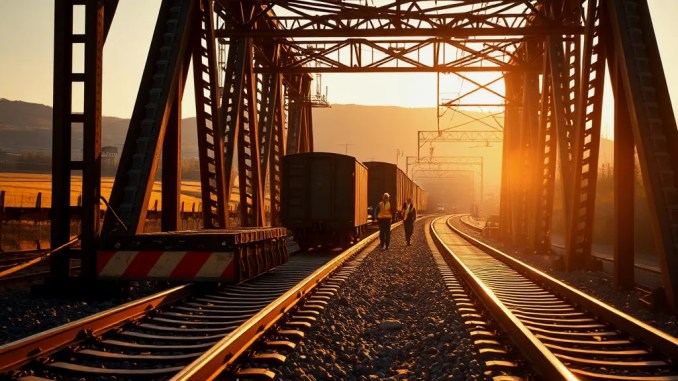
Overview of the Dornești freight derailment and immediate response
On 7 November a set of uncontrolled freight wagons rolled into Dornești station and struck two private locomotives. Initial reports listed 11 wagons; Operational checks revised that figure to 19 wagons. Six wagons derailed and three overturned. Teams mobilized heavy lifting gear and cleared two tracks by late evening so traffic could resume on critical lines.
How the wagons moved uncontrolled and timeline of events
The incident began during a grain-transfer operation at Vicșani: a block of wagons detached and moved without control toward Dornești. At 12:15 the wagons reached track 4 at Dornești and collided with two locomotives belonging to a private operator. CFR’s timeline shows the sequence: detachment at Vicșani, uncontrolled rolling toward Dornești, impact at 12:15, on-site verification and updated wagon count by 18:00, and progressive recovery work through the evening.
Detailed damage assessment and operational impact
Damage inventory collected on site identified:
– Rolling stock: 19 wagons involved; six left the rails and three overturned. One adjacent parked empty tank car (used for fuel) was among the derailed units. One locomotive suffered heavy damage when a bogie came off two axles.
– Track and infrastructure: The effect spread across tracks 2–6. The Y‑end of Dornești required clearance before normal movements could resume. CFR dispatched a 120-ton rail crane from Galați to lift and re-rail wagons, cut obstructing material, and make temporary repairs to the affected track sections.
Recovery operations: step-by-step actions used to clear the site
Recovery teams worked using a coordinated sequence to restore safe operations:
1. Secure site and verify no casualties. Medical checks confirmed no injuries; teams established exclusion zones around unstable wagons.
2. Stabilize and assess rolling stock. Engineers inspected overturned wagons and locomotives to determine lifting points, fluid leaks, and risk of further movement.
3. Bring specialized lifting equipment. A 120-ton rail crane from Galați arrived to hoist derailed wagons. Teams prepared rail-mounted accessories and jacks for controlled re-railing.
4. Lift, re-rail and tow. Crews sequentially lifted six derailed wagons, righted three overturned wagons, and moved 16 of the wagons back to Vicșani by 21:15 to clear the yard and allow access for track crews.
5. Track clearance and inspection. Rail teams cleared the Y‑end, removed debris, inspected sleepers and rails for plastic deformation, and made temporary repairs to restore standard gauge track geometry and safe running conditions.
6. Progressive reopening. After physical clearance and safety checks, operators reopened two lines at 22:00: line 1 (standard 1,435 mm gauge) and line 7 (broad 1,520 mm gauge), allowing both Romanian and cross‑border movements where mixed gauge connections exist.
Why two different gauges matter at Dornești and how it affected recovery
Dornești sits near a border area where Romania uses the 1,435 mm standard gauge and neighboring networks (Ukraine, Moldova) use 1,520 mm broad gauge. That mixed‑gauge environment influences both operations and recovery:
– Equipment positioning: Movement of wagons between gauge zones requires careful routing; some tracks host dual-gauge arrangements that complicate lifting and re-rail planning.
– Track repair standards: Different gauge alignments mean different rail fastening layouts and sleeper spacing—teams needed to verify both gauge-specific tolerances before reopening.
– Cross-border traffic continuity: Restoring at least one track per gauge minimized disruption to international freight flow, which is vital for grain and fuel corridors in this region.
Why no injuries occurred and how safety procedures helped
On-site accounts indicate that teams followed exclusion and transfer protocols during the grain handling operation, and that the uncontrolled movement happened within a freight yard rather than on a passenger route. Rapid establishment of safety perimeters, prompt medical checks, and the absence of populated passenger consist meant no injuries and no reported interruptions to scheduled passenger services.
Broader project context: Vicșani–Vadul Siret corridor and Dornești’s role
Dornești is part of an EU-supported upgrade on the Vicșani–Vadul Siret cross‑border corridor. Planned works on the Romanian side include electrification of the single-track 30.31 km section between Dărmănești and Vicșani and improvement of the Suceava River bridge at Dornești. Total eligible project costs were estimated at €48,761,092 with up to 50% potentially covered by the EU Connectivity Fund; implementation was scheduled from May 2023 to March 2026. Those upgrades increase traffic volumes and require resilient recovery plans for incidents like this to avoid prolonged cross-border disruption.
Follow-up investigations and next actions
Authorities opened legal and technical investigations to determine cause factors: coupling and braking system status, human and procedural factors during the grain transfer, signaling and track condition, and any failures in securement procedures. CFR announced continued recovery and track restoration operations on 8 November, including full re-railment, swap-out of damaged components, and detailed rail geometry surveys before permanent reopening.
Practical lessons and mitigation measures for similar yards
Operators and infrastructure managers can reduce recurrence by implementing a layered set of measures:
– Procedural controls: Mandatory mechanical security checks during wagon re‑marshalling and grain transfers; independent verification of handbrakes and air‑brake continuity.
– Physical safeguards: Catch points, derailing devices, and strategically placed buffer stops in yards with gradients toward station throats.
– Equipment readiness: Rapid deployment agreements for heavy lifting cranes and preapproved recovery contractors to cut clearance time.
– Training and drills: Regular live or table‑top recovery exercises that include mixed‑gauge complexities and cross‑border coordination.
What passengers and shippers should expect next
Because two tracks reopened the same night, passenger timetables reported no significant disruptions. Freight operators should expect targeted closures and speed restrictions while final repairs proceed. Shippers with time‑sensitive cargo, particularly grain and fuel consignments, should coordinate with CFR and private operators for rerouting options and updated ETAs until full infrastructure restoration completes.





Be the first to comment