
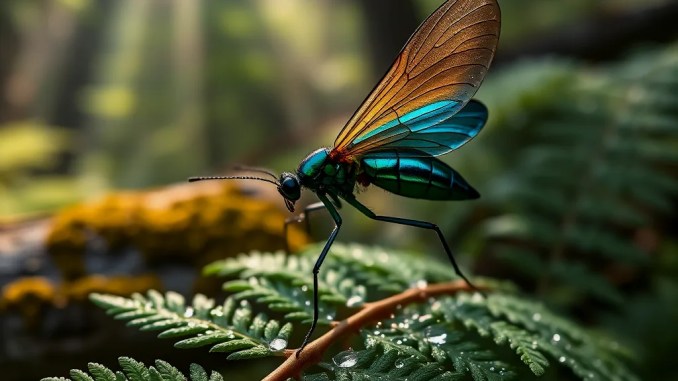
Discovery and confirmation of an elusive insect
Researchers first collected larvae in 1978 but could not locate adult specimens for decades. Field teams working in the Yadung region recently captured multiple adults and completed morphological and ecological descriptions. Laboratory dissection and microscopy revealed diagnostic features that separate this insect from closely related taxa, enabling taxonomists to formally add it to the literature. The discovery closed a ~50-year gap between larval records and adult-based classification.
How the adult form was recognized and documented
Scientists used a stepwise approach: targeted seasonal surveys in microhabitats where larvae had previously been found; live trapping at dusk and dawn when adults are active; preservation of specimens for both traditional morphology and high-resolution imaging; and comparison with museum material. These methods produced a cohesive dataset linking larval morphology to adult anatomy and behavior, supporting species delineation.
Key anatomical traits that distinguish the species
The adults reach approximately 19.5 mm in body length with a wingspan near 16 mm. Body color ranges from yellowish-brown to reddish-brown, and unlike several congeners this species lacks pronounced dark-striped abdominal patterns. Mouthparts show a reduced rostrum compared with nectar-feeding relatives, and internal dissections indicate structural adaptations consistent with a shortened adult feeding period.
Adult feeding strategy and life-history implication
Given the abbreviated rostrum, researchers infer that adults likely consume minimal resources or rely on reserves accumulated during larval stages. Observational data recorded few feeding events in the field; adult longevity appears limited, suggesting a life-history strategy that prioritizes reproduction over prolonged foraging. This shift explains morphological divergence from nectar-specialist relatives.
Larval architecture: funnel traps in sand and loose soil
Larvae build deep, funnel-shaped burrows in loose substrates to ambush prey. The construction sequence includes: (1) selecting a sloped patch of fine-grained sand or soil, (2) excavating a conical cavity with posterior enlargement, (3) lining the funnel walls with secretions and particle reinforcement, and (4) positioning the anterior end just below the surface to detect and capture falling prey. These traps function mechanically—prey slips inward and cannot climb the steep, unstable walls.
Larval morphology and defensive structures
Larvae measured in the Himalaya reach 20–28 mm, often exceeding adult length. They possess a distinctive semicircular fleshy appendage bearing five to seven spines, positioned to aid in prey retention and substrate anchoring. These appendages appear to serve a dual role: increasing trapping efficiency and protecting the larva from intruders.
Preferred substrates and adaptive tunneling strategies
Field experiments and substrate experiments show larvae prefer fine riverine sand but can adapt to three distinct substrate types: loose river sand, compacted mountain silt, and mixed-grain scree. In each substrate, they modify funnel angle, rim compaction, and lining secretion to maintain trap stability. Behavioral plasticity in excavation and lining explains successful predation across variable slopes and moisture conditions.
Ecological role and prey spectrum
Direct observations and gut-content analyzes reveal a diet consisting of small arthropods—springtails, immature beetles, and dipteran larvae—that fall into the funnels. Larval traps also capture occasional small vertebrate prey in the largest individuals. As ambush predators, these insects regulate microarthropod populations in localized sandy patches and influence nutrient flux by concentrating prey-derived organic matter at burrow sites.
Research methods that led to new insights
Investigators combined long-term field surveys with experimental manipulations: transplanting larvae between substrate types, measuring trap-building time and success rates, and using motion-triggered microcameras to record predation events. Morphological work included scanning electron microscopy of cuticular spines and micro-CT scans to compare larval internal anatomy with related taxa. These converging lines of evidence clarified behavior, physiology, and evolutionary relationships.
Implications for conservation and future study directions
Although current data come from localized Yadung populations, the species’ specialized larval habitat—patches of fine sand or gravel—makes it vulnerable to land-use change (riverbed extraction, altered flow regimes) and climate-driven shifts in sediment dynamics. Priority research actions include mapping population distribution, quantifying habitat extent, and assessing sensitivity to disturbance. Comparative genomic work could determine whether the prolonged separation between larval and adult records corresponds to cryptic diversity across the landscape.









Be the first to comment