
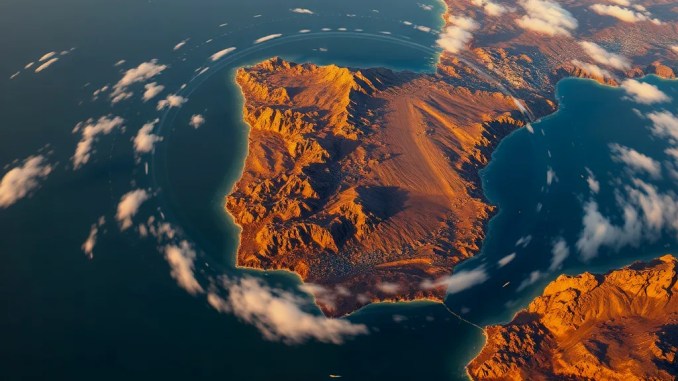
An international geoscience team combined satellite geodesy and seismic records to show that the Iberian Peninsula (Spain and Portugal) currently rotates slowly clockwise, reversing the counterclockwise motions recorded earlier in its geological history.
How researchers measured the Iberian rotation
Researchers used continuous GPS and InSAR observations to map horizontal surface velocities across the peninsula with millimeter-per-year precision, then cross-checked these vectors against local and regional seismic focal-mechanism solutions. They built a kinematic model that isolates rigid-body-like rotation from internal deformation by:
1. Defining a dense velocity field: combining station time series and interferometric line-of-sight displacements to reduce seasonal noise and transient offsets.
2. Removing regional plate motion: subtracting the best-fit Africa–Eurasia plate motion to highlight residual motions tied to Iberia.
3. Inverting for rotation pole and strain: jointly solving for a rotation pole (angular velocity) and a spatially variable strain tensor to separate clockwise rotation from localized shortening or extension.
Validation came from the agreement between GPS-derived rotation vectors and the pattern of earthquake slip directions around Gibraltar and the Alboran Sea, strengthening the interpretation that the peninsula behaves as a slowly rotating block relative to surrounding plates.
Why the direction changed: geologic drivers since the Cretaceous
Plate reconstructions indicate that during the Late Cretaceous (~90 Ma) the closure of the Tethys Ocean and Alpine orogeny forced Iberia to move and rotate counterclockwise as it opened the Bay of Biscay and later accreted to Eurasia, contributing to the growth of the Pyrenees. Today’s clockwise rotation reflects a different balance of forces:
• Convergent push from Africa: ongoing N–S to NNE–SSW convergence (roughly 4–6 mm/yr) imposes compressive boundary conditions on the southern Iberian margin.
• Complex plate boundary around Gibraltar: the narrow, highly heterogeneous transform-convergent zone transmits torques and differential block motions that can flip rotation sense over long time scales.
• Internal lithospheric heterogeneity: inherited crustal structure, variable lithospheric thickness, and preexisting faults allow some parts of Iberia to rotate as a coherent microplate while others accommodate more distributed strain.
Where rotation is strong and how much it matters
High-resolution geodetic maps show the largest clockwise components concentrated in western and southwestern Iberia, tapering eastward and inland where shortening across the Pyrenees and Betic–Alboran systems dominate. The observed angular velocity equates to a few tenths of a millimeter per year of lateral motion at distances of hundreds of kilometers from the rotation pole, yet over millions of years this accumulates to geologically significant offsets and reshapes basin geometries.
Implications for seismic hazard and regional tectonics
Clockwise rotation changes how we apportion strain among faults. Examples include:
• Redistribution of slip rates: faults in western Portugal and southwestern Spain may absorb more right-lateral or oblique slip when block rotation interacts with plate convergence.
• Triggering and clustering patterns: rotating blocks generate evolving stress fields that can promote seismicity migration along transfer zones such as the Gibraltar arc and Alboran region.
• Longer-term landscape evolution: persistent rotation influences river drainage patterns, sediment routing into basins (eg, the Gulf of Cádiz), and uplift/subsidence patterns tied to flexural and tectonic loading.
Data-driven steps to improve regional risk models
To incorporate block rotation into hazard assessments, follow these steps:
1. Integrate geodetic kinematic models with fault-based slip-rate databases so modeled strain partitioning reflects measured rotation and not just plate convergence.
2. Update Coulomb stress-transfer analyzes to include rotation-induced stress changes, improving forecasts of how one earthquake affects failure probability on neighboring faults.
3. Calibrate seismic cycle models with paleo–geodetic offsets where available (eg, trenching records, uplifted marine terraces) to relate long-term rotational motion to earthquake recurrence intervals.
Examples and data points supporting the conclusion
Key observations supporting a clockwise-rotating Iberia include:
• GPS velocity residuals aligned in an arcuate, clockwise pattern when Eurasia-fixed reference frames are used.
• Seismic focal mechanisms near Gibraltar and the Alboran Sea showing a mix of thrust, strike-slip and oblique solutions consistent with block rotation superposed on convergence.
• Geological markers of cumulative rotation such as the offset of sedimentary depocenters and rotated basins that match the direction inferred from geodesy when placed into a multimillion-year reference frame.
What open questions remain and how to resolve them
Remaining challenges include precisely locating the rotation pole, quantifying time variability (is rotation steady or punctuated?), and resolving how deep lithospheric structures control surface kinematics Address these by:
• Extending continuous geodetic networks into offshore and under-sampled continental zones using seafloor geodesy and more InSAR coverage.
• Running transient geodynamic models that couple mantle flow, slab interactions, and surface faulting to test which force balance produces the observed clockwise rotation.
• Increasing paleoseismic and geomorphic studies to tie modern rates to long-term behavior recorded in sediments and uplifted shorelines.
Practical takeaways for planners and scientists
Planners should incorporate block-rotation effects into regional fault-slip budgets and building-code scenarios. Scientists should prioritize joint geodetic–seismic inversions and offshore instrumentation to refine the rotation pole and its temporal behavior. Together, these actions will yield better hazard maps and clearer tectonic interpretations for the western Mediterranean.







Be the first to comment