
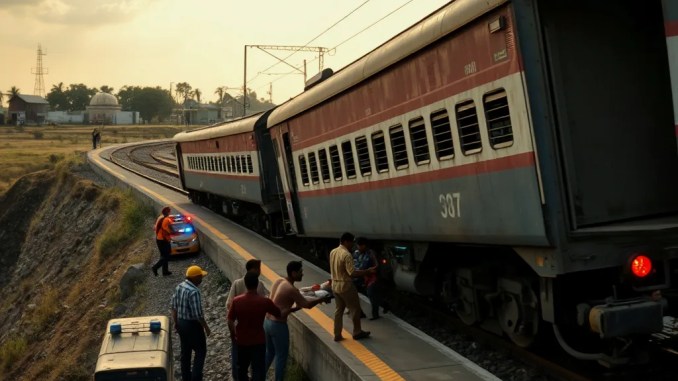
What happened near Guwahati and when
On a passenger service running between Assam and Kolkata, the locomotive and five attached coaches derailed near Guwahati. Emergency teams reached the scene quickly and attended to seven injured passengers. Local authorities opened an immediate investigation to reconstruct the sequence of events and determine contributing factors.
Evidence from the locomotive and crew statements
Video recorded inside the locomotive captures the driver reporting that brake pressure did not fall as expected and that the emergency brake failed to hold the train. The clip shows the locomotive subsequently striking a barrier and leaving the rails. Investigators will analyze onboard recordings, brake-system telemetry and maintenance logs to verify that account and to identify mechanical or procedural failures.
Injuries, response and on-site actions
First responders prioritized medical triage and rapid transfer to nearby hospitals for the seven injured. Crews stabilized the vehicle positions, secured the track area to prevent secondary incidents, and coordinated with rail operations to reroute or suspend nearby services. Standard accident-site actions — scene preservation, photographic documentation, and witness interviews — began immediately to support both safety and legal investigations.
How investigators generally determine cause in derailments
Rail accident investigators follow a stepwise process: collect physical evidence, download onboard data recorders, interview crew and witnesses, inspect track and rolling stock, and recreate braking and speed profiles. They also review maintenance history, recent repairs, and any reported faults. For brake-related claims, pressure curves and valve behavior are compared against manufacturer specifications and normal operation baselines.
Possible mechanical and operational factors to consider
Investigators typically evaluate multiple categories of failure that can act alone or together:
Mechanical: brake pipe leaks, defective brake valves, wheel or axle faults, suspension failures, or structural damage to couplers and underframe components.
Track and infrastructure: rail breaks, misalignment, faulty switches, or obstructions such as debris or barriers in the right-of-way.
Human and procedural: driver response time, adherence to speed restrictions, signal interpretation, and communication with dispatch.
Environmental: extreme weather, landslides, or flooding that undermines track stability.
Data and evidence investigators will prioritize
Key items that speed cause determination include:
Onboard recorder data: speed, brake-pipe pressure, control inputs and timestamps. These allow reconstruction of the train’s last minutes.
Brake system components: samples and bench tests of valves, reservoirs and shoes to identify wear, blockage or failure modes.
Track inspection: rail head condition, gauge measurements, sleeper integrity and any nearby infrastructure damage.
Maintenance records: recent servicing, reported defects and parts replacements for both locomotive and coaches.
Short-term safety measures and operational impacts
Rail operators typically implement immediate safety measures: impose temporary speed restrictions on the affected corridor, inspect nearby track segments, and perform targeted maintenance checks on similar rolling stock. Passenger services may face diversions, delays or cancellations until clearance and track restoration complete. Authorities may also require interim checks on braking systems fleet-wide when brake behavior is implicated.
Longer-term outcomes that can follow investigations
Depending on findings, recommendations can range from component redesigns and revised maintenance schedules to updated operating procedures or crew additional training. If systemic faults emerge, regulators can mandate fleet inspections, retrofits or restrictions until remedial actions are verified. Criminal or civil investigations may follow when negligence or noncompliance appears likely.
What passengers and local residents should expect next
Passengers and the public can expect a phased response: medical care and victim support first, controlled recovery of equipment and debris second, and a formal technical investigation third. Authorities will generally publish interim findings and later release a detailed report outlining probable cause and safety recommendations. Affected travelers should monitor official railway channels for service updates and follow guidance from emergency services.





Be the first to comment