
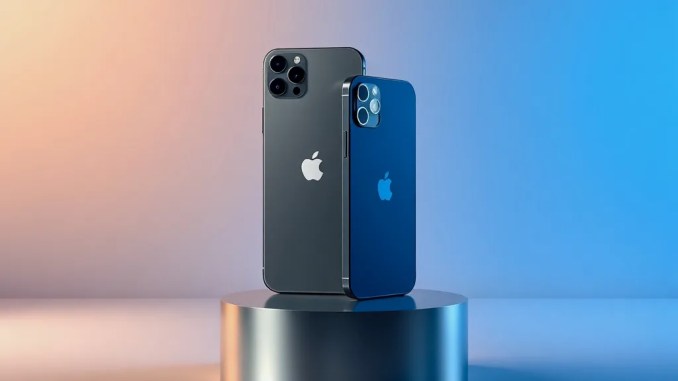
Where did the iPhone Air 2 and iPhone 18e mockups come from and why are they important?
Leaked mockups usually come from the supply chain or accessory manufacturers as pre-production molds. These physical prototypes don’t show the internal hardware; however, they clarify final design decisions such as size, camera placement, and button locations. Case manufacturers and assembly suppliers prepare based on the mockups; therefore, mockups are the most reliable external design indicators before market release.
Design: Differences visible in iPhone 18e and iPhone Air 2
Mockup photos show two vertically arranged camera modules on the iPhone 18e. The sensors are stacked on top of each other, and the LED flash is likely positioned next to or below them. The iPhone Air 2, on the other hand, shows a rear panel with a horizontal camera arrangement; this allows for a larger camera housing area and different sensor combinations. The edge profiles on the Air 2 are thinner and the antenna bands are less prominent, giving it a more refined surface feel.
Screen and panel: What sizes and technologies are expected?
The Air 2 is rumored to feature a 6.55-inch, 120Hz LTPO OLED panel, offering both fluidity and battery efficiency: LTPO dynamically reduces refresh rate to decrease power consumption; 120Hz makes a difference in scrolling and gaming. The 18e, targeting the entry/mid-range segment, may use a more modest OLED in the 60–90Hz range or an advanced IPS panel. Both models feature reduced bezels, and a smaller notch or punch-hole design for the front camera is being considered based on mockups.
Performance: Processor and daily usage experience
The A20 chipset attributed to the Air 2 provides energy management with more efficient CPU and GPU cores; measurable improvements are expected in multi-core workloads. In daily use, app launches, multitasking, and moderate gaming experiences are smoother. The 18e comes with lower clock speeds or a variant with fewer cores; basic workflows, social media, video watching, and light gaming are optimized to run smoothly.
Camera: Sensors, resolution, and real-world expectations
The Air 2’s claimed 48MP main sensor delivers cleaner images and high-resolution detail in low light thanks to pixel binning. Example: A 48MP sensor with 4:1 binning gives a 12MP, larger effective pixel size; this results in noise reduction and improved dynamic range in night photos. The ultra-wide-angle lens expands everyday composition; additional software modes (e.g., automatic perspective correction, enhanced portrait separation) improve photo quality. The 18e’s dual camera offers a simple but sufficient experience with software-supported portrait and night modes.
Battery and charging: Where could there be improvements?
The combination of an LTPO display and an A20-like processor extends real-world screen time on the Air 2: for example, energy saving is achieved by dynamically adjusting the screen refresh rate between 1–120 Hz. In addition to the hardware, software optimizations (background task management, adaptive power modes) bring visible gains in daily use. On the 18e, battery capacity is kept sufficient with a price/performance balance in mind; fast charging support is a basic expected feature, but super-fast charging values will likely remain limited.
Which model is more suitable for which user?
If you create content, take photos, or are sensitive to high refresh rates, the Air 2 is more suitable. The 6.55-inch 120 Hz LTPO display and 48 MP main camera make a difference in video editing and viewing experience. For users who prioritize simple communication, social applications, and budget, the 18e makes more sense: it provides a balance of adequate performance, a decent camera, and a lower price.
Release and accessory compatibility: When and what to expect?
According to Apple’s model schedule, entry-level and mid-range launches were postponed to early 2027; mockup leaks show that production processes are active. Since case manufacturers will prepare their molds according to these mockups, accessory compatibility will generally be high when it is released. However, minor changes in the final stages of production can sometimes lead to incompatibilities in the first batch of cases; waiting a few weeks before buying and checking user reviews reduces the risk.
Frequently Asked Questions (People Also Ask) and short answers
What is the biggest difference between the iPhone Air 2 and the iPhone 18e? Design and target audience: The Air 2 targets the upper-mid segment with a larger screen, higher refresh rate, and improved camera; the 18e is a budget-friendly, simple option.
What difference does a 48 MP sensor make in real life? High resolution allows for more detail and cropping; in low light, pixel binning provides less noise and better dynamic range.
Do the mockups show the final design 100%? No. Mockups offer strong indications of the external dimensions and layout; however, final production revisions rarely change the design.
Summary: What to expect and which clues are realistic?
Leaked mockups suggest that the Air 2 is a content-focused, larger-screened, and camera-oriented model, while the 18e is a budget-focused and simpler model. The LTPO 120 Hz panel, the A20 processor claim, and the 48 MP main camera make the Air 2 attractive for media consumption and creation. The final decision will be clarified with official announcements; for now, the mockups remain the strongest indication of the external design.




Be the first to comment