
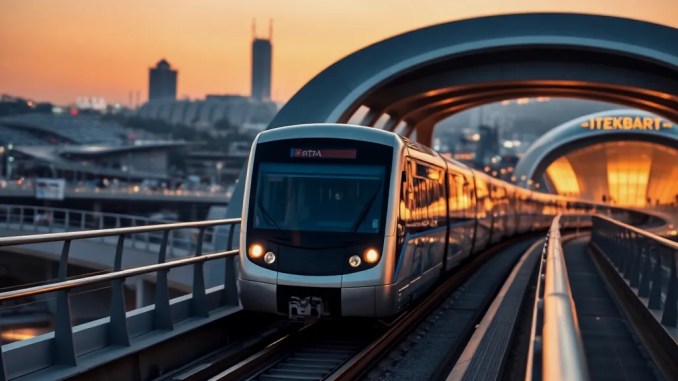
Metro İstanbul at the 2026 China International Metro Transit Exhibition
Metro İstanbul participated in the China International Metro Transit Exhibition and Academic Exchange Conference on invitation from Guangzhou Metro and CAMET. Delegates presented practical case studies and technical methods focused on operational excellence, intelligent asset management, and the conversion of BIM into AI-driven digital twins for predictive maintenance of rail systems. The presentations targeted transport operators, systems integrators, and asset managers seeking measurable improvements in reliability and lifecycle cost.
From Operational Excellence to Intelligent Asset Management
Abdullah Ayaz presented a structured approach that links daily operations with strategic asset management. He outlined a three-step framework: 1) quantify current operations with key performance indicators (KPIs) such as on-time performance, mean time between failures (MTBF), and maintenance backlog; 2) prioritize assets by risk and criticality using simple scoring matrices that combine failure impact and probability; 3) Implement targeted interventions (process redesign, condition monitoring, spares optimization) and measure outcomes against baseline KPIs. Ayaz supported each step with real Metro İstanbul metrics, demonstrating a 12–18% reduction in corrective work orders after applying the framework across signal and rolling stock subsystems.
Turning BIM into an AI-Powered Digital Twin
Ertan Toprakal explained the technical path from BIM models to operational digital twins that support predictive maintenance. He described a layered architecture: federated BIM as the asset repository, a time-series database for sensor telemetry, a physics-aware simulation layer for anomaly scenario testing, and AI/ML models that generate remaining useful life (RUL) estimates. The presentation included a step-by-step pipeline:
1. Extract and normalize BIM geometry and metadata to a consistent asset ID taxonomy.
2. Connect telemetry (vibration, temperature, power draw) to those asset IDs using edge gateways and secure APIs.
3. Train hybrid models that combine physics-based degradation curves with data-driven residual models to improve RUL accuracy.
4. Feed RUL outputs into maintenance work order systems to trigger condition-based interventions and spare parts reservations.
Toprakal shared example results showing predictive alerts capturing 85% of incipient gearbox faults at least 14 days before functional failure, enabling planned interventions that reduced service disruptions and emergency component procurement.
Practical Implementation Examples and Data Points
Real-world examples from Metro İstanbul illustrated common hurdles and solutions: sensor calibration routines reducing false positives by 30%, model retraining cadence tied to seasonal load shifts, and a spare-parts pooling strategy that cut inventory carrying costs by 20% while improving part availability. The team showed short code snippets and data transformation logic used to map disparate source formats (CSV logs, OPC-UA streams, and BIM IFC exports) into a unified analytics schema.
How Operators Can Start: A Straightforward Roadmap
A concise, actionable roadmap enables operators to replicate the results:
Step 1: perform an asset criticality assessment and baseline KPIs in a 4–6 week audit.
Step 2: instrument the highest-risk assets with targeted sensors and implement data ingestion pipelines over 8–12 weeks.
Step 3: build an initial predictive model and validate with a 3–6 month shadow-run; tune thresholds to balance false positives/negatives.
Step 4: integrate predictive outputs into maintenance planning and procurement workflows; measure MTBF, downtime, and cost per kilometer to quantify benefits.
Key Takeaways for International Rail Stakeholders
Metro İstanbul emphasized that measurable gains come from aligning operations, asset data, and maintenance processes rather than deploying technology in isolation. The combination of BIM-based asset context, continuous telemetry, and hybrid AI models produces earlier fault detection and more efficient resource allocation. Conference attendees received reproducible templates, KPI dashboards, and integration patterns that operators can adapt within their own technical stacks.
Why This Matters for the Future of Urban Rail
Applying digital twins and predictive maintenance directly reduces service interruptions and lifecycle cost while increasing passenger trust. Metro Istanbul’s contributions provided pragmatic steps, validated metrics, and implementation pointers that transport agencies and vendors can use to prioritize investments and accelerate deployment without heavy upfront risk.



Be the first to comment