
Background and what changed
MÁV has relaunched a procurement procedure to secure 15 years of maintenance for up to 93 used Stadler GTW units purchased from Switzerland. The rail operator reviewed the prior maintenance proposal, judged it financially excessive and insufficiently competitive, and therefore launched a new tender on 9 November 2026 to achieve more sustainable lifecycle costs.
Why maintenance pricing determines whether the purchase goes ahead
The Hungarian Transport and Investment Ministry set a clear condition: the trains can only be acquired if the long‑term maintenance deal is genuinely competitive. That position reflects a broader procurement principle — buying used rolling stock requires evaluating not only the upfront purchase price but the total cost of ownership across the vehicles’ remaining service life.
MÁV assessed the earlier bid point by point and flagged both the headline price and underlying contract terms as problematic. The ministry and MÁV are aiming to avoid committing public funds to a purchase that would impose high recurrent operating and repair costs, which could negate the benefits of a lower initial acquisition price.
How Stadler and Thurbo’s plan was structured
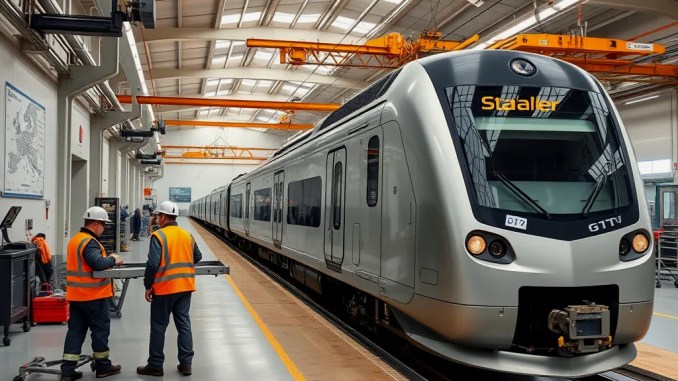
Stadler negotiated a sale of up to 93 GTW units from Swiss regional operator Thurbo, with an integrated plan: Stadler would acquire the units, perform a comprehensive fleet retrofit, then resell them to MÁV. That rollout was publicly announced by Stadler in January 2026 and scheduled as an incremental handover between 2027 and 2034, allowing conversion capacity to be staged and costs to be spread over several years.
What conversions are required for Hungary’s 25 kV network
The conversion scope includes electrical, accessibility and safety upgrades to adapt the trains from Thurbo’s environment to the Hungarian mainline network:
- Electric system conversion: Replace or adapt onboard power collection and transformers for Hungary’s 25 kV AC overhead supply.
- Train protection and signaling: Install Mirel and ETCS equipment to meet interoperability and national safety standards.
- Passenger systems: Fit modern passenger information displays and CCTV for both regulatory compliance and improved passenger experience.
- Accessibility adjustments: Add sliding steps and door adaptation to match Hungarian platform heights and boarding needs.
Stadler projected an average conversion time of about 12 weeks per unit. The plan called for prototype work to be completed in Switzerland and serial conversions to take place in Hungary to shorten delivery times and reduce cross‑border transport costs.
Timeline and key milestones to watch
Trackable milestones determine whether the acquisition will proceed and how quickly the fleet can enter service:
- Procurement award: Result of the new 15‑year maintenance tender — a determinant binding for the purchase.
- Conversion start: Once contracts are signed, prototype modifications and acceptance testing will verify conversion workflows.
- Phased deliveries (2027–2034): Annual handovers tied to Stadler’s conversion throughput and Thurbo’s fleet retirement schedule.
Key past dates: Thurbo’s renewal fleet decision (2021); Hungary’s purchase plan confirmation (2025); Stadler announcement (Jan 2026); ministerial instruction to halt signature (Sept 2026); new maintenance tender launch (9 Nov 2026).
Operational and financial implications for MÁV
Three practical effects will shape MÁV’s decision:
- Capacity boost: Up to 93 units translate into roughly 14,000 additional seats for the Hungarian network when deployed, addressing capacity gaps on regional corridors.
- Lifecycle cost exposure: If maintenance rates remain high, the net benefit of buying used trains disappears; lower acquisition cost cannot compensate for expensive servicing, parts replacement and compliance retrofits.
- Maintenance model risk: The choice between in-house servicing, third-party long-term contracts or hybrid arrangements affects capital budgeting, spare-parts inventories and depot investments. Each model carries distinct cost trajectories over 15 years.
Example: a hypothetical 15‑year maintenance package that reduces annual upkeep by 20% compared with the previous bid could swing the purchase from marginal to economically attractive by improving fleet availability and lowering per‑seat operating cost.
What bidders for the new tender should emphasize
To win the 15‑year contract and make the overall transaction viable for MÁV, bidders should present:
- Transparent unit cost schedules: Clear breakdowns for preventive maintenance, corrective repairs, spare parts, and consumables.
- Performance guarantees: Availability and mean time to repair (MTTR) targets with defined penalties for non‑performance.
- Local capacity and transfer plan: Evidence of workshop, staff training and parts supply within Hungary to reduce logistics costs and accelerate turnaround.
- Cost‑reduction measures: Lifecycle optimization proposals such as predictive maintenance, fleet commonality savings and bulk parts procurement.
Practical steps MÁV and the ministry can take now
To align the transaction with public finance prudence while keeping the project viable, the following stepwise actions are practical:
- Run a total cost of ownership (TCO) review: Model scenarios across maintenance price points, availability, and residual values to set a procurement threshold.
- Require staged payments: Link purchase payments to delivery and successful post‑conversion acceptance tests to reduce upfront risk.
- Insist on transparency clauses: Contractually mandate open‑book accounting for key maintenance cost categories during the 15‑year term.
- Use pilot conversions: Approve an initial batch of prototypes and measure in‑service reliability before committing to full fleet transfer.
How this decision affects Thurbo and the Swiss market
Thurbo plans to decommission and replace its GTW fleet with FLIRT Evo units through 2034. The staged sale of 93 units offers Thurbo an orderly disposal path and avoids immediate large surplus. For the Swiss supplier market, a failure of the Hungarian procurement would mean either alternative buyers for the GTWs or a slower scrappage/recycling timetable, which impacts secondary market pricing and refurbishment demand.
What to watch next and likely outcomes
Short term: the new maintenance tender result is the critical signal. A competitively priced, credible 15‑year offer will likely clear the path to purchase and the staged conversion plan. Long term: if MÁV secures lower lifecycle costs and enforces strong performance guarantees, the transaction can deliver additional capacity at materially lower cost than new trains, while spreading capital needs over several years.
Potential downside: if the market cannot meet MÁV’s cost threshold, Hungary may forego the acquisition and Thurbo will need alternative disposition strategies for those units.




Be the first to comment