
Google Introduces Next-Generation AI Processors
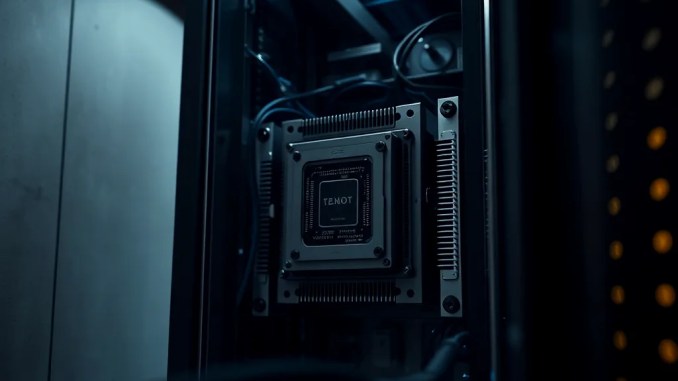
Google recently expanded its AI hardware portfolio with the announcement of the TPU 8tx and TPU 8i Max systems. These two systems are positioned as the company’s fourth AI processor platform introduced this year and target different priorities for both privacy-sensitive workloads and large-scale agent/multiple data processing. Google based its design decisions on reducing data transfer costs, increasing memory and processing capacity, and improving the developer experience in specific use cases.
TPU 8tx: What does it offer for secure training with sensitive data?
TPU 8tx is specifically designed to facilitate model optimization in environments containing sensitive data. With its data-in-place processing capability, the system eliminates the need to transfer data between infrastructures; this reduces the risk of data leakage and lowers latency in regulated sectors such as healthcare and finance. It reduces costs in frequent updates by providing memory and computational optimizations for small-to-medium-sized models. It facilitates compliance and simplifies audit processes with hardware-level isolation and encryption options. For example, retraining a model working on an electronic health record directly on the hardware without taking it outside the organization shortens loading time and reduces legal risks.
TPU 8i Max: Designed for AI agents, long video analytics, and large codebases
TPU 8i Max focuses on long-stream data and multimodal workloads with higher processing power and expanded memory addressing. Increased memory bandwidth for applications working with long videos, extensive code pools, or long-form documents reduces the need for fragmentation and shortens end-to-end processing time. For example, a media company can summarize hours of video content in a single workflow using 8i Max; the same infrastructure can simultaneously scan a large enterprise codebase for vulnerabilities and dependency issues by analyzing it in parallel. In large model training and high-volume batch inference scenarios, the 8i Max increases workflow efficiency by efficiently utilizing its compute units.
Google’s strategy: How is competition shaping up against Nvidia’s dominance?
Google positions its TPU series as a direct alternative to Nvidia. The strategy is shaped around three clear goals: vertical integration, differentiation based on use case, and software ecosystem support. Through vertical integration, Google tightly connects the hardware with its own data centers and cloud services, providing cost and performance advantages in specific workflows. While the TPU 8tx caters to privacy-focused customers, the 8i Max is geared towards high-capacity agents and those needing media/long data processing. On the software side, TensorFlow compatibility and optimized library investments facilitate the efficient use of TPUs in real-world applications.
Which TPU is more suitable for whom? Quick Decision Guide
This short guide helps you determine which TPU is more suitable for your use case:
Use case: Small-scale model training with sensitive health or financial data — Recommended TPU: TPU 8tx — Why: Data-in-place processing and hardware isolation eliminate data transport.
Use case: AI agents, large codebases, and multimodal tasks — Recommended TPU: TPU 8i Max — Why: More memory and processing capacity, long data processing capability.
Use case: High-volume batch inference — Recommended TPU: TPU 8i Max — Why: High throughput and parallel processing power.
Use case: Continuous small model updates — Recommended TPU: TPU 8tx — Why: Low latency and cost-effectiveness.
Application examples and tangible impacts
An example from the healthcare sector: An organization significantly reduces compliance burden and accelerates the model update cycle by keeping patient data in-house and performing periodic model updates on TPU 8tx. In media companies, 8i Max significantly reduces the number of segments and total throughput in tasks such as long video summarization and timestamp extraction. In enterprise security scans, an agent working on large code pools can generate comprehensive reports in a shorter time with parallel analysis thanks to 8i Max.
Transition costs, compliance and adoption steps
Organizations should follow these steps before migrating to TPUs:
1. Workload inventory: Which models, data types, and workflows are compatible with TPU capabilities? Real-time inference or interval training should be determined.
2. Security and compliance check: Necessary certifications, data storage, and data-in-place processing requirements should be verified.
3. Software and optimization: Models should be made compatible with TensorFlow or supported libraries; quantization, distributed training strategies, and memory optimizations should be planned.
4. Cost analysis and pilot: Hardware, energy, maintenance, and integration costs should be calculated; ROI should be measured through real-world data with pilot projects.
Frequently Asked Questions (Short and Clear)
What is the main difference between TPU 8tx and 8i Max? 8tx offers optimization focused on privacy and small-scale training; 8i Max is designed for large-scale agents and long data processing with higher processing and memory capacity.
What advantages do these TPUs offer over Nvidia GPUs? Google aims to differentiate itself with vertical integration, in-place data processing options, and TensorFlow-compliant optimizations; the choice depends on your use case.
Should you switch immediately? The decision to switch should be based on workload, compatibility, and cost analysis; testing with pilot projects is the safest approach.







Be the first to comment