
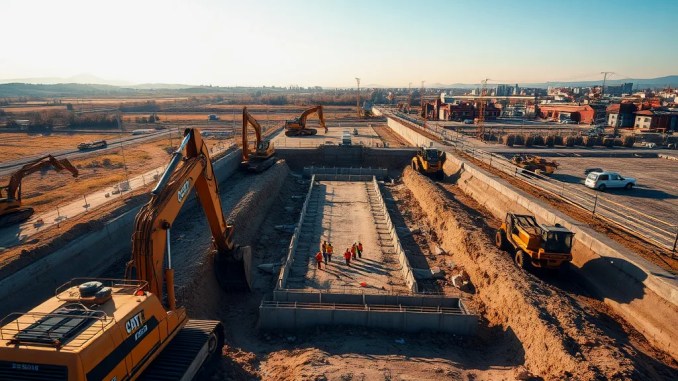
Overview of the approved sites and legal scope
Akyurt Municipality authorized the temporary use of municipal land for the Esenboğa Rail System construction. The council granted unanimous approval to use a 6,920 m² municipal parcel (1575 island 5 parcel) exclusively as a construction camp and for shaft works during the rail project’s active build phase. The authorization ties each use to strict temporal and restorative obligations: all temporary buildings, containers, storage, equipment and materials must be removed and the site rehabilitated to its prior condition once construction finishes. The municipality will require the responsible authority to repair any damage that occurs during occupation. The decision explicitly prohibits permanent facilities that would restrict municipal ownership or control.
Why the 6,920 m² parcel was approved and what activities it can host
The council evaluated the immediate operational needs of rail construction — on-site storage, worker facilities, small workshops and shaft access — and determined the 6,920 m² plot meets those requirements while remaining under municipal control. Allowed activities include temporary containerized offices, fenced material yards, short-term equipment parking and controlled loading/unloading zones. Prohibited items include any permanent foundations, utilities installed without removal clauses, and structures that would transfer or impair municipal title.
Conditions that protect municipal ownership and public interest
The approval attaches several protective conditions: (1) a defined start and end tied to the rail project schedule; (2) mandatory removal of temporary structures and full site cleanup; (3) financial responsibility by the occupying authority for any damages; and (4) prohibition of long-term or permanent construction that limits municipal rights. These conditions create clear, enforceable checkpoints municipal staff can use to monitor compliance and demand remediation when construction ends.
Large green area on Çubuk Stream: approvals needed from Ankara Metropolitan Municipality
A separate, larger green area bordering Çubuk Stream — approximately 79,430.95 m² east of Otonomi — was evaluated for use as an auxiliary construction site. Akyurt Municipality raised no principled objection to its temporary use, but highlighted that the parcel falls under the administrative responsibility of Ankara Metropolitan Municipality. Consequently, the council conditioned any occupation on receiving formal approval from the metropolitan authority. That approval is required because the area lies within metropolitan jurisdiction and likely interferences with riverside protection rules, floodplain management, and metropolitan environmental planning.
Practical implications of using the Çubuk Stream green area and mitigation steps
Using riparian green space requires explicit environmental and traffic safeguards. Practical conditions the metropolitan authority will likely impose include seasonal work windows to avoid wet-season impacts, erosion and sediment controls near the stream bank, defined limits for heavy-vehicle access to protect soils and turf, and restoration standards for re-vegetation post-works. The project team should prepare a restoration plan, a sediment-control plan, and a temporary access design that minimizes bank disturbance before seeking metropolitan consent.
Designating a 3,490.10 m² shaft site: traffic continuity as a primary requirement
The council reviewed an additional 3,490.10 m² area proposed for a construction shaft. The approval condition centers on preserving the road’s transport function: the road must remain open to controlled traffic flow during construction, and any lane or directional changes must maintain continuity rather than full closures. The council emphasized that because the road falls under Ankara Metropolitan Municipality responsibility, metropolitan approval is also necessary for this specific use.
Operational rules to maintain traffic during shaft works
To keep traffic moving while allowing safe shaft operations, project planners should implement these steps: 1) prepare a staged traffic management plan that shows vehicle and pedestrian circulation for every construction phase; 2) design temporary traffic diversions and sign plans that preserve at least one traffic lane in each direction where feasible; 3) schedule major deliveries during off-peak hours and use traffic marshals at complex junctions; 4) install durable temporary surfacing for heavy-vehicle paths to avoid pavement deterioration; and 5) monitor noise and dust to limit community impact. These measures will meet the council’s condition that the road’s transport function remains protected throughout construction.
Voting outcome and administrative follow-up
All items concerning site use for the Esenboğa Rail System were adopted by unanimous vote. The municipal council forwarded the meeting report and the decisions to the Plan and Project Directorate to begin necessary administrative steps, including drafting occupation agreements, setting restoration bonds or guarantees, and coordinating required submissions to the Ankara Metropolitan Municipality where jurisdictional consent is necessary.
Concrete next steps for project teams and municipal staff
For the occupying authority and municipal teams to translate approvals into practicable actions, complete the following checklist: 1) finalize occupation agreements with explicit start/end dates, removal obligations, damage-liability clauses and financial guarantees for site restoration; 2) prepare environmental protection and restoration plans for each site, especially the riparian area; 3) produce staged traffic management and traffic safety plans for the shaft location; 4) submit applications and technical packages to Ankara Metropolitan Municipality seeking required consent for the two jurisdictional sites; 5) register monitoring milestones with the Plan and Project Directorate and set a timeline for site handback and verification inspections.
What to expect from metropolitan review and typical timelines
When routed to the metropolitan authority, reviews commonly include jurisdictional checks, environmental screening, traffic impact assessment and agreement on restoration terms. Expect a request for detailed technical drawings, sediment and erosion controls for riverside work, traffic staging diagrams for shaft streets, and financial guarantees. Typical metropolitan review windows vary but budgeting for 6–12 weeks for technical review and conditional approvals, plus additional time for required revisions, gives realistic scheduling buffer for project planning.
How these decisions affect residents and local services
The council’s conditions aim to balance construction needs with neighborhood continuity. Residents may see increased construction traffic, temporary parking changes and localized noise during active phases, but the mandated traffic continuity measures and restoration obligations reduce long-term impacts. The municipality’s requirement that damages be repaired protects public infrastructure and green areas from permanent loss.








Be the first to comment