
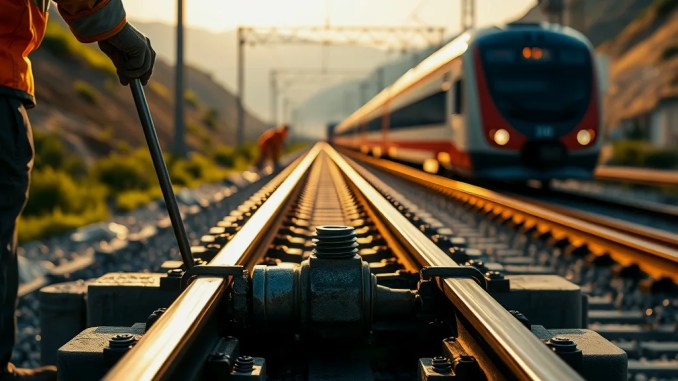
Chongqing–Kunming high-speed rail crews completed track laying along roughly 700 kilometers of the line designed for 350 km/h operation, placing the final rails at the Junlian Tunnel entrance on 24 October. The operator aims to finish testing and static acceptance so the Yibin–Kunming section can be service-ready in the first half of 2027.
Last Rails Installed at Junlian Tunnel Entrance
Track-laying teams from the Xikun contractor positioned the last 500 meters of continuous rail at 13:30 on 24 October, concluding uninterrupted rail placement across the constructed corridor. That milestone removes the final major physical discontinuity between Chongqing West and Kunming South stations and enables systemwide alignment, welding, and ballast consolidation operations to proceed without further major rail gaps.
Route and Key Cities Along the Corridor
The 700-km corridor traverses Chongqing, Sichuan, Guizhou and Yunnan provinces and integrates into the national Beijing–Kunming corridor. Major nodes on the approved alignment include Jiangjin and Yongchuan (Chongqing), Luzhou and Yibin (Sichuan), Bijie (Guizhou), and Zhaotong and Qujing (Yunnan). By reaching Kunming South, the line creates a faster spine linking southwestern regional centers and redistributes passenger flows away from congested highways and slower conventional rail.
What Remains Before Passenger Service on Yibin–Kunming
Construction advances in stages: the Chongqing–Yibin stretch has carried traffic since 29 September 2024, while Yibin–Kunming is still in the commissioning pipeline. Remaining tasks include final station fit-out verifications, systems-integration of signaling, electrical supply and communications, track tamping and dynamic alignment, and coordinated municipal works around stations.
Before opening to passengers, the project must complete static acceptance (structural and civil checks), subsystem tests (power, signaling, telecommunications), and integrated dynamic tests with trains at operating speeds. A typical sequence follows:
Step-by-step commissioning sequence
1. Static acceptance of civil structures and permanent way. 2. Subsystem functional checks (overhead catenary, traction power, signaling interlocking, telecoms). 3. Low-speed vehicle on-track testing for brake, pantograph and running gear verification. 4. Progressive speed tests (incremental speed ramps up to planned service velocity). 5. Integrated full-speed trials under traffic-simulation scenarios. 6. Safety certification and regulatory handover for passenger operations.
Capital, Stations and Construction Timeline
The National Development and Reform Commission approved the feasibility study in 2019. Planned investment totals 141.62 billion yuan with a planned construction period of six years and a design scope of 20 stations. Funding blends central railway construction funds, provincial and municipal contributions from Chongqing, Sichuan and Yunnan, and commercial bank financing. That mix aims to match long-term infrastructure returns with short-term fiscal needs.
Travel Time Reductions and Regional Connectivity Effects
The line will cut travel times sharply: projected travel time between Kunming and Chongqing falls to about 2.5 hours, and Kunming–Chengdu to under 3 hours. Those time savings reconfigure day-trip feasibility, labor-market catchments and tourism flows. For example, a 2.5-hour link means daytime business meetings become practical between Kunming and Chongqing, increasing commuter and business-visitor volumes and stimulating B2B scheduling that previously required overnight stays.
Operational and Economic Impacts — Examples and Data Points
Short-term operational impacts: faster rolling stock rotations (higher daily cycles per trainset), improved asset utilization and transfer of freight-passenger demand from highways to rail. Medium-term economic effects: accelerated regional integration through tighter labor and goods markets, higher property values near new stations, and strengthened tourism corridors (eg, quicker access from Chongqing’s tourism base to Yunnan’s scenic sites).
Example scenario: if the line raises daily passenger throughput by 30% between two regional nodes, local hotels, restaurants and retail around stations often report a 10–20% revenue lift within one to two years of sustained operations, based on comparisons from other Chinese high-speed openings.
Risks, Mitigations and What to Watch
Key risks include schedule slippage in system integration, supply-chain constraints for signaling equipment, and complex geological conditions in tunnel sections that could delay dynamic testing. Mitigations in place include modular testing contracts for signaling suppliers, phased dynamic-testing windows to avoid rework, and targeted geotechnical monitoring in long tunnels. Watch for formal static-acceptance announcements, regulatory test clearances and the operator’s public timetable release — these are the best signals the Yibin–Kunming section will enter passenger service.
Quick FAQ (People Also Ask style)
When were the final rails laid? 24 October, with the last 500 meters placed at Junlian Tunnel entrance.
When will Yibin–Kunming open? The target is the first half of 2027, pending completion of static acceptance and integrated testing.
How fast will trains run? The design speed is 350 km/h for the corridor.
How much does the project cost? Total planned investment is about 141.62 billion yuan.
Conclusion — Why This Matters
The completion of continuous track laying marks a decisive construction milestone and transitions the program into systems integration and testing. Once certified, the line will compress travel times, reshape regional mobility patterns and unlock economic opportunities across southwestern China.






Be the first to comment