
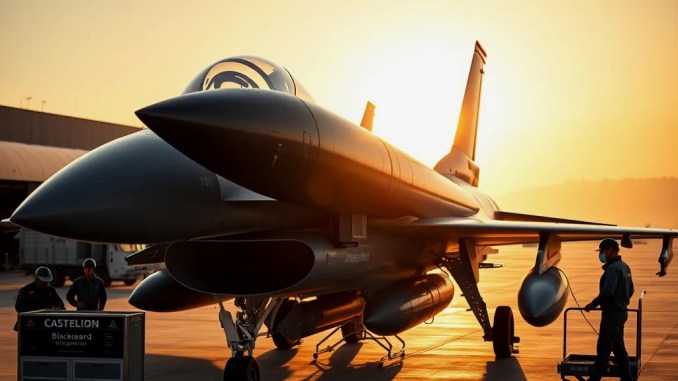
F-16 integration advances after AFRL contract amendment
Castelion received a contract modification from the US Air Force Research Laboratory (AFRL) to expand work on integrating the Blackbeard hypersonic missile onto F-16 fighter aircraft. The company confirmed the change on its official social account and framed the amendment as an extension of existing work the firm has performed for the Navy and Army. The modification signals a concrete step toward fielding Blackbeard within US Air Force platforms, though AFRL and Castelion have not disclosed the specific schedule, individual tasking, or the date for the first F-16 flight test.
What Blackbeard is designed to do and why speed matters
Blackbeard is engineered to fly at speeds above Mach 5 within the atmosphere while retaining the ability to maneuver. That combination increases the missile’s probability of penetrating modern defensive layers by complicating interception geometry and compressing defender decision timelines. Unlike purely ballistic threats that follow predictable arcs, Blackbeard’s maneuvering profile forces tracking systems and interceptors to predict a changing trajectory—raising the cost and complexity of effective defense.
Production goals, cost profile, and company background
Castelion emphasizes a development path centered on low per-unit cost and high production cadence. Founded in 2022 by former SpaceX engineers and headquartered in Torrance, California, the company plans a New Mexico manufacturing campus designed to scale toward an annual production capacity of roughly 500 missiles. That production objective underscores the program’s aim: deliver a high-speed strike capability that can be procured and fielded in quantity rather than as a limited, bespoke capability.
Contract value, timeline, and remaining unknowns
AFRL announced in September a $16.4 million supplemental action to Castelion’s existing contract, bringing the total contract value to about $37.2 million. The work scope extends through June 2028 and focuses on developing a long-range, low-cost strike weapon suitable for serial production. The latest modification specifically references F-16 integration, but AFRL has not publicly broken out the additional funding tied to that integration, nor published milestones, test dates, or acceptance criteria associated with adapting launch interfaces, avionics integration, and flight-clearance processes for the F-16.
Technical steps required to integrate Blackbeard on an F-16
Integration of an air-launched hypersonic missile onto an F-16 typically requires a sequence of technical and programmatic steps:
1. Interface engineering: define mechanical mounting points, release mechanism, and aerodynamic interactions between missile and pylon that preserve aircraft handling and clearance across flight envelopes.
2. Electrical and data integration: ensure missile and aircraft avionics share power, telemetry, weapon-select logic, and safe-release signals consistent with F-16 architecture.
3. Software integration and ground testing: update mission computer software and weapon control suites; run hardware-in-the-loop simulations and bench tests to verify handshake and abort logic.
4. Flight clearance and envelope expansion: conduct captive-carriage flights to validate structural integrity, aerodynamics, and loads; progress through incremental speed/altitude regimes before live release tests.
5. Live-fire validation: execute controlled release and propulsion ignition tests to demonstrate separation, boost stability, and guidance performance across operational profiles.
How this integration differs from the F/A-18 and other platforms
Castelion previously tied Blackbeard to carrier-capable F/A-18E/F Super Hornets and has worked on Navy and Army variants. The F-16 presents different constraints: a lighter airframe, different pylon standards, and alternative mission computer architectures. Compared with F/A-18 work, F-16 integration may require narrower weight allowances and different center-of-gravity accommodations, plus adjustments to the weapon employment zone to match the fighter’s tactical roles—air-superiority and multirole escorts rather than purely maritime strike profiles.
Operational implications and potential employment concepts
Fielding a low-cost, maneuvering hypersonic missile on legacy fighters changes tactical options. Possible employment concepts include:
– Long-range precision strike from dispersed pressing: F-16s operating from shorter or austere fields could deliver high-speed standoff effects without requiring strategic airlift.
– Saturation attack packages: High unit production enables massed launches to overwhelm layered air defenses by exploiting speed and maneuverability.
– Paired sensor-shooter tactics: Integrating Blackbeard with airborne or space-based sensors could permit cueing outside of contested corridors and reduce time-to-target for time-sensitive strikes.
What remains uncertain and what to watch next
Key open items to monitor in public disclosures and future AFRL announcements:
– Specific funding allocated to F-16 integration within the overall $37.2 million contract.
– Timeline for captive-carry and release flight tests and whether the first test will be developmental or part of an accelerated fielding demonstration.
– Certification approach that AFRL and the Air Force will adopt to clear Blackbeard for operational use from F-16 platforms.
– Production ramp milestones at Castelion’s New Mexico site and any subcontractor relationships affecting throughput and sustainment.
Short example scenario: how a test sequence could proceed
One plausible test sequence to qualify Blackbeard on an F-16:
Step 1 — Bench validation: validate power and telemetry links in lab harnesses and mission computer simulators.
Step 2 — Captive-carry sorties: fly the missile attached across a planned envelope to collect loads, vibration, and separation clearance data.
Step 3 — Instrumented separation tests: perform non-propulsive releases to confirm clean separation and aerodynamic safety.
Step 4 — Propulsive flight test: execute live propulsion ignition after clean separation to validate guidance, thermal loads, and seeker performance.
Step 5 — Operational integration trials: fly mission-representative profiles with targeting cues and assess end-to-end kill chain performance.
Bottom line
AFRL’s contract change to expand Castelion’s work marks a measurable shift toward integrating a potentially mass-producible hypersonic strike weapon on legacy fighter aircraft. While the program shows clear intent and growing investment—evidenced by the $37.2 million contract total—critical details on schedule, specific funding for F-16 work, and test timelines remain undisclosed. Close tracking of AFRL releases, flight-test notices, and Castelion production milestones will reveal how rapidly Blackbeard can move from development to operational use.









Be the first to comment