
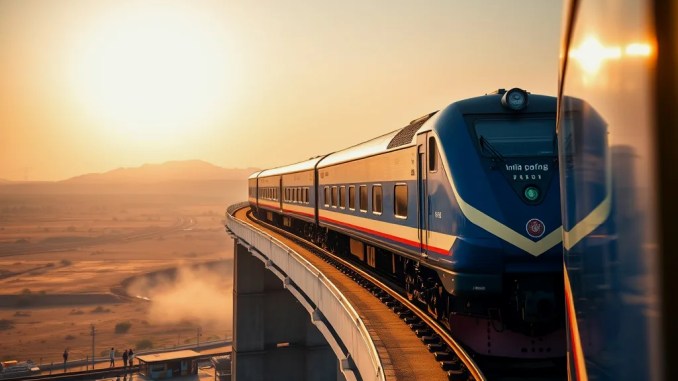
New Jaipur–Tatanagar–Santragachi Express launched to connect five states
The Ministry of Railways inaugurated the Jaipur (Khatipura)–Tatanagar–Santragachi Express on 26 October, establishing a direct weekly rail connection across Rajasthan, Uttar Pradesh, Bihar, Jharkhand and West Bengal. Officials led by Union Railway Minister Ashwini Vaishnaw and West Bengal Chief Minister Suvendu Adhikari joined the launch via video link. The service aims to expand travel options for migrant workers, students, traders and regular intercity passengers by adding a long-distance weekly train that links Jaipur, Jamshedpur (Tatanagar) and Kolkata (Santragachi).
Timetable and route details: when and where the train runs
The train will operate as 18061 from Santragachi, departing every Wednesday at 14:15 starting 4 November 2026 and arriving Khatipura the next day at 23:00. The return 18062 departs Khatipura every Friday at 09:15 beginning 6 November and reaches Santragachi Saturday at 19:45. Major scheduled stops include Santragachi, Kharagpur, Tatanagar (Jamshedpur), Ranchi, Daltonganj, Pt. Deen Dayal Upadhyaya (formerly Mughalsarai), Prayagraj, Kanpur Central, Idgah (Agra) and Khatipura (Jaipur). Running weekly, the service is positioned to strengthen rail connectivity across the five-state corridor and to provide a consistent timetable for onward planning.
Composition and passenger amenities: what the 22 coaches offer
The express will run with 22 coaches configured to serve diverse passenger needs. Coach composition includes 1 First AC, 2 Second AC, 4 Third AC, 2 AC Economy (or equivalent), 6 Sleeper Class coaches, 4 General Unreserved coaches, 1 Pantry Car, 1 Power Car and 1 Guard/Conductor coach. This mix aims to balance fare affordability and comfort: AC tiers for long-distance overnight comfort, multiple sleeper coaches to carry high-demand medium-income travelers, and general coaches for last-minute or low-fare travelers. The presence of a pantry car supports onboard catering for the long-duration journey.
Why this service matters: socioeconomic and mobility impacts
Introducing the weekly Jaipur–Tatanagar–Santragachi Express addresses several mobility gaps. First, it provides a direct long-haul option for seasonal and permanent migrants traveling between Rajasthan and eastern India, reducing the need for multiple transfers. Second, students and professionals commuting or relocating between educational and industrial centers (Jaipur, Prayagraj, Kanpur, Ranchi, Jamshedpur, Kolkata) gain a predictable weekly connection. Third, traders and small-business owners along the corridor benefit from a scheduled freight-sensitive passenger service that complements local freight operations by enabling reliable movement of people linked to supply chains.
Jharkhand and West Bengal: targeted rail investment and station upgrades
At the launch, the minister highlighted major investment increases: Jharkhand’s annual rail allocation rose from about INR 450 crore previously to INR 7,500 crore, funding roughly INR 75,000 crore worth of ongoing works. Under the Amrit Bharat Station redevelopment programme, 57 stations in Jharkhand are slated for renovation; Godda, Govindpur Road, Lohardaga, Madhupur and Muri are already completed. Across India the program targets redevelopment of more than 1,300 stations; in West Bengal, Santragachi, Jalpaiguri Road, Joychandi Pahar, Haldia and Kamakhyaguri are on the list. These upgrades focus on passenger amenities, accessibility, platform augmentation and better circulation to match rising demand.
Capacity upgrades: four-tracking Howrah–Tatanagar corridor and metro progress
The government is progressing a four-line expansion on key sections linking Howrah, Kharagpur, Chakulia and Tatanagar to raise corridor capacity and reduce congestion. Four-tracking typically separates slow suburban/parcel traffic from long-distance expresses, allowing higher throughput and timetable resilience for both passenger and freight trains. Separately, Kolkata Metro works reported completion of a 4.5 km segment between Beleghata and the IT hub, currently under trials; that segment will connect into the Green Line, improving intracity connections and last-mile access to the long-distance network.
How passengers can plan travel on the new weekly service
To use the weekly express effectively:
1. Book early for AC and sleeper berths. Weekly services allocate limited reserved berths; booking 2–4 weeks ahead increases chance of confirmation, especially for AC and sleeper classes.
2. Coordinate local connections. Check local train or bus schedules at intermediate stations (Ranchi, Daltonganj, Prayagraj) to plan arrivals and departures, particularly when traveling to smaller towns served by this train.
3. Carry provisions for long travel. Although a pantry car is provided, bring water and snacks for contingency and dietary needs; long-distance trains may face catering delays.
4. Use verified PNR and platform alerts. Monitor PNR status, platform assignments and real-time running information through official railway apps or station announcements to avoid missed connections on multi-leg journeys.
Practical example: sample itinerary for a student moving from Jaipur to Jamshedpur
Scenario: a student relocating from Jaipur (Khatipura) to an institute near Tatanagar.
Step-by-step plan:
Step 1 — Book 18062 Return/Forward: Reserve a sleeper or AC 3-tier berth on 18062 departing Khatipura every Friday at 09:15. Prefer booking at least three weeks out during academic season.
Step 2 — Reach Khatipura early: Arrive at the station 60–90 minutes before departure to handle luggage check, boarding and berth finding.
Step 3 — Overnight on board: Use the pantry car or prepackaged meals; the train reaches Tatanagar early evening next day, offering daylight arrival for local last-mile transfers.
Step 4 — Local transfer: Arrange a local taxi, autorickshaw or campus shuttle from Tatanagar station; notify accommodation of approximate arrival time.
What to expect from future expansions and service frequency
Officials indicated investments and corridor upgrades aim to improve capacity and eventually permit higher frequency on busy corridors. If four-tracking and station upgrades complete as planned, authorities can re-evaluate rake utilization and potentially add intermediate weekly or biweekly services, convert some weekly trains into biweekly or triweekly ones, and optimize timings to serve weekday commuters and weekend travelers separately. Continued monitoring of passenger load factors on the new Jaipur–Tatanagar–Santragachi Express will guide frequency changes.
Data snapshot: key facts at a glance
– Service name: Jaipur (Khatipura)–Tatanagar–Santragachi Express (weekly).
– Train numbers: 18061 (Santragachi→Khatipura) and 18062 (Khatipura→Santragachi).
– Start dates: 18061 from 4 Nov 2026; 18062 from 6 Nov 2026.
– Weekly days: 18061 every Wednesday; 18062 every Friday.
– Major stops: Santragachi, Kharagpur, Tatanagar, Ranchi, Daltonganj, Pt. Deen Dayal Upadhyaya, Prayagraj, Kanpur Central, Idgah (Agra), Khatipura.
– Coach composition: 22 coaches (1 First AC, 2 Second AC, 4 Third AC, 2 AC Economy, 6 Sleeper, 4 General, 1 Pantry, 1 Power, 1 Guard).
Quick answers to common passenger questions
Q: Will tickets be available through normal online booking portals? Yes — reservations and cancellations follow standard railway rules and are accessible via the national online booking portal and authorized apps.
Q: Is onboard catering provided? A pantry car is attached, but travelers should carry essentials for dietary or timing preferences.
Q: Can the service frequency increase? Frequency depends on demand and infrastructure upgrades; Planned four-tracking and station redevelopment aim to create capacity for future frequency increases.
Q: Which stations received redevelopment funding nearby? In Jharkhand: Godda, Govindpur Road, Lohardaga, Madhupur, Muri. In West Bengal: Santragachi, Jalpaiguri Road, Joychandi Pahar, Haldia, Kamakhyaguri.







Be the first to comment