
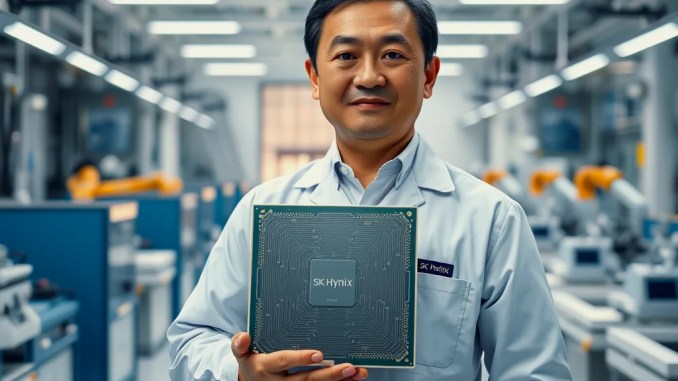
South Korean memory chipmaker SK hynix reported its strongest quarter ever in Q3 2026, driven by surging demand from AI data centers and multiple long-term supply agreements. Revenue jumped to 104.6 trillion won and operating profit climbed to 83.3 trillion won, reflecting sharp price improvements in high‑value DRAM and HBM memory and a shift toward multi‑year customer commitments.
Operating Profit Soared to 83.3 Trillion Won in One Year
SK hynix increased operating profit from 11.4 trillion won a year earlier to 83.3 trillion won, raising operating profit margin from roughly 47% to about 80%. Revenue surpassed 100 trillion won for the first time in a quarter. Quarter‑over‑quarter, revenue rose 32% and operating profit grew 38%, while net profit reached 39.8 trillion won — up roughly 216% year‑over‑year. Price recovery for high‑bandwidth and server DRAM products accounted for most of the margin expansion.
14 Customers Reserved More Than Half of Planned 2027–2028 Capacity
The company signed long‑term supply agreements with 14 major customers, including large global cloud providers. Those contracts cover more than half of SK hynix’s planned production capacity for both 2027 and 2028. Contracts use a flexible pricing corridor rather than hard fixed prices, balancing revenue visibility for SK hynix with market price sensitivity for buyers. That structure helps both parties: customers secure supply through supply cycles, and SK hynix secures demand visibility to justify capacity investments.
Contract Structures and Why They Matter
SK hynix’s contract framework typically includes:
Pricing corridors: indexed ranges tied to market benchmarks to share upside and downside.
Duration: often multi‑year (commonly five years), with some extensions under negotiation.
Volume commitments: minimum purchase obligations that support capex planning.
These elements reduce mid-cycle revenue volatility and enable the company to plan factory ramps, wafer starts, and procurement of expensive inputs (eg, EUV mask sets, advanced reticles) with lower commercial risk.
Demand Visibility Extends Toward 2029 but Not Fully Contracted
SK hynix management says that contracted orders plus ongoing advanced negotiations point to demand for DRAM and HBM to extend into 2029. This implies customers are signaling planned consumption that would absorb increased capacity. However, management cautions that signaling and negotiated but unsigned plans are not the same as fully contracted volumes—meaning upside exists but is not guaranteed.
Why HBM and DRAM Are Central to AI Workloads
High‑Bandwidth Memory (HBM) feeds large AI accelerators with the parallel, very high throughput memory those chips require. HBM4 and HBM3E target training and inference clusters that process petabytes of weights and activations. DRAM and DDR5 inventories sustain server memory pools for model hosting and data preprocessing. As transformer‑scale models increase parameter counts and memory footprints, HBM’s throughput per socket and DRAM capacity per node become decisive procurement factors.
HBM4 Capacity Expansion and Product Mix Shifts
SK hynix plans to ramp the M15X facility in South Korea to full HBM4 capacity by year‑end. The company expects HBM4 shipments and revenue in Q4 to outpace the HBM3E generation. At the same time, SK hynix will push DDR5 server modules and higher‑capacity enterprise NAND offerings. For NAND, accelerating deployment of 321‑layer technology will lower cost per terabit and support higher density SSD designs for hyperscalers.
Factory Investments Likely to Increase in 2027
Strong order visibility is key to SK hynix’s capex outlook. The firm expects capital expenditures to rise notably in 2027 as the Yongin fab approaches full ramp and auxiliary projects expand. Management emphasized that absolute capex timing and scale will remain tied to firm customer commitments and margin dynamics—meaning they will calibrate spend to demand to avoid oversupply.
Investor Returns: 100 Trillion Won Distribution Program
Following the record quarter, SK hynix announced a roughly 100 won trillion shareholder return program for 2026, stacking on a previously completed 40 trillion won distribution with an additional ~60 trillion won planned through buybacks and dividends. Proceeds from the Kioxia stake sale will feed part of this program. At the end of September, cash and cash equivalents totaled 114.5 trillion won while debt stood at 15.8 trillion won, giving the company strong liquidity to fund both investments and returns.
Implications for the Memory Market and Customers
Several clear market implications follow from SK hynix’s update:
Supply planning: Multi‑year contracts reduce short‑term procurement risk for cloud and AI customers.
Pricing mechanics: Corridor pricing smooths volatility and may keep spot price swings moderate.
Capacity pacing: Accelerated HBM4 ramps will tighten supply for HBM lines and could sustain premium pricing for years if demand continues to grow.
For enterprise buyers, negotiating corridors with minimums and optional volumes becomes a strategic procurement tool to secure capacity without overpaying in down cycles.
What to Watch Next
Key indicators to monitor in coming quarters:
Contract signings: additional long-term agreements or extensions that convert signaled demand into firm orders.
HBM4 yield and shipment trends: yield improvements and volume growth at M15X that validate Q4 guidance.
NAND layer transition progress: commercial production volume and ASP movement after 321‑layer ramp.
Capex cadence: timing of announced investments and their linkage to customer commitments.
Tracking these metrics will clarify whether the current profitability levels reflect a durable structural shift or a favorable cyclical period.
Bottom line: SK hynix’s Q3 2026 results demonstrate how strategic long‑term customer commitments, targeted HBM capacity ramps, and favorable memory pricing can combine to produce exceptional profitability while leaving optionality for calibrated investment and continued shareholder returns.









Be the first to comment