
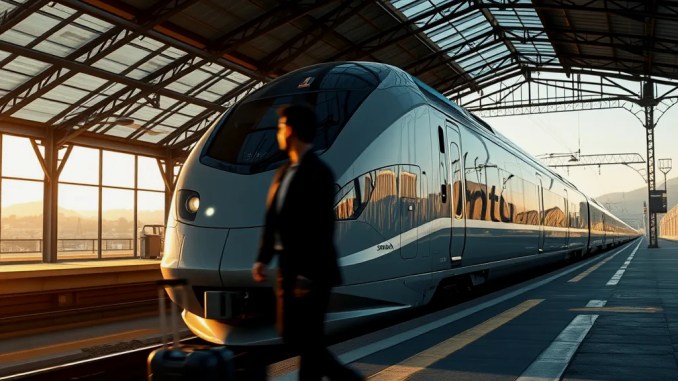
Renfe signs €1.218bn contract with Siemens Mobility for 30 Velaro Novo trains
Renfe awarded Siemens Mobility a €1.218 billion contract to deliver 30 Velaro Novo high-speed trains, with an option to purchase 10 additional units. The deal covers train manufacture and maintenance services and targets fleet renewal and capacity expansion across Spain’s high-speed network. Siemens designed the Velaro Novo for commercial operation up to 350 km/h and prioritized higher seating density while preserving passenger comfort.
How the seven-car Velaro Novo fits 520 passengers and why it matters
The seven-car Velaro Novo carries 520 passengers by using lighter, more compact onboard systems and optimized interior layouts. Compared with Renfe’s eight-car 103 Series (404–405 seats), the Novo adds at least 115 seats per train despite having one fewer car. This increases network throughput per train path, reduces per-passenger energy and infrastructure cost, and creates more flexible capacity for peak services without lengthening platforms.
Seating classes, layout details, and passenger amenities
The entire 520-seat arrangement sits on a single level: 404 seats in Turista (standard) and 116 in Preferente (first). Turista uses a 2+2 seating layout across the aisle; Preferente uses a 2+1 layout. Seats swivel to face travel direction and include individual power sockets and USB ports. Designers allocated larger multipurpose areas for luggage and bicycles and dedicated accessible spaces for passengers with reduced mobility. The configuration balances high capacity with practical onboard service options such as multiple luggage zones and universal-access features.
Delivery schedule: first five trains in 40 months, full 30 in 62 months
Renfe expects the first five units to arrive within 40 months and the full 30-train order to be delivered within 62 months, with additional trains arriving at regular intervals. Earlier tender documents set milestones—first five by month 40, full fleet ready before month 78 and roughly one train delivered every 1.5 months—but the new contract compresses the main delivery window to 62 months. The announcement did not specify the start date used to calculate those timelines.
Price versus initial tender estimate and optional 10-unit expansion
The signed contract price of €1.218 billion sits below Renfe’s initial tender estimate of €1.362 billion for 30 trains. An optional purchase of 10 more units was modeled at €1.777 billion in the tender phase, but Siemens’ option pricing was not disclosed in the announcement. The Novo’s 520-seat layout exceeds the minimum 450-seat requirement from the tender, delivering more capacity per procurement euro.
Energy efficiency, predictive maintenance and onboard systems
Velaro Novo targets lower lifecycle energy consumption through reduced component count, lighter bogies, and improved aerodynamics. The trains include high-capacity batteries that can support traction equipment short-term—helpful for self-maneuvering after certain incidents and reducing reliance on rescue locomotives. Digital monitoring and remote diagnostics enable predictive maintenance: sensors feed centralized analytics to detect degradation early, reduce unplanned stops, and optimize workshop scheduling. The platform also supports over-the-air updates and higher-capacity onboard Wi-Fi to maintain services across the fleet life.
Operational benefits: capacity, reliability and cost impacts
By increasing seats per train and using predictive maintenance, Renfe can operate more passengers on the same infrastructure footprint while lowering per-passenger delay risk and maintenance cost. Sample impact: if a corridor runs 10 daily services, replacing 103 Series trains (≈405 seats) with 520-seat Novos increases daily capacity by about 1,150 seats (10 × 115 extra seats), improving revenue potential on busy corridors without adding train paths. Predictive maintenance reduces incidence-driven cancellations and can shorten workshop turnaround, increasing fleet availability.
Design choices reducing noise, vibration and lifecycle weight
New bogie designs and material choices cut unsprung mass and improve aerodynamics, lowering energy draw at high speed and reducing cabin vibration and external noise. These changes typically translate into measurable gains: lighter running gear reduces rolling resistance; improved aerodynamics reduces consumption at 300+ km/h where aerodynamic drag dominates. The combination preserves comfort while supporting more sustainable operation on long-haul routes.
How this procurement fits Renfe’s fleet strategy
Renfe aims to both renew aging equipment and expand capacity in competitive high-speed markets. The 103 Series fleet originally entered service in 2007 and currently numbered 26 units; the Novo order provides a modern, higher-capacity alternative for routes where demand and infrastructure speeds justify larger trains. Siemens continues to couple train supply with systems work — signaling, electrification and communications — in other markets, supporting turnkey or integrated upgrades when operators need coordinated infrastructure and rolling-stock improvements.
What travelers and operators should expect next
Expect progressive introduction of the Novo on high-demand routes after initial testing and commissioning. Operators will stage driver training, depot readiness upgrades, and timetable adjustments to reflect higher capacity. Travelers should see denser seat maps on trunk corridors, improved onboard connectivity, and potentially reduced cancellations stemming from enhanced monitoring. If Renfe exercises the 10-unit option, capacity gains and network impacts will scale accordingly.





Be the first to comment