
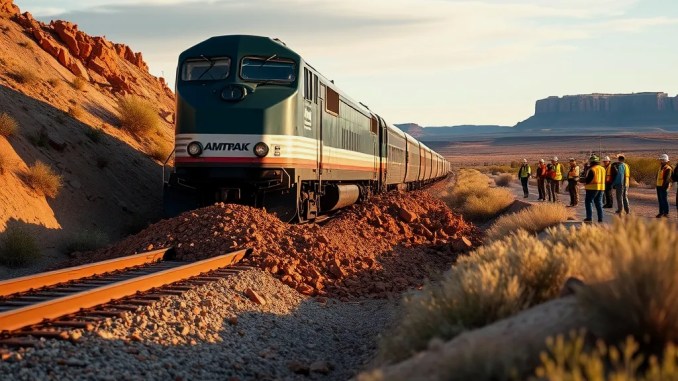
BNSF main line closed after flood-induced washout near Laguna
On Oct. 24, floodwaters undermined the BNSF Gallup Subdivision main line west of Albuquerque near Laguna, forcing an immediate suspension of train movements on the affected track. Track crews mobilized to inspect a washout that BNSF initially described as a “flood-related derailment.” The company has not released details identifying a specific train involved or a full damage inventory; however, available field reports and satellite imagery show scoured ballast, missing roadbed, and sections of rail left without adequate support over several dozen feet.
Which Amtrak services were canceled and why
Amtrak canceled three Southwest Chief runs that use that main line segment because the route became impassable west of Albuquerque. specifically:
– Westbound Train 3 (Albuquerque–Los Angeles) scheduled Oct. 23 was canceled.
– A Kansas City–Los Angeles run scheduled Oct. 24 did not operate.
– Eastbound Train 4 (Los Angeles–Chicago) scheduled Oct. 25 was canceled in full. Those cancellations stem from a physical break in the continuous main line; rail operations require verified, restored track geometry and tamped ballast before passenger equipment can safely transit.
How BNSF is evaluating and estimating restoration time
BNSF dispatched bridge and roadbed crews, geotechnical engineers, and inspection teams to the site to evaluate the scope of erosion and rail support loss. Their field process follows these steps:
1) Rapid safety inspection: confirm no immediate hazard to personnel or nearby infrastructure and establish a perimeter.
2) Detailed survey: measure undermined ballast depth, alignment deviations, and any damage to ties, rail, and drainage structures using track geometry cars and handheld instruments.
3) Temporary stabilization: install sandbags, riprap, or timber cribbing where possible to prevent further washout during repair staging.
4) Reconstruction: rebuild subgrade, re-ballast, replace ties and rails as needed, align and tamp the track, and perform proof-running tests with maintenance-of-way vehicles before restoring revenue service.
Ten Oct. 25 BNSF provided provisional timing that one secondary main could reopen by 20:00 local time that day, but the railroad did not confirm reopening by Oct. 26. Exact restore time depends on how much subgrade and drainage piping require replacement and whether heavy equipment can reach the site safely.
Operational and commercial impacts for freight and passenger movements
Closure on a trunk line like the Gallup Subdivision creates immediate network effects. Freight trains face reroutes, increased transit times, and possible backlog at classification yards. Customers shipping time-sensitive goods may receive individualized routing updates; BNSF’s Load & Make Ready teams usually contact directly affected shippers within 24 hours to discuss options.
For passenger service, Amtrak must decide between rerouting over alternative corridors where available, bus bridging around the outage, or canceling trains when neither option is viable. For the Southwest Chief there are limited practical reroute choices without major schedule disruption because of the specialized corridor through New Mexico and Arizona.
How this event fits a pattern of recent Southwest flooding incidents
This Laguna washout represents the second significant flood-induced main line incident BNSF reported in the same general region within a month. Ten Sept. 30 crews repaired a Lupton, Arizona, washout that had taken one of the Gallup Subdivision’s two main tracks out of service on Sept. 28; teams rebuilt track sets and reopened that segment by Sept. 29 pm. Earlier storm remnants tied to Hurricane Polo caused rapid floods between Sabinal and Rincon in the El Paso Subdivision, producing multiple washouts over roughly 240 km of line before crews restored service in mid-October.
Recurring intense rainfall and constrained drainage corridors in parts of New Mexico and northeastern Arizona increase the probability of repeat washouts, especially where culverts and roadside drainage fail to pass sudden, high-volume flows. BNSF’s recent pattern highlights the operational vulnerability that heavy, localized flooding poses to main-line rail infrastructure in the Southwest.
What passengers and shippers should expect next
– Passengers: Amtrak ticketed customers on canceled Southwest Chief trains will receive refund or rebooking options through Amtrak policies; Travelers should monitor Amtrak alerts and contact customer service for alternate routes. Expect delays or cancellations to remain possible until BNSF confirms restored track geometry and issues a clearance for passenger equipment.
– Shippers: Freight customers should expect outreach from BNSF’s commercial teams. Contingency routing and priority decisions will reflect commodity type, customer contracts, and available network capacity. Consider short-term inventory adjustments if shipments are time-critical.
Signs to watch for official service restoration
Look for these concrete indicators that the line will reopen:
– BNSF press release or customer bulletin confirming track reopened and specifying which main(s) are back in service.
– Amtrak service update listing resumed Southwest Chief departures on affected dates, or published bus-bridge alternatives and revised timetables.
– Track geometry test reports and photos showing tamped ballast and proof runs by maintenance-of-way equipment.
Absent those confirmations, expect cancellations or modified service to remain in place.
Why rebuilding can take from hours to days
Repair duration depends on four primary variables: the length and depth of washout, accessibility for heavy equipment, availability of replacement materials (ties, rails, ballast), and prevailing weather during repair operations. A short, shallow washout on an accessible grade can be stabilized and reopened within a day using emergency crews; a deep scour under multiple track panels or one that undermines adjacent bridge approaches can require multi-day reconstruction and coordination with geotechnical contractors.
Practical example: what a 48–72 hour repair sequence looks like
Day 1 morning: establish secure work zone, remove debris, and bring in cranes, ballast hoppers, and tamping machines. Day 1 afternoon: place subgrade fill, install filter fabric and culvert segments where needed, begin re-laying ties and rails. Day 2: complete alignment, tamp ballast, and conduction geometry measurements; run a light test train by late afternoon. Day 3: certify tests, remove speed restrictions, and reopen for scheduled freight and passenger services if all metrics pass.
Key takeaway
BNSF’s Laguna-area washout has halted both freight and Amtrak Southwest Chief service on the Gallup Subdivision while crews assess and repair the damaged main line. Restoration timing remains uncertain until BNSF publishes confirmation of repaired track geometry and Amtrak updates its schedules. Shippers and passengers should monitor official BNSF and Amtrak communications for definitive reopen notices.






Be the first to comment