
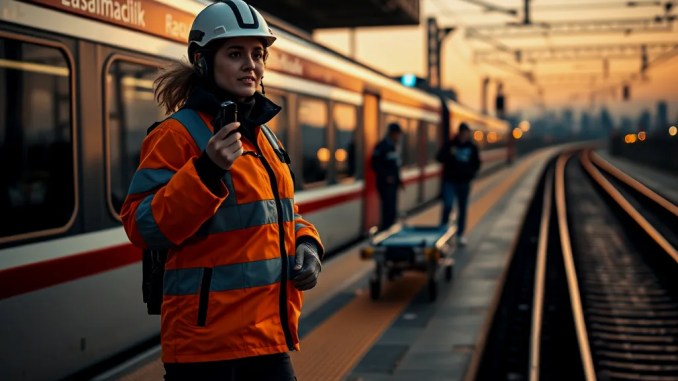
Balliyö Train Fire Drill Recreates Realistic Emergency Conditions
On 26 October 2026, TCDD Taşımacılık AŞ executed a full-scale emergency action drill at the Ankara Loko Maintenance Workshop area that simulated a fire on a Başkentray commuter train. Organizers staged a fault originating in the train’s electrical equipment and used smoke generation, actor-victims, and timed degradation of systems to create a realistic, time-pressured response environment. The scenario focused on rapid passenger evacuation from coupled (coupled) train sets operating on the Sincan–Kayaş corridor, triage of smoke-inhalation casualties, and coordination of rescue resources across multiple agencies.
How the Scenario Tested Operational Capabilities Step by Step
The exercise followed a clear sequence to validate standard operating procedures and decision points:
1. Incident detection and notification: Simulated sensor alarms and crew reports triggered the incident command activation within minutes, testing automated alerts and human escalation chains.
2. Immediate on-board response: Train crew executed emergency braking, announced evacuation instructions, and deployed on-board fire extinguishers. Observers recorded time-to-clear aisles and passenger compliance rates to identify bottlenecks.
3. Passenger evacuation and access control: Evacuation prioritized those nearest exits and those with visible respiratory distress. Teams assessed exit obstruction, door operation under fault conditions, and platform crowding to refine egress procedures.
4. Medical triage and stabilization: UMKE and 112 teams established a triage area, applied START-style sorting for mass-casualty prioritization, and initiated oxygen and first-aid protocols for smoke-inhalation and burn simulation victims.
5. Fire suppression and technical recovery: Ankara Fire Department executed suppression tactics suitable for electrical-origin fires, coordinated with rail technical teams on isolation of power supply, and tested procedures for safe access to de-energized rolling stock.
6. Inter-agency command and information flow: AFAD and law enforcement integrated with the exercise command post to test unified command, radio interoperability, and public messaging that would be used in a real incident.
Participants, Roles, and Measured Outcomes
Key participating organizations included Ankara Fire Department, AFAD, UMKE, 112 Emergency Medical Services, and security forces. TCDD Tasimacilik’s Emergency Action Directorate coordinated the drill and collected performance metrics: response times, victim processing rate, false-alarm handling, and resource allocation efficiency. Measured outcomes provided quantitative baselines—such as average time-to-first-extrication and percentage of properly triaged victims—used to prioritize corrective actions.
Distinct Insights and Practical Learnings from the Exercise
The drill surfaced actionable findings that strengthen commuter-rail emergency readiness:
Communication clarity: Clear, concise evacuation announcements and confirmation protocols reduced passenger hesitation; scripted emergency messaging templates improved speed and consistency.
Door and corridor management: Observers noted that coupled-set door malfunctions and narrow vestibules created choke points; recommendations included routine door-actuator checks and staff positioning during peak operations.
Medical resource staging: Pre-identified triage zones and modular medical kits allowed UMKE/112 teams to scale care rapidly; adding portable oxygen caches on key stations cut time to first oxygen delivery in simulations.
Power isolation procedures: Coordination between fire crews and rail electrical teams to isolate traction power minimized re-ignition risk and allowed safe access—formalizing this handover reduced access delay in the exercise.
Why Multi-Agency Drills Improve Real-World Outcomes
Combining firefighting, medical, disaster management, and law enforcement capabilities in a single exercise reveals interface gaps that single-agency training does not. The drill demonstrated improved situational awareness when agencies shared a common operating picture via the exercise command post, leading to faster decision loops and fewer duplicate resource deployments. Documented improvements included reduced scene congestion and more efficient victim routing to hospitals.
Recommendations Adopted After the Drill
Following evaluation, TCDD Taşımacılık prioritized a set of measures to embed lessons learned into operations:
– Update emergency manuals: Revise evacuation checklists and specify crew roles for coupled-train incidents.
– Equipment investments: Procure additional portable oxygen units, dedicated door-unlocking tools, and enhanced smoke control equipment for key rolling stock.
– Scheduled joint training: Institute quarterly multi-agency tabletop and live drills focused on corridor-specific hazards and peak-period constraints.
– Communication protocols: Implement standardized radio channels and public messaging templates to reduce ambiguity during cross-agency responses.
Concrete Example: Reducing Evacuation Time on Coupled Sets
A targeted intervention tested after the drill changed crew roles during evacuation: one crew member concentrated on door checks and crowd-channeling while the other managed public address and passenger assistance. Repeat runs showed evacuation completion times reduced by an average of 22% in simulated peak-load conditions, illustrating how simple role reallocation and clear protocols produce measurable improvements.
Next Steps and Ongoing Preparedness
TCDD Taşımacılık will integrate after-action reports into the 2024–2028 strategic planning cycle, track remediation actions against timelines, and continue collaborative exercises with AFAD, UMKE, Ankara Fire Department, and medical services. Regular performance measurement—using the metrics trialed in the exercise—will provide objective evidence of increasing readiness and help allocate budget for the most impactful investments.
Key Takeaway
Realistic, multi-agency drills that simulate electrical-origin fires on commuter trains expose operational bottlenecks and produce clear, actionable improvements. The Ankara exercise validated procedures, enhanced inter-agency coordination, and generated specific recommendations that can reduce casualties and accelerate recovery in future real incidents.







Be the first to comment