
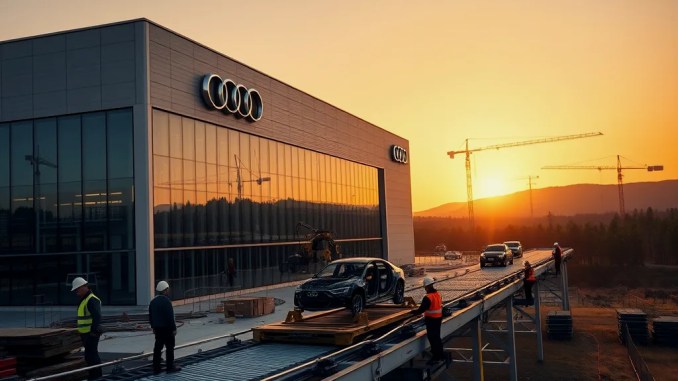
Audi confirms plan for a Georgia manufacturing hub and outlines scope
Audi will build its first US production facility at the Middle Georgia Megasite in Peach County, Georgia, targeting high-end SUVs for the North American market. The company proposes roughly a $4 billion investment to establish a plant capable of producing up to 200,000 vehicles per year and directly employing approximately 4,500 workers. The project emphasizes proximity to major logistics corridors and existing industrial capacity; final investment and start dates remain subject to Volkswagen Group board approvals.
Why Middle Georgia Megasite won: rail access, ports, and ready land
Decision makers prioritized sites that minimized inbound parts cost and outbound distribution time. Middle Georgia Megasite offers:
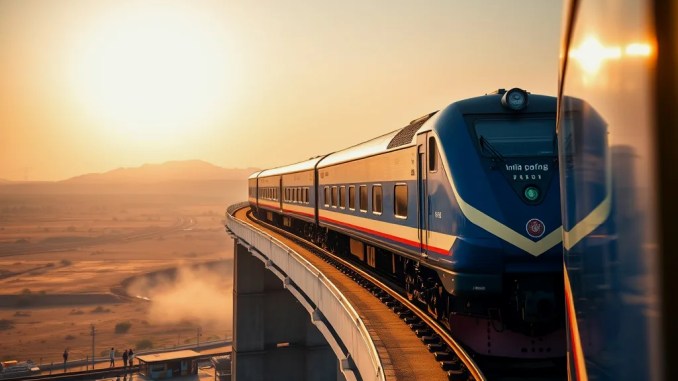
Direct access to Norfolk Southern’s Class I rail network, with line connections from the site to the Savannah and Brunswick ports in under five hours by rail under current routing estimates. That rail link reduces dependence on long-haul trucking for bulky components and finished vehicles.
More than 1,100 acres of largely development-ready land, enabling phased campus buildout and space for supplier parks. Regional partners already own the parcel and have marketed it for advanced manufacturing since 2022.
Clustered state support and utilities from Georgia Economic Development, Georgia Ports Authority, Georgia Department of Transportation, and Georgia Power, which streamlines permitting, workforce training commitments, and infrastructure coordination.
How rail and ports change Audi’s logistics calculus
Using an integrated rail–port model changes unit economics and inventory needs:
Example: inbound powertrain or stamping shipments — Rail moves large, heavy, or bulk shipments (engine blocks, stamping coils, chassis subassemblies) at lower per-ton cost than truck. For a factory consuming thousands of tons monthly, rail can cut material inbound cost by a meaningful percentage and reduce damage rates on heavy items.
Example: finished vehicle export — A finished SUV loaded onto rail and moved to the port within five hours minimizes dwell time and export container handling. Shorter door-to-port lead times reduce buffer inventory and working capital requirements for export-destined volumes.
Operationally, this supports a mixed inbound strategy: high-frequency, low-volume truck lanes for time-sensitive parts and bulk rail lanes for heavy, predictable flows. Norfolk Southern’s statements emphasize connecting OEMs and suppliers to both domestic and international markets; that connection underpins Audi’s site choice.
Construction and production timeline with milestones
Audi and state partners provided a phased schedule. The timeline below aggregates public statements and planned milestones to make dependencies clear:
2027 — site preparation: grading, utilities, and rail spur planning. This phase must resolve final environmental permits and any new rail-connection design needs.
2028 — factory shell and core build: vertical construction of assembly halls, body shop, paint shop, and primary utilities. Supplier pad sites and employee training center construction begin in parallel.
2030–2031 — pilot runs to full production: equipment installation, commissioning, and ramp to full capacity. Audi has indicated a goal of putting production into service in the early 2030s, while state releases put full-rate production at around 2031.
Key dependencies that could shift dates: Volkswagen corporate approvals, permitting, rail infrastructure enhancements (if required), and workforce availability. Project managers should treat these as trigger points for contingency planning.
Planned workforce strategy and training pipeline
The site proposal pairs direct hiring with strategic workforce partnerships to meet a 4,500-employee target:
Short-term training — Georgia Quick Start will develop curricula for assembly, robotics operation, paint finishing, and quality inspection. These courses will run at existing technical college campuses while the permanent training center is built.
Long-term pipeline — a dedicated training facility adjacent to the plant will host apprenticeship programs, cross-training for supplier roles, and leadership development to reduce first-year attrition and compress time-to-competency for new hires.
Local hiring impact — beyond direct roles, suppliers, logistics providers, and service firms will create secondary jobs. Economic multipliers for advanced manufacturing typically multiply direct employment by 1.5–2.5x in regional job creation estimates; applying a conservative 1.7x multiplier implies several thousand additional indirect positions in the broader region over time.
Site rail infrastructure: existing assets and unresolved questions
The parcel borders a Norfolk Southern mainline and includes a secondary rail connection nearby, creating multiple routing and siding options. Public announcements do not yet state whether:
a) Audi or Norfolk Southern will fund new dedicated spurs and switching yards,
b) rail capacity upgrades (signaling, heavier rail, or additional sidings) will be necessary to meet peak inbound/outbound windows, or
c) freight flow agreements with the ports and Class I carrier will include guaranteed train paths to limit dwell time.
Early project actions should include a rail logistics audit: map inbound and outbound bill-of-materials by weight, volume, and frequency; model siding and yard capacity; and negotiate pathing windows with Norfolk Southern to secure export and inbound supply reliability.
Projected local economic impacts and incentives
Projected impacts include direct payroll, construction spending, and a broader supplier ecosystem. State and local incentives typically include tax credits tied to hiring, infrastructure grants, and accelerated permitting. In this case, the site benefits from coordinated state agency involvement, which accelerates infrastructure funding and workforce program agreements. Examples of measurable outcomes to track:
Construction phase — local contracting awards, temporary worker counts, and short-term lodging demand.
Operational phase — annual payroll, supplier spend within a defined radius, and changes in county unemployment rates.
What to watch next: approvals, rail scope, supplier commitments
Stakeholders should monitor three critical items to assess program risk and schedule fidelity:
Volkswagen Group approvals — final sign-off governs capital spending and model allocation.
Railwork scope and financing — whether the project requires new mainline work, dedicated spurs, or yard expansions, and how those costs and responsibilities split between public agencies, Norfolk Southern, and Audi.
Tier 1 supplier commitments — suppliers establishing local footprints speed ramp-up and reduce logistics lead times; announcements of supplier plants or supplier park agreements indicate stronger schedule confidence.
Specific examples and recommended action steps for regional planners
To maximize economic benefit and minimize schedule risk, regional planners can take these steps now:
1) Pre-authorize utility corridors — designate and pre-permit power, water, and broadband corridors to eliminate long lead items during the 2027–2028 window.
2) Create a rail coordination task force — include Norfolk Southern, Georgia DOT, ports, and Audi procurement to define train path guarantees, yard staging plans, and switchyard funding responsibilities.
3) Fast-track training partnerships — align Quick Start, technical colleges, and local community colleges on intake quotas and staggered cohort schedules to supply the 2028–2031 hiring ramp.
4) Attract supplier anchors — offer site-ready pads and incentives for battery pack, powertrain subassembly, and stamping/tubing partners to co-locate, which shortens inbound logistics and improves control over quality and timing.
These actions convert strategic advantages (land and rail access) into operational readiness and a tighter, more predictable build-and-ramp schedule.




Be the first to comment