
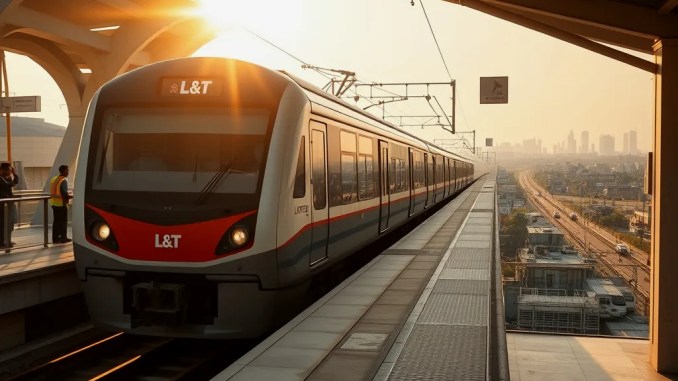
Overview of the Contracts and Project Scale
Larsen & Toubro (L&T) won two substantial system contracts for Dhaka Metro Line-1, funded by the Japan International Cooperation Agency (JICA). One contract (CP09) is a joint award with Sumitomo Corporation covering rail and electrical power systems. The other contract (CP10) is awarded solely to L&T and covers signaling, telecommunications and platform screen doors. Both contracts span design, supply, installation, testing and commissioning phases. L&T categorized these orders as large projects in the INR 5,000–10,000 crore band.
What CP09 Covers: Rail, Traction Power and Key Deliverables
CP09 includes end-to-end delivery of the rail and electrical infrastructure for the Line-1 corridor. Responsibilities include:
Detailed tasks and deliverables:
Railworks: continuous welded rail supply, track formation, fastening systems, turnouts and rail welding along the corridor.
Traction power: design and supply of traction power substations (TPSS), traction transformers, rectifiers and switchgear necessary for DC traction supply.
Overhead equipment: supply and erection of overhead catenary or contact line systems where applicable, including support structures and tensioning systems.
Power distribution: station and depot power distribution systems, auxiliary power supply, earthing and lightning protection, and integration with the local utility interface.
Testing and commissioning: power system load studies, protection coordination, primary and secondary injection tests, integrated system trials, and handover documentation for operations.
What CP10 Covers: Signaling, Telecommunications and Platform Safety Systems
CP10 focuses on train control and passenger systems that ensure safe, reliable operations across the entire network. Key elements include:
Signaling: design and deployment of the signaling system—like a communications-based train control (CBTC) or modern interlocking—covering inter-station sectioning, route locking, axle counters/track circuits, and fail-safe logic implemented to international standards.
Telecommunications: fixed and mobile radio networks, fiber backbone, public address systems, CCTV integration, operational data links and network management systems.
Platform screen doors (PSDs): full-height or half-height PSDs, door control units, integration with signaling for train alignment, passenger safety interlocks, and ventilation/fire design considerations.
Procurement documents also listed an Enterprise Resource Planning (ERP) or Corporate Resource Management System as part of CP10’s broader scope, although L&T’s announcement did not reference that module explicitly.
Procurement and Tender Process: Timeline and Method
The competitive procurement process began in 2022. Dhaka Mass Transit Company Limited (DMTCL) issued prequalification notices: CP09 on 8 August 2022 and CP10 on 22 August 2022, with submissions originally planned for November 2022. JICA provided development financing for both contract packages and the tenders followed a two-envelope, single-stage international competitive bidding procedure.
Project Timeline, JICA Financing Phases and Milestones
JICA financed Line-1 through two loan agreements:
Phase I (Line-1 I): loan agreement signed 29 May 2019 up to JPY 52.57 billion, with DMTCL as the executing agency and targeted completion of facilities by December 2026.
Phase II (Line-1 II): loan agreement signed 22 November 2021 up to JPY 115.027 billion, with a planned completion in August 2027. L&T’s announcement did not provide an updated commercial service start date for the whole line.
Scope and Route: What Line-1 Will Look Like
Line-1 will run roughly 31 kilometers with two main corridors:
Airport corridor: connects Kamalapur to Hazrat Shahjalal International Airport (the airport alignment).
Purbachal corridor: runs from Natun Bazar to Purbachal Terminal.
The project envisions 19 stations and a maintenance depot in Pitalganj. The combined corridors strengthen trunk connectivity across Dhaka and address critical capacity and congestion issues through high-capacity rail links.
Technical Integration and Delivery Strategy
Delivering an integrated metro system requires tight coordination across suppliers, civil contractors and system integrators. L&T and Sumitomo will coordinate on equipment interfaces where traction power and trackwork interact with signaling and depot systems. Key integration checkpoints include:
1) Interface control documents (ICDs): formalized hardware and communication interfaces between TPSS, OHE (if present), CBTC/signaling and depot systems.
2) Factory acceptance and site acceptance testing: FAT of major assemblies (transformers, traction converters, signaling racks) followed by SAT and integrated dynamic testing with rolling stock.
3) Commissioning phasing: staged commissioning per corridor section to enable progressive revenue service rather than waiting for entire network completion.
L&T’s Experience and How It Applies Here
L&T previously delivered the integrated railway systems package for Dhaka Metro Line-6, the country’s first commercial metro corridor, and continues work on Jakarta Metro contracts. The company plans to apply lessons from Line-6 and Jakarta in systems engineering, supplier management and final integration. Practical examples include standardized test plans, modular control cabinets to speed site assembly, and prevalidated signaling-to-power protection coordination templates to shorten commissioning windows.
Operational and Safety Considerations
Key operational outcomes targeted by these systems are reduced headways, improved punctuality and enhanced passenger safety. Concrete safety measures embedded in the scope:
• PSD integration with CBTC to prevent platform-train incidents and to automatic door-closing sequences synchronized with train berthing accuracy.
• Redundant communication paths in telecom backbones and train control to ensure resiliency during single-point failures.
• Protection schemes for traction power that isolate faults quickly and permit selective restoration to minimize service disruptions.
Questions Frequently Asked by Operators and Planners
How will testing validate full-system behavior? Testing proceeds from component FAT to subsystem SAT to system integration trials with rolling stock; final performance runs establish headway, breaking performance and signaling fail-safe behavior.
Can sections open progressively? Yes — the contracting and integration approach supports sectional commissioning so revenue service can begin on completed segments while remaining works continue.
What determines final commissioning dates? Civil completion, successful integrated testing, safety certification from the licensing authority and coordination of rolling stock deliveries govern final handover timing.
Impact on Dhaka’s Mobility and Next Steps
Completing traction, power, signaling and passenger-safety systems will allow Line-1 to operate as a high-capacity urban backbone, reducing surface congestion and travel times. Next steps include detailed design finalization, procurement of long-lead items, ramped-up factory testing and coordinated site commissioning with DMTCL and JICA oversight. Transparency on commercial contract values remains limited; L&T labeled both orders in the INR 5,000–10,000 crore range without publishing exact figures.
Concluding Remarks: What to Watch
Monitor three near-term indicators to assess project momentum: milestone publications from DMTCL on sectional civil completion; supplier FAT/SAT reports; and any rolling stock delivery schedules. Those signals will clarify when traction, power and signaling systems will move from installation to full operational status.



Be the first to comment