
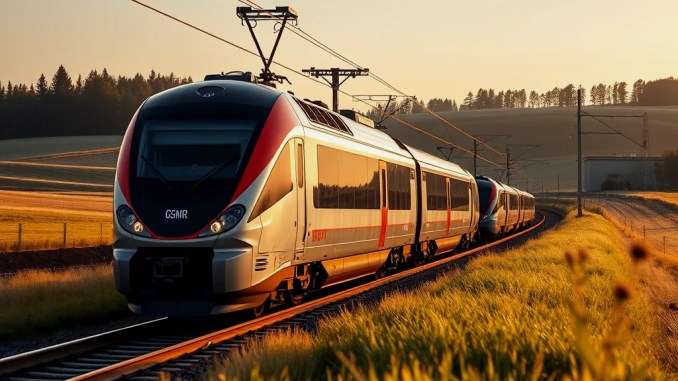
GSM-R tests confirm radio reliability for 250 km/h operations
PKP PLK completed live GSM-R digital railway radio tests on the Central Rail Line (CMK) and demonstrated stable communications at 250 km/h along the 224 km section between Grodzisk Mazowiecki and Zawiercie. Engineers validated handover between base stations, call times setup, signaling message integrity and radio coverage margins under real train dynamics. The tests included high-speed runs with full passenger-train loading profiles to create realistic antenna tilt, roof interference, and Doppler effects. Results showed consistent control-channel availability and latency within thresholds required for high-speed signaling.
What remains: ETCS Level 2 tests and formal authorization
GSM-R alone does not allow revenue service at 250 km/h. The next steps are:
1. ETCS Level 2 functional testing: Run trains under radio-based movement authority only (no lineside signals) to validate continuous train supervision, RBC (Radio Block Centre) interaction, and fallback behaviors.
2. Subsystem certification: Complete interoperability tests for trackside and onboard equipment, produce test dossiers, and submit evidence to the Polish Office of Rail Transport (UTK).
3. Formal authorization: UTK inspects the line-of-sight safety cases, hardware conformity, and operational documentation before issuing a service permit. PKP PLK leadership stated these administrative steps will follow ETCS trials; a firm calendar has not been released.
Where 250 km/h will apply and why only parts of the CMK
The 250 km/h target will cover roughly 180 km split into two continuous segments: kilometer 21.370–168.631 and 171.369–204.937. Those sections offer alignment geometry, cant, and turnout standards compatible with very high speed. Passages near Psary and Góra Włodowska include many turns certified only up to 200 km/h, so they will not be upgraded to 250 km/h immediately. Remaining stretches will retain posted limits between 110 and 200 km/h to match local infrastructure and station operations.
Travel-time impact with concrete numbers
PKP PLK modeled journey times with Pendolino EMU performance and the planned 250 km/h blocks. Key reductions: Warsaw–Kraków from 2h47m to 1h56m; Warsaw–Katowice from 2h34m to 1h54m; Warsaw–Zawiercie from 1h48m to 1h23m; Warsaw–Sosnowiec from 2h14m to 1h45m. The modeling used average running speeds per section, acceleration/braking profiles for ED250 sets, and realistic dwell times. Example: on the 224 km Grodzisk–Zawiercie run, a Pendolino accelerated to 250 km/h where permitted and averaged a higher mean speed, completing the distance in approximately 57 minutes under the scenario assumptions.
Rolling stock readiness and operational planning
PKP Intercity’s ED250 Pendolino fleet already holds national certification for 250 km/h capability. Operational readiness requires timetable retuning, crew training for ETCS Level 2 operations, revised traction power assessments, and updated maintenance intervals based on higher dynamic loads. Infrastructure teams must confirm OHL (overhead line) stiffness, pantograph contact stability at sustained 250 km/h, and reserve capacity for regenerative braking behavior in network power management.
Step-by-step: from test completion to commercial runs
1. Close-out GSM-R test reporting: finalize measurement logs, issue rectification orders for coverage gaps.
2. Execute ETCS Level 2 dynamic tests: run progressive scenarios from single-train to multi-train operations under traffic conditions.
3. Produce technical files: safety cases, interoperability certificates, maintenance regimes, and staff training records.
4. Seek UTK authorization: present dossiers, host inspections, and demonstrate emergency procedures.
5. Phased service introduction: start with selected timetabled services, monitor performance metrics, then widen 250 km/h slots.
Risks, mitigations and examples from other networks
Risk: unexpected RF dead spots can cause transient loss of movement authority. Mitigation: add GSM-R repeaters, adjust antenna patterns, or provision temporary fallback procedures. Risk: turnsouts rated lower than 250 km/h can force speed transitions that impair timetable reliability. Mitigation: keep buffer margins, adjust speed profiles around approach sections, and prioritize turnout renewals where traffic benefits justify cost. Example: on similar upgrades in Italy and Spain, operators phased authorizations—initially limited to off-peak high-speed trains introduced while maintenance and ETCS maturity ramped up—reducing early operational disruptions.
When will passengers see faster timetables?
Poland’s Infrastructure Ministry forecasted the 250 km/h capability for the CMK in the 2027/2028 timetable period, contingent on ETCS Level 2 validation and UTK’s authorization. If ETCS tests and certification follow promptly, operators can redesign schedules for the 2027/2028 service year; Any delays in testing, paperwork, or hardware fixes could push that start date later. Monitoring official UTK bulletins and PKP PLK test reports will provide the most accurate progress updates.
What travelers should expect in practice
Passengers will see shorter journey times on key city pairs and potentially a modest increase in timetable resilience where higher speeds enable recovery from minor delays. Early service rollouts will likely target a limited number of high-demand Pendolino services before broadening to more connections. Fare structures and rolling-stock allocations will be adjusted alongside the timetable to match new service patterns.








Be the first to comment