
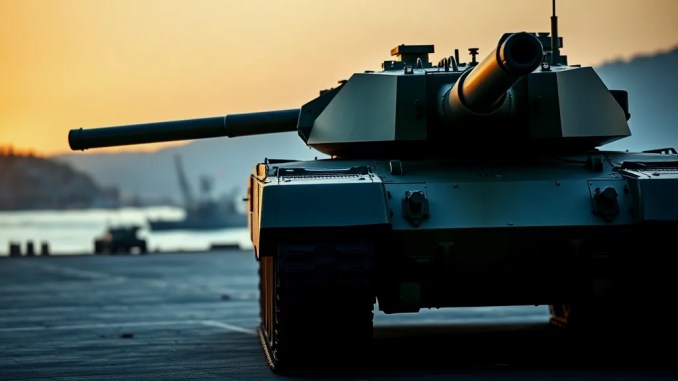
Reports indicate Italy has signed two contracts worth a combined €3.7 billion through the Leonardo‑Rheinmetall Military Vehicles (LRMV) joint venture for 30 KF51 Panther main battle tanks and 48 Lynx infantry fighting vehicles. Officials and the companies have not yet publicly confirmed the award. If finalized, the order would represent the first production contract for any KF51 Panther variant and expand Italy’s ongoing armored modernization programs.
KF51 Panther order could mark the platform’s first production run
The alleged 30‑tank order focuses on a KF51 configuration tailored to Italy’s requirements. Rheinmetall developed the KF51 with a modular turret, advanced electronic architecture, and a 130 mm main gun option that aims to leapfrog current NATO tank lethality. For Italy, adopting a Panther derivative would allow rapid insertion of a modern MBT while its national new-tank program continues to evolve.
Key program implications and likely actions:
Short-term fleet impact: Deliveries from an LRMV production run could supplement modernized C2 Ariete tanks, giving combat brigades a mix of legacy and next-generation capabilities during the transition.
Industrial tailoring: LRMV has signaled systems integration and a portion of production in Italy, so the KF51 examples may incorporate Italy‑specific subsystems, communications suites, and logistics packaging to match Italian Army doctrine.
Unresolved questions: Timelines, percent of the €3.7 billion devoted to development versus hardware, and whether any vehicles will include the 130 mm gun or an intermediary 120 mm configuration remain unspecified.
Lynx IFV tranche of 48 vehicles would augment Italy’s A2CS roadmap
The second reported contract would supply 48 Lynx infantry fighting vehicles. Those would add to an earlier Italian order for 21 Lynx vehicles and feed into the broader A2CS (Army Armored Combat System) vision that targets a family of roughly 1,050 Lynx‑derived vehicles across multiple roles.
Practical considerations for the Lynx deliveries:
Configuration variants: Italy previously accepted a temporary Speed‑based configuration used by Hungary for five vehicles and ordered 16 vehicles in an Italy‑specific configuration. The new 48 vehicles could be split similarly — some interim fieldable units while other platforms adopt Italian mission equipment packages (comms, C4I, remote weapon stations, and ERA options).
Force structure effects: Additional Lynx vehicles will accelerate replacement of VCC‑80 Dardo IFVs across maneuver brigades and enable standardized maintenance chains and training pipelines, but will also increase demand for spares, simulators, and integrated sustainment plans.
A2CS and MBT programs combined could approach €23 billion
Open‑source reporting has suggested the combined cost of the A2CS family and Italy’s new main battle The tank program may reach approximately €23 billion, with A2CS extending through 2040 and the MBT program lasting until around 2037. Those timelines indicate procurement, production, in‑service upgrades, and logistics modernization spanning a decade or more.
Examples of program phases and deliverables:
Phase 1 — Capability definition (0–2 years): Detailed Italian operational requirements, integration points with existing C2 systems, and final platform configurations.
Phase 2 — Prototyping and initial production (2–6 years): Factory lines in Italy or under IT‑based LRMV responsibilities produce initial batches for unit evaluation; training packages and simulators enter service.
Phase 3 — Full‑rate production and fleet introduction (6–12 years): Serial deliveries, unit conversions, logistics networks, and mid-life upgrades begin to scale across brigades.
Leonardo and Rheinmetall ramp Italian industrial content through LRMV
Leonardo and Rheinmetall formed LRMV in 2024 as a 50/50 joint venture, committing that 60% of activities occur in Italy. The model combines local production, systems integration, test activity, and logistics support while enabling the Italian defense sector to capture a significant portion of program value.
How that industrial approach translates to operational benefits:
Local testing and integration: Conducting integration, acceptance testing, and selected assembly in Italy shortens feedback loops for national requirements and accelerates fielding of Italy‑specific variants.
Supply chain and workforce development: A domestic workshare builds supplier capacity for armored platforms, strengthens long‑term sustainment, and preserves sovereign repair and upgrade capability.
What to watch next: confirmations, delivery schedules, and capability details
Monitor three classes of updates to assess program maturity and real battlefield effect:
Official confirmations: Formal announcements from the Italian Ministry of Defense, Leonardo, or Rheinmetall will validate contract scope and legal milestones.
Delivery and IOC dates: Contractual delivery windows and initial operational capability (IOC) milestones will indicate the speed at which Italian brigades receive and operate new assets.
Configuration disclosures: Exact turret, gun caliber, protection packages (ERA, APS), and electronic suites determine interoperability, survivability, and how these platforms complement Italy’s existing fleet.
Overall, the reported €3.7 billion package—if confirmed—would represent a concentrated near‑term infusion of next‑generation armor into Italy’s modernization roadmap while dovetailing with a longer, higher‑cost effort that seeks to field a multi‑role Lynx family and a new MBT fleet.





Be the first to comment