
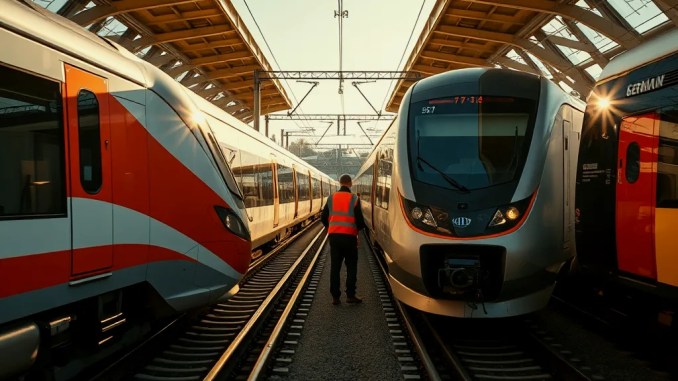
Overview of the 2026 Netherlands–Germany Rail Declaration and Immediate Effects
On 10 November 2026 the Netherlands and Germany signed a non-binding joint declaration in Berlin to expand bilateral rail cooperation. The agreement builds on a 2019 intent focused on freight and extends coordinated work to passenger services, border infrastructure, capacity management and military mobility. It entered into force the same day and runs until 31 December 2035, automatically renewing annually unless one party delivers written notice at least three months before year‑end.
Which international passenger corridors will be prioritized?
The declaration prioritizes three Amsterdam‑centred corridors for capacity increases and incremental journey‑time reductions:
Amsterdam–Hamburg — planners will also investigate stronger links to Copenhagen as demand rises.
Amsterdam–Berlin — upgrades and timetable coordination aim to bolster onward connections toward Warsaw and Prague.
Amsterdam–Frankfurt — this corridor will be considered alongside connections toward Basel and Vienna.
The Netherlands’ infrastructure ministry noted that daily high‑speed services to Paris currently outnumber Berlin services by roughly two to one, signaling room to grow Amsterdam–Germany frequencies. The declaration deliberately omits fixed train counts and firm timetables; instead it sets a process to remove market access barriers so new operators can compete for both day and night international services.
Which cross‑border lines will be developed?
Germany agreed to pursue improvements on four main transboundary routes, including segments that fall under federal German financing responsibility:
• Emmerich–Oberhausen and inner Betuwe Route stretches
• Venlo–Kaldenkirchen–Viersen
• Bremen–Oldenburg–Groningen–Amsterdam (assessed in combination with the Wunderline project and the Lelylijn extension)
• Bad Bentheim / Oldenzaal border crossing
Holland has begun examining Lelylijn’s possible extension into Germany and set up an advisory committee to scope feasibility. Annual traffic data published by the Dutch ministry estimates roughly 45,000 freight trains cross the border each year via Zevenaar, Venlo and Bad Bentheim—underscoring the combined corridor significance for freight and potential passenger roll‑out.
How will the Betuwe route and the proposed third track be advanced?
Extending the Betuwe freight corridor between Zevenaar, Emmerich and Oberhausen, including a proposed third track, remains a joint priority Dutch authorities do not expect completion within ten years from December 2025; Germany’s October 2026 infrastructure plan sets a full‑completion horizon around 2038. To accelerate progress, both governments agreed to convene a one‑off fast‑track meeting with DB InfraGO, ProRail and ministry officials to define short‑term deliverables and bottleneck mitigation steps.
What governance bodies will steer implementation?
The establish declarationes an annual high‑level steering group composed of senior citizens Representatives from each country to monitor implementation, convene stakeholders and ministry form temporary working groups as required. Meetings will rotate between the two countries, with participants covering their own expenses. Immediately after signing, the partners also launched a freight working group to continue cooperative projects started in 2019.
Which technical harmonization priorities appear in the plan?
Technical workstreams will target interoperable electrification standards, digital train‑control systems and operational rules required to run longer freight formations under EU TEN‑T guidelines. Both governments explicitly referenced enabling 740‑metre freight trains through signalling, electrification and platform/yard adjustments—critical for sectors such as bulk liquids and military logistics that benefit from longer sets.
What R&D and pilot activities are expected?
Joint research will concentrate on digital automatic coupling, Automatic Train Operation (ATO), ERTMS/ETCS roll‑out, noise mitigation, sustainability measures and ground‑borne vibration control The partners will develop a practical implementation strategy that includes cross-border pilot projects to validate technical solutions before network‑wide adoption.
How will Amsterdam–Berlin ICE operations change through 2027?
Ongoing German infrastructure works have already affected Amsterdam–Berlin ICE patterning. From 2 October 2026, three of the seven daily ICE works terminated at Hannover, requiring transfers; the remaining trains routed via Hamburg. A Deutsche Bahn timetable change effective 13 December 2026 will standardize daily operations so four ICE trains in each direction use the Hamburg corridor, adding about 60 minutes to some journey times. NS International stated this Hamburg‑via operation is planned to continue through December 2027.
Key milestones and dates to watch
Relevant milestones in the bilateral rail timeline:
2019 — initial freight‑focused intent signed.
17 May 2026 — DB InfraGO completed an 80-week construction phase on Emmerich–Oberhausen (~73 km).
2 October 2026 — interim Amsterdam–Berlin ICE modifications implemented due to German works.
10 November 2026 — joint declaration signed in Berlin (effective immediately through 31 December 2035).
December 2026 — planned start of Coevorden–Bad Bentheim passenger service (subject to confirmation).
December 2027 — target for ending the Hamburg‑via routings for Amsterdam–Berlin ICE services (subject to infrastructure completion).
2038 — target year listed in Germany’s infrastructure plan for finishing Betuwe third track.
Practical steps for operators, regional authorities and shippers
To convert the declaration into network benefits, stakeholders should act on these concrete steps:
1. Operators — submit coordinated slot applications across borders, prepare compatible rolling stock (ERTMS/ETCS fitment, pantograph profiles) and test overnight/night‑train operations for demand sensitivity.
2. Infrastructure managers — prioritise freight‑capable electrification and siding works to accommodate 740‑m trains, align signaling upgrades and publish joint capacity timetables for cross-border paths.
3. Regional authorities — factor new international services into local transport plans, station accessibility upgrades and intermodal last-mile connections.
4. Shippers and military planners — use the freight working group to identify predictable paths, harmonized technical requirements and pilot windows for long‑train freight trials.
Expected passenger and freight benefits
When implemented, the program aims to deliver:
• Increased frequency and improved journey‑time competitiveness on Amsterdam–Germany corridors, making rail a more viable option for intermediate trips to Hamburg, Berlin and frankfurt
• Enhanced freight throughput across strategic border points, supporting modal shift ambitions and military mobility needs.
• Faster market entry for new operators, increasing service variety and potentially lowering fares and cargo rates where competition intensifies.
Limitations, risks and monitoring needs
The declaration is non-binding and contains no financial commitments, so successful delivery depends on national budget cycles, EU funding alignment and timely co-operation among DB InfraGO, ProRail and regional stakeholders. Key risks include construction delays (the Betuwe third track is already pushed into the late 2030s in Germany’s plan), short‑term timetable disruptions during works and slower than expected uptake from private operators. The steering group must publish progress indicators and a rolling action plan to sustain momentum.
How to track progress and where to find updates
Follow regular publications from the Netherlands Ministry of Infrastructure and Water Management, Germany’s Federal Ministry of Transport and Digital Infrastructure, ProRail and Deutsche Bahn/DB InfraGO. The newly formed steering and freight working groups will be primary sources for joint status reports, pilot announcements and technical guidance.





Be the first to comment