
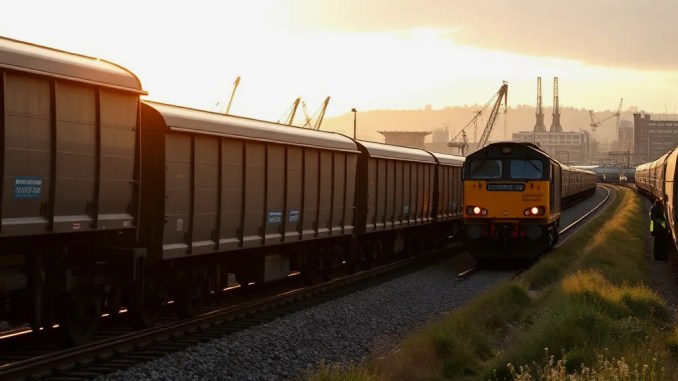
Porterbrook invests in 56 MWA wagons to boost scrap-steel logistics for 7 Steel UK
Porterbrook will finance the build of 56 closed MWA wagons that GB Railfreight (GBRf) will operate to carry scrap steel into 7 Steel UK’s Cardiff plant. The first wagon, built by WH Davis in Nottinghamshire, is scheduled for completion in September 2027. Porterbrook assumes the investment risk while GBRf handles day‑to‑day operation and routing. This public–private split accelerates fleet deployment by letting a rolling stock investor procure vehicles to a rail operator’s specification.
How the new wagons will serve 7 Steel UK and local supply chains
The wagons will move high‑volume scrap loads from collection points and scrapyards to 7 Steel UK’s Cardiff facility, where metal is melted, refined, and cast into steel for UK infrastructure and construction projects. Rail moves reduce truck journeys, cut local road wear, and improve delivery consistency for a plant that relies on steady scrap feedstock. By integrating these rail flows, GBRf and 7 Steel UK expect to tighten turnaround times at the melt furnaces and reduce stockpile variability that can disrupt production planning.
Why MWA closed wagons and TF25 bogies matter for scrap transport
WH Davis’s MWA design targets scrap handlers’ typical operating stress: heavy, uneven loads, frequent shunting, and abrasive materials. Each wagon’s 75‑m3 capacity provides roughly 25% more volume than many standard closed wagons, raising payload per train and lowering average transport cost per tonne. TF25‑compatible bogies reduce wheel and rail wear under heavy cyclical loading, which lowers lifecycle maintenance costs and increases fleet availability — a direct saving for operators running high‑frequency scrap turns.
Production timeline and manufacturing details
WH Davis, part of the Buckland Rail group, will produce the entire 56‑wagon batch at its Nottinghamshire facility. The announced schedule targets the first completed unit in September 2027, followed by phased deliveries. Manufacturing steps include chassis fabrication, body assembly optimized for abrasive scrap, TF25 bogie installation, braking and coupling system fitment, and rigorous dynamic testing under loaded conditions to validate ride quality and structural response. Using a single domestic manufacturer simplifies logistics and supports local supply chains for steel plate and assemblies.
Commercial structure: Porterbrook finance + GBRf operations
Under the deal, Porterbrook provides capital expenditure to procure the wagons; GBRf will lease or operate them within its network to serve the Cardiff flows. The pact complements an 11‑year haulage agreement between GBRf and 7 Steel UK that begins service in October 2026. That contract covers inbound scrap deliveries and outbound distribution of processed steel across the UK. The financial arrangement spreads procurement risk to a specialist asset owner and lets the operator focus on operational performance and customer service.
How this fleet enlarges GB scrap-to-steel capacity — quantified view
Estimating conservatively: if each 75‑m3 wagon carries roughly 20–25 tonnes of compacted scrap depending on density, a 56‑wagon fleet could move 1,120–1,400 tonnes per full train. At two daily turns, the fleet could supply 2,240–2,800 tonnes per day to Cardiff, equal to roughly 700,000–1,000,000 tonnes annually assuming 300 operating days. That scale materially increases railborne scrap capacity into the plant compared with typical road‑only receipts and allows 7 Steel UK to secure a larger share of UK scrap feedstock for domestic steelmaking.
Operational and maintenance implications for GBRf and 7 Steel UK
Introducing a specialized fleet reduces bespoke maintenance needs on mixed wagons and delivers consistent tare weights and loading profiles—simplifying wagon planning, axle‑load management, and siding compatibility TF25 bogies and standardized MWA assemblies let GBRf create targeted maintenance cycles, predict parts consumption, and apply condition‑based inspection regimes. For 7 Steel UK, scheduled delivery windows and higher payloads help minimize inventory buffers and shrink mill downtime risk tied to feedstock variability.
Context: previous Porterbrook–GBRf rolling stock collaborations
Porterbrook and GB Railfreight previously cooperated on multiple wagon purchases to expand freight capability. In March 2024 they agreed on 50 JNA‑X wagons built by Greenbrier for ballast and stone traffic. Those investments show a pattern: Porterbrook funds specialist freight vehicles while GBRf applies its operational network to deliver freight contracts, enabling rapid fleet scale‑up without upfront capital burdens for the operator.
Risks, constraints and unanswered details
The companies have not disclosed the contract’s total value or a complete delivery timetable beyond the first wagon date. Key operational risks include scrap density variation that affects payload economics, potential loading/unloading bottlenecks at highway‑to‑rail transfer sites, and track access or pathing constraints on busy mixed‑traffic corridors. Mitigations include pre‑calibrated loading protocols, dedicated yard slots at Cardiff, and staged introduction of wagons tied to measured ramp‑up milestones.
Practical example: a typical scrap run workflow
Step 1: Collection — scrap gathers at local depots sorted by type and compacted to target densities. Step 2: Load planning — dispatchers allocate the right number of MWA wagons to meet furnace feed plans, balancing weight and volume. Step 3: Loading — cranes or grabs load wagons to the designed fill height, with weighbridge checks ensuring axle‑load compliance. Step 4: Transit — GBRf runs the train under pre-booked paths to Cardiff, minimizing dwell. Step 5: Unloading — discharge swiftly into plant bunkers or storage via grabs, then rapid return to collection points. Each step reduces turnaround time compared with mixed or road‑only logistics and maximizes wagon utilization.
What to watch next
Watch for a full delivery schedule from WH Davis, any published wagon performance metrics (availability, mean time between failures), and details of how the 56 wagons integrate with the two specialized sets GBRf mentioned for 2027. Also monitor regional scrap market prices and 7 Steel UK’s production ramp, since feedstock demand will drive routing frequency and fleet utilization.



Be the first to comment