
Taurid Meteor Showers: What to Expect and How to Watch
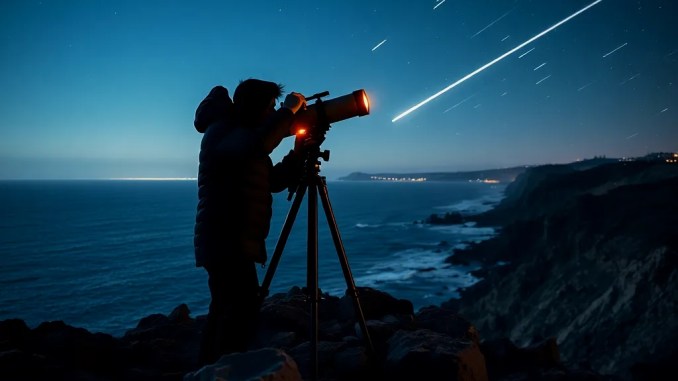
The South and North Taurid meteor streams peak in early and mid-November; South Taurids concentrate around November 5 and North Taurids around November 12. Each shower typically delivers a low rate of meteors — about five per hour — but produces an outsized number of bright fireballs. Pick a night with minimal light pollution, let your eyes adapt for at least 30 minutes, and lie back with a wide field of view. Avoid binoculars and telescopes; meteors cross large sections of sky and naked-eye observing maximizes your chance to catch slow, bright Taurid fireballs.
Mars and Jupiter Close Approach: How to See the Pair on November 15–16
Mars and Jupiter will appear roughly 1.2 degrees apart on the mornings of November 15–16. This is a line-of-sight close approach: the planets remain far apart in space but align from Earth’s perspective. Look toward the southeast about an hour before sunrise; Jupiter will be the brighter white object and Mars the smaller, reddish point nearby. Use a tripod-mounted camera or a phone adapter on a small scope to capture both planets in one frame. For sharper images, shoot with low ISO, small aperture (higher f-number) and exposures of 1–4 seconds if you are using a stable mount.
Leonid Meteor Shower: Peak Strategy for November 17–18
The Leonids peak on the night of November 17–18 and can reach roughly 15 meteors per hour under ideal dark-sky conditions. Leonid particles strike the atmosphere at very high velocities, producing short, bright streaks. Aim to observe after moonset and well before dawn for the best rates. Position yourself where the radiant (near the Leo constellation) is above the horizon—meteor detections rise as the radiant climbs. Track activity in 15–30 minute segments to build a simple activity curve: note start/end time, number seen, brightness class (faint, average, bright), and color. This log helps you quantify peaks and compare nights.
Voyager 1 Reaches One Light-Day Distance: Practical Implications
On November 18 Voyager 1 will sit roughly one light-day from Earth, about 25.9 billion kilometers away. That distance means one-way radio communication requires close to 24 hours. Mission teams must plan commands and data retrieval on multi-day cycles: a command sent today may take a day to arrive, and any telemetry confirming execution another day to return. For science, the value lies in continuous in-situ measurements of the heliosphere boundary and interstellar medium; for operations, the delay forces autonomy and cautious sequencing of critical activities.
Supermoon on November 24: Why It Looks Bigger and Brighter
The November 24 full moon qualifies as a supermoon because it occurs near lunar perigee, when the Moon is closer to Earth on its elliptical orbit. Observers may perceive it as up to ~14% larger and ~30% brighter than a full moon at apogee. To photograph surface detail, lower exposure settings and use a small telescope or telephoto lens at modest magnification; the increased apparent size helps frame landscapes where the Moon acts as a dramatic background element rather than just a bright disk.
People Also Ask: Short, Actionable Answers
When should I go outside to catch meteors? Go out after moonset and through the pre-dawn hours; peak shower nights give the best chance, but the middle of the night often works well if the radiant is high.
Do I need a telescope to see meteors? No. Meteors streak across wide patches of sky; naked-eye viewing gives the best detection area.
Can I observe meteors with partial cloud cover? Small gaps matter: if cloud cover is under ~30% and windows of clear sky persist, you can still catch meteors. Continuous heavy clouds end observing.
How should I log meteor observations? Use consistent time blocks (15–30 minutes). For each block record start/end time, number of meteors, estimated brightness, color, and sky transparency. This simple, repeatable format reveals activity patterns.
Seven-Step Observation Plan for November
1) Check moon phase and local weather, then pick nights with little moonlight and clear skies. 2) Choose a low-light location using dark-sky maps. 3) Dress warmly and bring a blanket or reclining chair to reduce neck strain. 4) Allow at least 30 minutes for dark adaptation; Use a red flashlight for map checks. 5) Orient yourself to the radiant but scan broadly—meteors appear across the sky. 6) If photographing, use a sturdy tripod, wide lens (14–24mm full-frame), low ISO (800–1600) and 20–30 second exposures; bracket settings. 7) Keep a simple log: time blocks, counts, brightness; include seeing and cloud notes.
Compact Data and Examples to Improve Your Observing
Example log entry format: “Date: 2026-11-17, 02:00–02:30 UT, 6 meteors, 2 bright fireballs, one orange-red, sky transparency 4/5.” Use that example to compare nights and compute meteors-per-hour rates. For photography, a sample camera setting for a suburban site: 20s, f/2.8, ISO 1600, 14mm — adjust exposure time to avoid strong star trails while maximizing meteor capture area.
Summary: High-Value Targets and Immediate Actions
Focus immediate planning on Leonid peak nights and the Taurid fireball window. Schedule one or two pre-dawn observing sessions around November 17–18 and November 5–12, pick dark sites, and use the seven-step plan above. Photograph with wide-angle setups and log observations in fixed intervals to turn casual watching into useful data. Finally, note Voyager 1’s one light-day milestone on November 18 as a reminder of how distance shapes real-time command and science operations.








Be the first to comment