
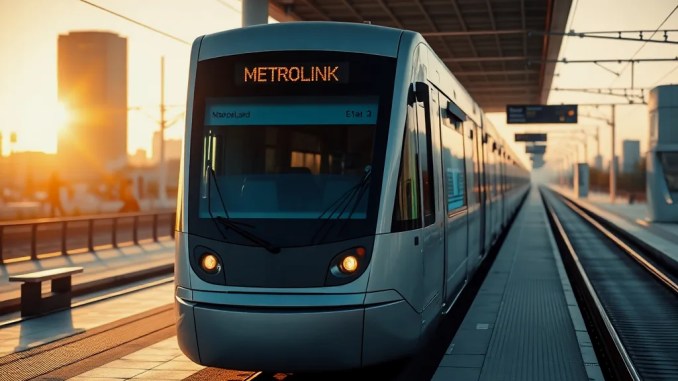
Overview of TfGM’s Metrolink tram procurement
Transport for Greater Manchester (TfGM) has opened a market engagement process to procure a new fleet of high‑floor light rail vehicles to replace and expand its Metrolink network. The engagement seeks manufacturing partners to design, build, test and commission vehicles, and to provide lifecycle support including technical documentation, training, spares supply and sustained engineering assistance. The initial contract term is projected from 1 December 2027 to 30 November 2052, with options extending the agreement through 30 November 2057. The deadline for manufacturers to express interest is 23:59 on 30 November 2026.
Why this procurement matters now
TfGM’s current fleet of 147 M5000 trams is approaching the end of its ~30‑year design life. TfGM needs replacements both to refresh aging assets and to increase capacity for planned route extensions and new services. Metrolink already handles more than 46.6 million passenger journeys per year (as of March 2026) over 100+ route kilometers, with 99 stops and two depots. Procuring a modern, sustainable fleet now reduces long‑term risk, enables new operational patterns (including tram‑train use on partially non‑electrified lines) and supports regional growth plans such as the Pathfinder tram‑train proposals.
What TfGM requires from manufacturers
TfGM requires suppliers capable of producing high‑floor light rail vehicles consistent with Metrolink’s infrastructure. Suppliers must be able to deliver vehicle design, production, factory and on-line testing, commissioning and entry into service. The scope includes: technical documentation, operator and maintenance training, spare parts provisioning and lifecycle technical support. Because Metrolink uses high-floor platforms, manufacturers who only produce low-floor variants are not suitable unless they can meet the high-floor specification.
How the market engagement is structured
TfGM is running a two-phase early market engagement. Phase one tests market capability and appetite: it asks manufacturers whether they can meet volumes, technical constraints and delivery windows. If TfGM gains sufficient insight from phase one, it may decide not to run a separate second phase. Interested firms register for opportunity DN833433 on the ProContract portal at no cost, use the portal messaging to record interest and complete a short pre-qualification survey. TfGM plans up to six one‑to‑one workshops with individual suppliers; Where applications exceed capacity, TfGM will select participants to represent a range of technical and commercial approaches. Workshop invitations go only to firms intending to bid as prime suppliers; supply‑chain firms and bid‑support consultants are excluded from workshop invitations but may submit written feedback.
Key technical concept: New-generation vehicles and tram-train variants
The emerging concept for the next fleet envisions trains approximately 60 meters long with inter-vehicle gangways for free passenger flow along the train. The fleet may include both pure tram and tram‑train variants. For tram‑train models, TfGM is considering a battery capability to operate on sections without overhead electrification, reducing the requirement for full route electrification and enabling phased infrastructure upgrades. Designs will need to balance vehicle weight, battery capacity, acceleration and regenerative braking to meet timetable performance without imposing heavy axle loads on existing track.
How the new fleet supports Pathfinder and network expansion
TfGM is coordinating vehicle procurement with strategic projects such as the Oldham–Rochdale–Heywood–Bury tram‑train Pathfinder. The Pathfinder business case is due to government in early 2027, with preparatory work expected to start around 2028. Procuring tram‑train‑capable vehicles now helps avoid later compatibility issues: vehicles designed to accept battery packs and dual systems can operate across electrified and non‑electrified corridors, simplifying depot operations and enabling staged roll‑out of new services.
Procurement timeline and practical next steps for suppliers
Key milestone dates and supplier actions:
By 30 Nov 2026 — Express interest via ProContract (DN833433) and complete the short survey.
Early 2027 — TfGM expects to run workshops with shortlisted firms (up to six one‑to‑one sessions).
1 Dec 2027 — Anticipated contract start (subject to procurement rules and successful tendering).
2028 onwards — Vehicle production, testing and commissioning phases align with network expansion timelines.
Suppliers should prepare information covering manufacturing capacity, previous vehicle programs, delivery lead times, approach to systems integration (including battery or hybrid traction where applicable), and lifecycle support models (warranty, spares, training, depot modifications). Provide example program plans with phased milestones, key resource allocations and risk‑mitigation measures (eg, component redundancy, alternative supply sources, testing contingencies).
Procurement model and constraints
The opportunity sits above the public procurement threshold and follows the public services procurement regime. TfGM is procuring rail vehicles and tramcars in a single lot; it has not published the number of vehicles or an estimated contract value at this stage. TfGM emphasizes that participation in the voluntary market engagement will not prejudice future tendering eligibility nor indicate a preferred procurement route.
Practical design and operational considerations TfGM will evaluate
Manufacturers should expect TfGM to examine:
Vehicle compatibility: Platform heights, track geometry, curve radii, depot clearances, and line electrification constraints.
Performance metrics: Acceleration, top speed, braking distances, energy consumption, and timetable adhesion.
Passenger experience: Capacity, seating/standing ratios, accessibility solutions for high‑floor operations, onboard information systems, CCTV and mouse equipment integration.
Maintainability: Mean time between failures targets, modular components, diagnostic access, spare parts lead times and training curricula for depot staff.
Environmental and whole‑life cost: Energy usage, battery lifecycle and recycling plans, carbon reduction measures, and total cost of ownership projections.
Examples and practical tradeoffs to consider
Example tradeoffs suppliers often face and how to address them:
Battery size vs weight: Larger batteries extend range on non-electrified sections but increase vehicle mass, affecting track wear and energy consumption; use modular battery packs and scalable thermal management to balance range and weight.
Gangway design vs structural stiffness: Full inter-vehicle gangways improve capacity flow but complicate crashworthiness and reduce torsional stiffness; adopt tested gangway modules with central articulation design and validated crash energy management.
Standardisation vs customisation: Off-the-shelf bogies and traction modules reduce cost and speed delivery, but bespoke body profiles may be needed for depot and platform constraints; Propose a platform‑based vehicle family with configurable end modules.
How TfGM will use market feedback
TfGM will use feedback to refine technical specifications, procurement packaging and delivery timelines. The authority seeks realistic lead times, supply‑chain resilience input and potential options for staged deliveries. Suppliers’ submissions that include detailed program plans, risk registers and examples of prior retrofit or tram‑train conversions will help TfGM assess feasibility and shape the formal tender documents.
Next steps for non‑prime participants and wider stakeholders
Supply‑chain companies, consultants and specialist suppliers cannot attend prime‑only workshops but may submit written evidence and capability statements. Local authorities, operators and passenger groups should expect TfGM to publish more detailed procurement documentation as the market engagement matures; These documents will include technical appendices and safety certification expectations. TfGM has published the market notices on Find a Tender (5 November) and Sell2Wales (6 November) to ensure wide exposure.
Bottom line for bidders
Manufacturers with proven capability to produce high‑floor light rail vehicles and to integrate battery propulsion options where needed should prepare comprehensive capability statements for DN833433 on ProContract. Demonstrate delivery history, technical solutions for gangwayed 60m vehicles, lifecycle support packages, and clear program milestones. Well‑structured risk mitigation and supply‑chain resilience evidence will strengthen responses and help TfGM finalise a procurement that supports Metrolink’s growth and long‑term reliability.



Be the first to comment