
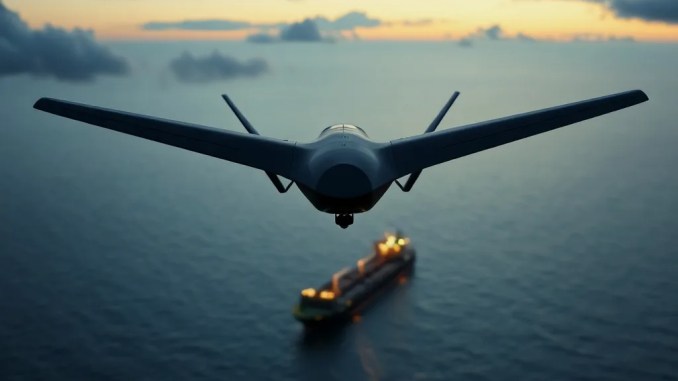
Kamikaze Drone Attacks Surge in the Strait of Hormuz
Between March and early October, security incident records in the Strait of Hormuz show a marked shift toward one-way attack drones. International Maritime Organization logs record 96 security incidents during 1 March–4 October; independent analysis attributes at least 18 incidents explicitly to kamikaze unmanned aerial vehicles (UAVs), with physical damage patterns and witness statements suggesting an additional 17 attacks likely used the same drone type. The most significant inflection point occurred on 15 July: before that date, Iran relied primarily on armed patrol boats, anti-ship missiles, unmanned surface vessels, and boarding operations. After 15 July, recorded surface-attack and boarding incidents dropped while drone strikes rose—47 incidents after 15 July included 29 (62%) classified or consistent with kamikaze drone attacks, versus just 7 such attacks in the prior 47 incidents.
How Iranian Tactics Combine Small Boats and Drones
Iran appears to choreograph small-boat surveillance with swarms of loitering munitions. Open-source imagery and analysts’ reports show Islamic Revolutionary Guard Corps (IRGC) fast patrol boats conducting reconnaissance along the southern, narrower passage of the Strait, tracking merchant vessels’ position, speed, and course. Operators then task approximately two to five kamikaze drones per target. This tactical pairing increases persistence—small boats maintain contact and cue drones that expend themselves on single attacks—while limiting the IRGC’s exposure to counterstrikes because the boats can operate close to shore and the drones are expendable.
Which Drone Types and Sensors Are Implicated?
Available evidence points to Iranian Shahed-series drones, notably Shahed-136 derivatives and newer, jet-powered Shahed-238 variants. Analysts note impact patterns that suggest guided terminal seekers, and some forensic findings and intelligence reports cite infrared (IR) seekers capable of homing on heat sources. Ukraine’s intelligence reported a Shahed-136 examined in 2025 containing an IR camera and an Nvidia Jetson processing module—components consistent with target-acquisition and onboard image processing. That single finding does not prove ubiquitous use of that kit across all Strait incidents, but it demonstrates Iran fields relatively low-cost, sensor-equipped loitering munitions that can discriminate thermal signatures such as engine rooms, funnels, or other hot spots on merchant vessels.
Targeting Patterns: Why Engine Rooms and Funnels Are Hit
Strike location patterns reveal intent to disable or immobilize rather than to sink. Incident reports indicate impacts concentrated near sterns, funnels, and engine compartments—areas that concentrate heat and key systems. An IR-guided seeker that prioritizes thermal contrast will naturally direct a terminal munition to these hot zones. Hitting a ship’s machinery or exhaust area can remove propulsion or steering capability, force anchoring, or necessitate lengthy repairs in port. Across the attacks, most resulted in localized fires rather than catastrophic structural failure, indicating either limited warhead sizes, partial-targeting success, or deliberate choice to deny shipping capability without causing mass loss of life or creating large wrecks that complicate navigation and salvage.
How US Strikes Affected Iranian Capabilities—and What Remains
US strikes on IRGC and naval coastal infrastructure reduced Iranian shore-based support but did not eliminate the threat to commercial traffic According to the analysis, US operations—particularly a wave of strikes in July that targeted bases, port facilities, observation towers, and radar sites—aimed to degrade Iran’s ability to detect, track, and cue attack assets. Those attacks likely degraded some surveillance coverage and logistics nodes, yet the IRGC adapted by shifting emphasis to distributed, low-cost systems (small boats plus expendable drones). The result: reduced centralized capability but preserved asymmetric capacity to harass and intermittently damage merchant shipping on transit corridors.
Practical Impacts on Merchant Shipping and Risk Mitigation Steps
Shipping operators face elevated operational risk; Mitigating measures must combine tactical, procedural, and technological steps. Practical recommendations that reduce vulnerability include:
1) Route selection and timing. Favor the widest available deepwater track when transits permit, and vary transit times to complicate adversary cueing. Where permitted, prefer the northern track through the Strait’s broader channel to increase standoff.
2) Improved watch and sensor fusion. Deploy shipboard electro-optical/infrared watches and integrate radar, automatic identification system (AIS) anomalies, and visual reporting to detect small-boat activity and inbound low-signature aerial threats earlier.
3) Hardening and compartmentalization. Reinforce critical machinery spaces and add passive protections around exhaust outlets; segregate fuel and control lines to reduce mission-killing single-point hits.
4) Active defense and counter-drone options. Equip transiting vessels with kinetic or soft-kill countermeasures suited to loitering munitions—short-range small-arms, naval close-in weapon systems (CIWS) for escorted vessels, electronic jammers, and directed-energy prototypes where available—and ensure rules of engagement cover drone interception in international waters.
5) Information sharing and convoying. Increase real-time intelligence sharing among commercial operators, flag-state naval escorts, and coalition maritime patrol assets; consider grouped transits under naval escort when risk levels spike.
Open Questions Analysts Still Face
Open-source data points to trends but leaves key technical and operational uncertainties unresolved. Analysts cannot yet quantify true hit probability for these kamikaze drones across all incidents because of limited forensic access and inconsistent reporting; The extent to which sophisticated image-processing and IR homing are standard across Iran’s inventory remains unclear. It is also uncertain how quickly Iran can replenish drone stockpiles under export controls and strike attrition, and how readily the IRGC can scale up coordination to sustain high-tempo operations without exposing fixed infrastructure.
Scenario-Based Examples: What a Typical Attack Sequence Looks Like
Step 1: Reconnaissance and cueing. An IRGC small boat uses visual spotting or radar to fix a merchant vessel’s position and heading as it departs the southern choke point.
Step 2: Target assignment. The small boat transmits target bearing and range to a nearby drone launch cell or shore battery via short-range datalink or pre-arranged plan.
Step 3: Launch and approach. Two to five kamikaze drones launch, fly a high-loiter profile to reduce detection, then descend on the thermal signature detected near engines or stack.
Step 4: Terminal homing and impact. An IR seeker or multimodal guidance system locks onto a heat source; the munition impacts near the machinery space, creating a fire and disabling propulsion or steering.
Conclusions: Adaptive, Low-Cost Threat That Persists
Despite strike damage to Iranian coastal infrastructure, the IRGC’s shift toward expendable drones and distributed small-boat surveillance preserves an ability to harass commercial shipping in the Strait of Hormuz. The technique leverages low-cost, sensor-capable loitering munitions to maximize disruption per asset loss. Short-term mitigation requires layered defenses and operational adjustments; long-term disruption of this threat depends on sustained interdiction of production, supply chains for key components, and persistent maritime domain awareness provided by coalition assets.





Be the first to comment