
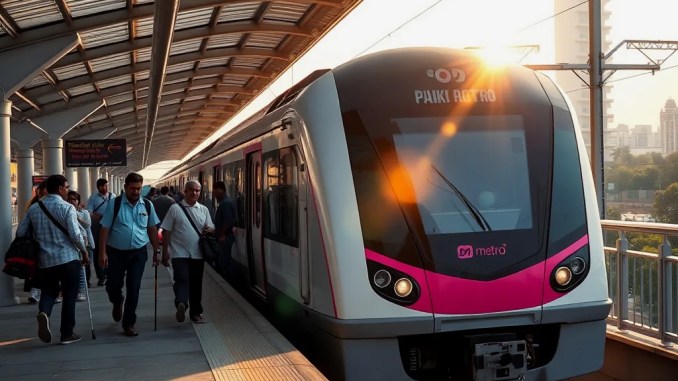
Modi to Open 7.5 km Elevated Pink Line Section Between Kalena Agrahara and Tavarekere
The Prime Minister will inaugurate the first elevated 7.5-kilometer section of Bengaluru Metro’s Pink Line on 13 November 2026. The new stretch, constructed at a cost of about 3,470 crore INR, links Kalena Agrahara and Tavarekere. Officials say the ceremony begins around 12:45 PM, followed by a demonstration ride from Tavarekere Station to IIM Bangalore Station. This opening forms part of a wider investment package for Karnataka that exceeds 15,600 crore INR and includes projects in power transmission, renewable energy, petroleum infrastructure, waste management and rail upgrades.
Passenger Services Start at 06:00 on 14 November with Initial Fleet and Timetable
Transport authorities confirmed regular passenger services will commence at 06:00 on 14 November. The line begins operations with five trains allocated to the section: four in service and one held as backup. Operators plan eight-minute headways at launch; frequency will tighten or loosen based on observed passenger demand and the stability of signaling systems. The new Kalena Agrahara–Tavarekere segment provides interchange access at Jayadeva Station toward the Electronics City corridor, integrating the section with Bengaluru’s wider metro network. Once active, the city’s operational metro network will span about 103 kilometers.
Remaining Pink Line Segment Will Run Underground to Nagawara
The Pink Line continues beyond Tavarekere as an underground alignment between Dairy Circle and Nagawara. State officials report that passenger service across the entire Pink Line will begin only after completion of the underground portion. When finished, the Pink Line’s total length will reach approximately 21.2 kilometers. The state government also aims to expand Bengaluru’s active metro network to 170 kilometers within the next 18 months, prioritizing high-demand corridors and systematic commissioning to avoid service disruption.
Rail Projects and New Vande Bharat Service in Modi’s Bengaluru Visit
On 13 November, the Prime Minister’s program will also roll out multiple rail improvements. A new Vande Bharat Express will connect Bengaluru, Mangaluru and Madgaon (Goa), calling at Hassan, Sakleshpur, Mangaluru, Udupi and Karwar. The inauguration underscores a strategic push to shorten journey times between Karnataka’s coastal and interior cities using higher-speed, semi-high-speed rolling stock. Officials expect modal shifts from road to rail in corridors where the Vande Bharat service reduces end-to-end travel time significantly.
Key Electrification and Capacity-Up Projects Opening
The event includes commissioning of the 55-kilometer electrified section between Sakleshpur and Subrahmanya Road, completing electrification work on the Bengaluru–Mangaluru route. The Bagalkot–Wandal 45-kilometer segment — part of the Gadag–Hotgi double-tracking project — will also enter service to boost line capacity and reduce congestion bottlenecks. Together, these segments form part of a 284-kilometer package designed to increase network throughput, raise average speeds and lower operating costs through electrification and track doubling.
Station Upgrades under Amrit Bharat to Open Simultaneously
As part of the Amrit Bharat Station Redevelopment initiative, renovated stations at Chamarajanagar, Chikkamagaluru, Sakleshpur and Subrahmanya Road will open during the same program. Upgrades include improved passenger circulation, digital information systems, enhanced last-mile access, and platform modifications for level boarding where feasible. These upgrades aim to reduce dwell times and improve the overall passenger experience across both long-distance and commuter services.
What This Means for Commuters: Ridership, Connectivity and Daily Operations
Opening the 7.5 km elevated segment will immediately relieve congestion on adjacent arterial roads by offering a fast, predictable alternative for peak-period commuters. The Jayadeva interchange will enable seamless transfers to the Electronics City corridor, shortening total journey times for IT hub commuters who currently rely heavily on road transport. Authorities expect initial ridership to concentrate on morning and evening peaks; they will adjust train allocation and headways based on real-time demand metrics from automated passenger counters and signaling performance logs.
Implementation Steps and Operational Readiness Checklist
Officials followed a phased commissioning plan before public launch: site safety certification, signaling and telecom integration tests, trial runs under simulated peak loads, staff training for operations and emergencies, and third-party audits for structural and electrical systems. The final checklist included traction power reliability tests, platform screen door alignment where applicable, passenger information system validation, and a contingency operations plan to handle disruptions during the first weeks of service.
Detailed Project List Commissioned on 13 November
The program’s scheduled openings for Karnataka on 13 November include:
– Bengaluru Metro Pink Line: Inauguration of the 7.5 km elevated section between Kalena Agrahara and Tavarekere.
– Vande Bharat Express: Launch of Bengaluru–Mangaluru–Madgaon service with stops at Hassan, Sakleshpur, Mangaluru, Udupi and Karwar.
– Sakleshpur–Subrahmanya Road: Commissioning of 55 km electrified section on the Bengaluru–Mangaluru corridor.
– Bagalkot–Wandal: Bringing a 45 km double-track segment into service as part of the Gadag–Hotgi project.
– Station upgrades: Reopened Chamarajanagar, Chikkamagaluru, Sakleshpur and Subrahmanya Road stations under the Amrit Bharat scheme.
Practical Tips for Passengers on Opening Weekend
Passengers planning to use the new Pink Line segment on the opening weekend should: arrive earlier than usual to allow for crowd management and ticketing queues; use smart cards or mobile ticketing where available to reduce cash handling delays; check live service updates from metro and rail operators; and consider off-peak travel to avoid the first-day rush. Commuters transferring at Jayadeva should allow additional transfer time until staff and signage fully stabilize passenger flows.
Broader Impact: Network Growth and Next 18 Months Roadmap
The incremental 7.5 km opening represents a tactical milestone in a larger plan to grow Bengaluru’s metro footprint and modernize regional rail corridors. With the state targeting an operational metro network of 170 km within 18 months, stakeholders expect a steady cadence of phased openings, electrification rollouts and station modernizations. Those steps will collectively increase capacity, improve multimodal connectivity and support the economic activity of Bengaluru and Karnataka’s coastal and interior regions.






Be the first to comment