
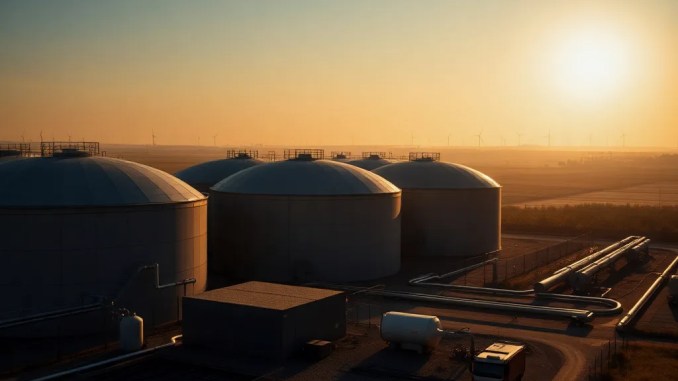
Europe’s largest gas consumer, Germany, enters the pre-winter period with underground storage at about 61% capacity, raising tangible concerns about supply security if temperatures plunge. The German Gas Storage Initiative (INES) models show that, under an extreme cold scenario, monthly shortfalls could reach 6.6 terawatt-hours in January–March 2027, creating acute demand gaps on the coldest days. Policymakers, storage operators and import planners must weigh immediate operational changes and medium-term structural measures to avoid disruptions.
2027 First Quarter Shortfall Risk and Daily Peaks
INES’ scenario work estimates up to 6.6 TWh monthly deficit during an unusually cold January–March 2027. To put that in context, Germany’s full-winter consumption implies this shortfall equals roughly 1.5 days of national gas use over the peak period. On extreme cold days, the model shows intraday differences between demand and available supply rising as high as 1.7 TWh, about 40% of the average daily consumption recorded in January 2026.
These figures arise from combining: observed storage fill levels, historical cold-weather demand profiles (including 2010-style extreme cold), and conservative assumptions about pipeline and LNG inflow capability. INES explicitly notes the probability of a 2010-like winter is low, but the compound impact of a prolonged cold snap with lower-than-expected imports creates a measurable tail risk that operators should address.
Why Storage Matters When Pipelines and LNG Can’t Ramp Instantly
Pipeline imports and LNG shipments provide steady inflows, but they have limited capacity to instantly respond to rapid demand spikes. Pipeline flows are constrained by entry capacity and transit commitments; ramping up requires upstream availability and often contractual rearrangements. LNG regasification capacity can increase throughput, but terminal constraints, shipping slot timing, and the global market’s tightness limit immediate responsiveness. Storage acts as the short-duration buffer that smooths daily and weekly demand swings—precisely the function in jeopardy when fill rates drop below resilient thresholds.
INES Proposals: Financial Incentives, Mandatory Use, and Strategic Reserve
INES recommends a three-part approach to strengthen resilience:
1) Increase financial incentives for higher fills: Use targeted subsidies or capacity payments to offset the opportunity cost storage operators face when filling fields instead of selling gas on spot markets. Higher guaranteed revenue for maintaining buffer stocks makes non-commercially optimal fills commercially viable.
2) Introduce mandatory minimum operating fill levels: Legal obligations for operators to keep storage at predefined percentages before winter reduce systemic exposure. Well-designed mandates can include flexibility mechanisms—allowing releases under declared emergencies while maintaining overall preparedness.
3) Create a state-controlled strategic gas reserve: A government-held reserve would serve as a backstop when market-driven supplies and private storage fall short. Public ownership removes direct commercial incentives to sell holdings during price spikes and creates a coordinated release mechanism for crisis days.
Operator Economics etc. System Security
INES represents 17 major operators (including SEFE, Uniper and VNG) that control more than 90% of Germany’s storage capacity. Operators earn revenue by marketing capacity and selling gas held in storage; higher fill mandates can conflict with short-term commercial returns. Balancing operator with incentives system-level security requires compensation mechanisms, clear rules for emergency use, and transitional arrangements to avoid market distortion while achieving policy goals.
Federal Network Agency’s View and the Divergence in Assessments
Federal Network Agency (Bundesnetzagentur) offers a contrasting assessment, arguing that available import options reduce the immediate likelihood of severe shortages and that Germany no longer needs to rely solely on achieving specific storage fill targets. Their stance rests on assumptions about flexible import availability and responsive market adjustments. The divergence with INES highlights a core policy choice: whether to place greater emphasis on market-led flexibility or on pre-committed physical buffers.
Operational Steps to Reduce Near-Term Risk
Practical actions that can lower short-term exposure include:
– Prioritise storage injections ahead of peak months: Shift contractual demands and purchase patterns to fill storage earlier when market prices are lower.
– Coordinate with upstream suppliers for swing capacity: Negotiate contracted swing volumes with neighboring suppliers to allow temporary upstream increases during cold snaps.
– Optimized LNG regas scheduling: Pre-book regas slots and shipping windows for winter, and diversify sourcing to reduce single-supplier risk.
– Implement transparent release protocols: Define trigger thresholds and release sequences so operators can act quickly when daily demand surges materialize.
Longer-Term Structural Measures and Examples
Beyond the immediate operational toolbox, structural reforms can baseline raise resilience. Examples include targeted investments in additional underground storage, retrofitting existing sites to faster injection/withdrawal rates, and establishing a formal strategic reserve similar to oil strategic stocks but tailored for gas seasonality.
Case study parallels: several EU neighbors operate national buffer arrangements—combining mandatory storage commitments, price-stabilization mechanisms, and regional sharing agreements. Germany could adapt best practices: use transparent compensation for operators, regional coordination for cross-border releases, and legal safeguards to preserve reserve integrity.
What Households and Industry Should Expect
For most households and many industries, normal winter scenarios will likely see uninterrupted supply. However, in extreme scenarios, gas-intensive sectors (chemicals, certain manufacturing processes) and large district heating networks could face supply pressure first. Operators and policymakers should publish prioritized allocation plans and temporary demand-reduction measures (eg, voluntary curtailment programs, controlled industrial interruptions) to reduce uncertainty and allow businesses to plan contingencies.
Key Metrics to Watch Weekly
Stakeholders should monitor:
– Storage fill percentage: Weekly changes reveal injection progress relative to seasonal norms.
– Net import nominations and scheduled LNG arrivals: These indicate available incremental supply heading into cold periods.
– Weather-based demand forecasts: Multi-week temperature and heating-degree-day projections help predict demand spikes.
– Market spreads between summer and winter contracts: Large spreads may signal market concern and influence operator behavior.
Bottom line
Germany currently faces a credible—but not certain—risk of gas shortfalls if an extreme cold winter hits while storage remains at 61%. INES favors stronger fill mandates, financial incentives and a state strategic reserve to close the gap between market signals and system-level security. The Federal Network Agency points to import flexibility as a mitigating factor. Policymakers can reduce tail risk by combining short-term operational steps, near-term compensation schemes for operators, and medium-term structural reforms that raise resilience baseline against rare but high-impact cold scenarios.








Be the first to comment