
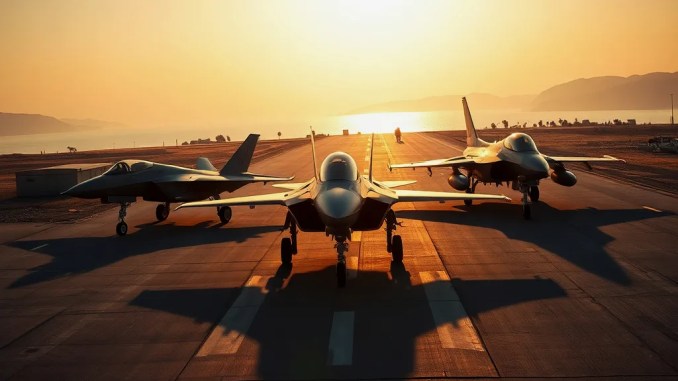
Rafale and F-16 Viper form the backbone of current combat capability
Greece is upgrading its frontline strike and multirole fleet by modernizing legacy F-16 Block 50s while keeping Rafale multirole fighters at the center of air operations. The Air Force Commander announced concrete steps: avionics and mission-computer upgrades for Block 50s, integration of modern air-to-air and air-to-ground weapons, and tactics updates that exploit Rafale’s sensor fusion. These combined changes increase sortie generation, reduce time-to-target and improve networked engagement, demonstrated during recent large-force exercises where mixed Rafale–F-16 formations cut target detection-to-engagement timelines.
F-35 induction requires doctrinal, training and network changes
Bringing F-35s into service means redefining how Greece plans and fights air campaigns. The command framed F-35 procurement as a systems-level transition: secure datalinks, joint mission planning tools, and distributed command nodes. Step-by-step preparations described include: 1) establishing training pipelines for pilots and maintainers using allied F-35 schools; 2) certifying weapons and sensors in national configuration; 3) deploying secure backbone communications for sensor-sharing; and 4) running integrated live-virtual-constructive exercises to validate tactics. The commander emphasized that accurate F-35s will act as airborne sensor hubs, feeding real-time tracks to Rafales, F-16s and ground C2 nodes to enable faster, more engagements.
Human-unmanned teaming: Loyal Wingman and Collaborative Combat Aircraft concepts
The Air Force is actively preparing mixed human and unmanned mission profiles. Commander statements prioritized Loyal Wingman and Collaborative Combat Aircraft (CCA) concepts—where lower-cost unmanned platforms extend sensor reach, perform dangerous suppression missions, or act as decoys under human supervision. Implementation examples include pairing an F-16 / Rafale as mission lead with autonomous wingmen that carry electronic warfare packages or expendable munitions. Trials will focus on secure control handoffs, rules of engagement for autonomous actions, and reducing pilot workload via automated sensor fusion displays.
Transport, refueling and logistics: KC-390 and sustainment focus
Air mobility and sustainment form the operational baseline that enables sustained air presence. Greece plans to procure KC-390 Millennium transports to increase rapid lift and humanitarian response capacity while improving aerial refueling and forward-basing logistics. The commander highlighted modernizing maintenance depots, upgrading spares pipelines, and introducing condition-based maintenance analytics to raise aircraft availability. Practical benefits: faster sortie generation, longer on-station time for fighters through refueling, and reduced downtime from predictive component replacement.
Layered air defense and modern command-and-control architecture
Strengthening national airspace defense requires integrated sensors and multi-tier intercept capability. Command emphasis centered on fusing radar, passive sensors, AWACS/AEW assets and ground-based interceptors into a coherent picture. Upgrades focus on early warning radars, low-signature detection, hardened C2 nodes and automated track correlation. This layered approach shortens detect-to-scramble cycles and enables prioritized engagement of high-value threats while leaving lower-tier assets to handle less demanding targets.
Operational examples, metrics and timelines to measure progress
The modernization plan ties technical upgrades to measurable operational outcomes. Examples of metrics the command plans to track: sortie generation rate per day, aircraft mission-capable rate, mean time to repair for critical components, time from initial radar cue to weapons release, and percentage of missions flown in mixed human-unmanned formations. A phased timeline includes near-term Block 50 avionics retrofits and KC-390 induction, medium-term F-35 arrival and training pipeline establishment, and long-term operationalization of human-unmanned teaming and AI-assisted C2.
Training, doctrine and international cooperation as force multipliers
Technical upgrades pair with updated doctrine, joint training and allied interoperability. The commander highlighted collaboration with partner air forces for pilot conversion, multinational exercises for combined-arms drills, and shared logistics arrangements to reduce acquisition and sustainment costs. Training centers will incorporate live, virtual and constructive environments to rehearse distributed missions with sensor fusion, enabling crews to practice decision-making under congested, contested conditions.
Key risks and mitigation: supply chains, cybersecurity and rules of engagement
The plan identifies supply chain fragility, cybersecurity and legal frameworks for autonomous systems as primary risks. Mitigations include diversified suppliers, local sustainment hubs, hardened and segmented networks, continuous red-team cyber testing, and clear command rules for unmanned engagements. The Air Force intends to validate mitigations through exercises that stress logistics, contested comms and contested cyber environments.
Why these changes matter for national defense
The integrated approach raises deterrence and operational resilience. By modernizing fighters, adding stealthy sensors, fielding transport/refuel capabilities and preparing human-unmanned teaming, Greece increases its ability to detect, deter and defeat multiple threat types while maintaining political and humanitarian response options. Investments in sustainment and C2 ensure those platforms remain available when needed, turning procurement into sustained combat power rather than one-time capability spikes.







Be the first to comment