
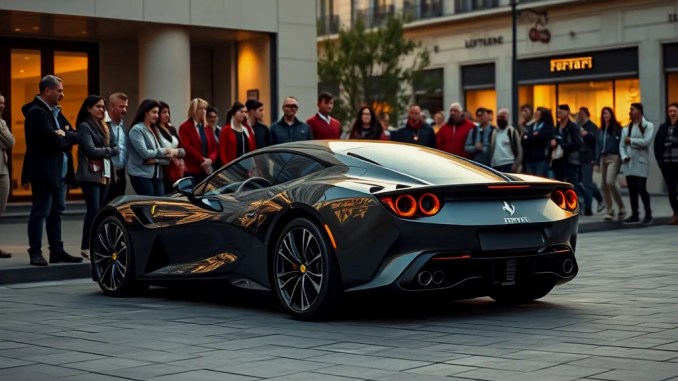
Ferrari’s Luce Hits Full 2027 Allocation; New Orders Face ~12-Month Wait
Ferrari announced that the entire 2027 delivery allocation for the Luce, its first fully electric model, is sold out. CEO Benedetto Vigna reported that development and production are proceeding on schedule and that customers who place new orders now should expect roughly a 12-month wait for delivery. Ferrari did not disclose exact production numbers for the 2027 allocation, but the firm confirmed demand exceeded the slots available for that year.
Why Buyers Are Committing Before Deliveries Begin
The Luce attracted strong pre-launch interest for several reasons. First, the model represents Ferrari’s first pure-electric production vehicle, creating pent-up demand among collectors and brand loyalists eager to secure an early allocation. Second, Ferrari marketed the car with exclusive experiences—private previews and planned driving events—that increase perceived value and prompt earlier purchase commitments.
Concrete examples: Ferraris historically sold allocations through a combination of client relationships, targeted events, and limited-run availability. That model encourages early commitments even when production timelines remain broad. For Luce, Ferrari’s plan to stage international drive events in early 2027 functions as both a validation and a marketing accelerator: customers who experience the car in-person are likelier to finalize purchases and accept wait times.
Design Controversy Didn’t Slow Orders
The Luce provoked debate with a four-door, five-seat layout that departs from Ferrari’s typical two-seat sportscar profile. Contributions from former Apple design chief Jony Ive amplified attention and polarized reactions; Some enthusiasts criticized the departure from tradition, while other buyers valued the fresh approach.
Even with vocal criticism, the model’s allocation filled because purchase decisions often rest on a mix of brand cachet, anticipated future value, and exclusivity—factors that outweigh design objections for many high-net-worth buyers. In practice, brands that break from convention frequently see early adopters and collectors secure units precisely because the deviation signals rarity and a new chapter for the marque.
Production Complexity: New Parts and Technologies
Vigna emphasized that Luce uses a large number of new components and manufacturing techniques compared with Ferrari’s ICE and hybrid models. Introducing bespoke battery packaging, electric drive modules, and thermal management subsystems increases assembly complexity and ramps slower than repeat processes. Ferrari reports no major production disruptions, but acknowledges that the learning curve for novel parts and supplier coordination lengthens lead times.
Step-by-step where complexity affects timelines:
1. Prototype validation: multiple design iterations and bench testing to verify thermal, NVH (noise-vibration-harshness), and crash performance for EV layouts.
2. Supply-chain ramp: qualification of new suppliers for battery cells, inverters, and high-voltage cabling with stricter traceability and safety testing.
3. Assembly-line adaptation: retraining teams, adding equipment for high-voltage assembly, and implementing new quality checkpoints.
4. Pre-delivery validation: customer-specific options and bespoke finishes require individualized inspections that extend throughput time.
Planned Customer Experience: Test Drives and Delivery Phasing
Ferrari intends to begin delivering early Luce examples in late 2026 and to hold international media drives in early 2027. Those events serve two functions: expose the product to press and prospective buyers and reduce ordering friction by letting customers test the vehicle before their units arrive. For customers, this phased roadmap means:
– Late-2026: first customer cars delivered (likely limited-volume, allocation-based).
– Early-2027: international drive events and expanded customer demos.
– Duration 2027: staggered aligned deliveries with production batches and final quality checks.
Market Implications and Ferrari’s 2030 EV Ambition
Filling the 2027 allocation signals commercial appetite for Ferrari’s electrification direction, but it does not reveal the full scale of demand because Ferrari withheld specific production and sales figures. The company’s 2030 roadmap aims for 20% of the model lineup to be fully electric, 40% hybrid, and 40% internal-combustion-powered—indicating a staged transition rather than an abrupt shift.
What this means for the market:
– Pricing resilience: Strong early demand supports premium pricing for allocations and the potential for healthy residual values for early-production examples.
– Competitive signaling: Ferrari’s success with Luce may encourage other luxury marques to accelerate EV programs, emphasizing bespoke experiences around early deliveries.
– Production constraints: Until Ferrari scales specialized EV manufacturing, wait times might remain an allocation management tool that preserves exclusivity.
Data Gaps and What to Watch Next
Ferrari left several open questions that will determine whether demand sustains beyond initial allocation fills. Key metrics to monitor:
– Actual production volume: precise number of units scheduled for 2026–2027 deliveries will clarify real demand versus constrained supply.
– Geographic distribution: how allocations split across markets (Europe, North America, Asia) will show regional appetite patterns.
– Option mix and uptake: percentages of buyers choosing high-value bespoke options reveal margin drivers.
– Secondary-market behavior: resale pricing and time-to-sale for early Luce cars will indicate longer-term desirability.
Practical Advice for Prospective Buyers
If you consider ordering a Luce now, apply these practical steps to manage timing and expectations:
1. Confirm allocation terms: verify deposit structure, cancellation policies, and any price adjustment clauses tied to configuration or options.
2. Schedule test-drive events: attend Ferrari’s planned early-2027 drive events to validate ergonomics, software behavior, and charging experience before final configuration.
3. Plan charging infrastructure: prepare home and destination charging—assess power availability, install a compatible EV charger, and budget for upgrades.
4. Track registration/tax implications: consult local advisors about incentives, registration timing, and emissions-based taxes that vary by country.
5. Consider resale horizon: if you buy as an investment or limited-use collector car, study comparable early EV launches for depreciation and collector premiums.
Conclusion
Ferrari’s Luce has transformed early curiosity into concrete orders: 2027’s allocation is sold out and new buyers should expect about a year-long lead time. The car’s unconventional design, significant new technology content, and Ferrari’s experience-driven sales model combined to create early scarcity. Watch upcoming production figures, regional allocations, and resale trends to gauge whether demand remains robust once deliveries scale.





Be the first to comment