
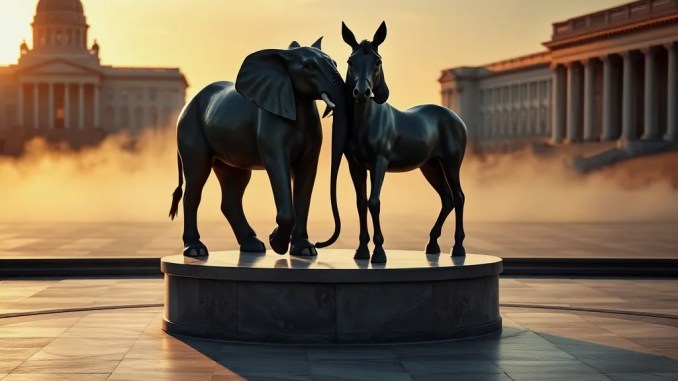
The origins of the donkey symbol for Democrats
The donkey first appeared as a political insult in the 1828 presidential campaign against Andrew Jackson. Opponents labeled Jackson a “donkey” to mock what they saw as stubbornness. Jackson turned the slur into a strength: campaign literature and rallies adopted the animal as a symbol of persistence and discipline. Over subsequent decades, presses and pamphleteers repeated the image until it circulated widely among voters rather than only as an attack.
How Thomas Nast cemented both animal icons
Cartoonist Thomas Nast, publishing in Harper’s Weekly in the 1870s, gave the two animals lasting visual form. In an 1870 cartoon he drew Democratic newspapers as a donkey kicking a lion — an image that linked the creature to press influence and popular resistance. In 1874 Nast depicted the Republican Party as a massive, uneasy elephant teetering at a cliff in a cartoon titled “The Third-Term Panic,” associating the elephant with power and an alarming, uncontrollable momentum. Those repeated, widely distributed illustrations transformed ephemeral jabs into durable party emblems.
Why the animals stuck: symbolism and public adoption
Symbols endure when they match an easily grasped trait and appear enough times for collective memory to take hold. The donkey suggests stubbornness, humility and steady labor; the elephant evokes size, strength and institutional weight. Newspapers, political cartoons, campaign posters and later party merchandise reinforced consistent visual cues. Citizens saw the animals repeatedly in different contexts — election pamphlets, editorial cartoons, protest banners — and the images migrated from satire to identity.
Key moments that fixed the icons in public life
Three developments accelerated adoption: widespread circulation of illustrated weeklies in the late 19th century; the rise of mass political machines and party branding; and the introduction of campaign ephemera (buttons, broadsides, later posters). For example, during the 1870s and 1880s Harper’s Weekly and similar outlets syndicated Nast’s images nationally, so a single cartoon could reach readers coast to coast. By the early 20th century, both parties used the animals informally at rallies and, eventually, on merchandise — a shift from ridicule to ownership.
How both parties use the symbols today
Modern campaigns deploy the animals for quick recognition across media: logos, animated graphics in ads, fundraising merchandise and social posts. The donkey appears in imagery tied to grassroots turnout and social safety-net messaging; the elephant features in visuals emphasizing national security, economic authority, and institutional experience. Digital reuse and memetic culture accelerate changes: political illustrators remix the animals to signal subfactions, satire, or issue-specific stances while keeping baseline recognition intact.
Examples and concrete cases
Example 1: A 20th-century campaign poster for a Democratic mayor used a working donkey hauling a cart of ballots to suggest civic duty and persistence. Example 2: In several mid-century Republican Senate races, campaign materials showed an elephant standing guard beside the Capitol to convey stability. Contemporary example: online ads often animate an elephant barricading a vault to symbolize fiscal responsibility, while grassroots groups animate donkeys helping neighbors to convey community-focused policy.
Search-focused answers people ask often
What animal represents the Democratic Party? The donkey. Why a donkey? It originated as an insult in 1828 and was reclaimed by Andrew Jackson and later popularized by Thomas Nast, becoming associated with resilience and populist appeal. What animal represents the Republican Party? The elephant. Why an elephant? Thomas Nast’s 1874 cartoons linked the elephant to Republican power and a looming, institutional presence.
Step-by-step: how a political caricature becomes a party symbol
1) A graphic image first appears in a high-circulation outlet (eg, a weekly magazine). 2) Readers repeat and republish the image; political actors reference it. 3) Opponents and supporters alike reuse the image, widening recognition. 4) Parties and campaigners begin to adopt the image for rallying, fundraising and identification. 5) Media and merchandise standardize the depiction so future generations recognize it instantly.
Why visual metaphors matter in politics
Visual metaphors condense complex ideas into accessible cues. A single animal can carry connotations across policy, temperament and strategy; Eyes grasp these cues faster than detailed platforms. Repetition across trusted media turns a metaphor into a near-instant heuristic that voters use when scanning headlines, ads or ballots.
Bottom line: from satire to identity
Both the donkey and elephant began as elements of satirical journalism and evolved through repeated public exposure into durable party symbols. Their persistence results from clear symbolic fit, widespread dissemination in the 19th century, and continuous reuse in modern campaign communication. These images now function as shorthand for political values and strategic posture in American public life.









Be the first to comment