
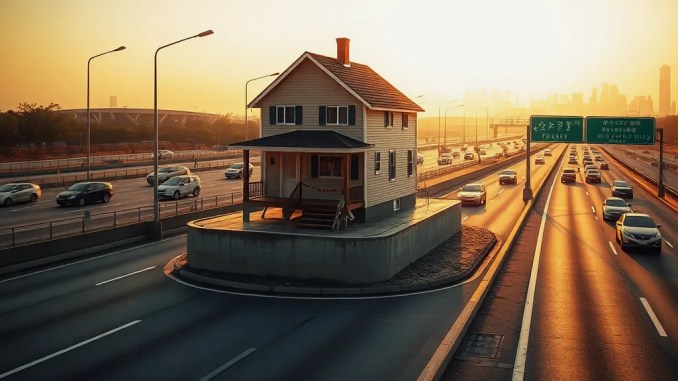
In Jiangxi province, a house nicknamed the “Eye of Jinxi” ended up directly inside a newly built expressway’s route, prompting the owner to leave after prolonged resistance to compulsive purchase.
The highway route left the house isolated
The local government proposed compulsive acquisition and offered about 1.6 million yuan (roughly). $223,000) for the property. The owner, identified as Huang Ping, rejected the offer primarily because officials proposed to pay the sum in two installments and the parties could not agree on terms. Planners adjusted the road alignment to avoid wider demolition, routing the highway around the parcel so the house remained in the middle of a circular junction-like formation. That unusual siting quickly made the building a public talking point under the nickname “Eye of Jinxi.”
Noise and vibration made occupation untenable
Once the expressway opened in April, continuous heavy-vehicle traffic produced high decibel levels and perceptible ground vibration at all hours. The house lacked adequate sound insulation or structural measures to isolate vibration, so living conditions deteriorated rapidly. Huang stated to local reporters that his family relocated to a rented unit in a nearby town because the constant noise and shaking disrupted sleep, damaged fragile items, and increased stress. Observers later noted broken windows and overgrown weeds around the empty property, confirming the move.
Compensation and demolition create legal and financial uncertainty
Local authorities and legal advisors now face a key question: if the house is demolished later to improve road safety or aesthetics, what compensation applies? Chinese eminent domain practice typically values compulsive acquisition differently when a structure is demolished post-project versus negotiated before construction. Sources indicate that the owner’s earlier rejection of the authority’s offer could leave him with a lower regulatory payment if the house is cleared after the fact, because baseline valuations and hardship allowances are often set during pre-construction negotiations. That disparity explains why owners sometimes resist offers even when post-construction conditions become intolerable.
Practical issues the case highlights for property owners and planners
Several operational and legal lessons emerge from this event. First, route adjustments to spare structures can create long-term livability problems for those residual buildings; Planners should assess noise and vibration impacts, not only demolition counts. Second, compensation timing and payment structure matter: owners confronted with installment offers should seek escrow or bank guarantees to ensure funds arrive as promised. Third, where heavy traffic will pass closely, investing in retrofitted sound insulation, vibration dampers, or temporary relocation allowances during construction can reduce forced displacement. Finally, transparent dispute-resolution mechanisms—binding offers from appraisal panels, independent mediators, or interim relief payments—reduce prolonged standoffs and the social cost of abandoned properties.
Data, comparisons and a short checklist for affected homeowners
Examples from other Chinese infrastructure projects show a pattern: when authorities revise alignments to minimize demolition, leftover structures frequently face degraded living conditions. Comparative studies of road-adjacent noise suggest that residences within 30 meters of heavy-traffic lanes experience average day-evening-night (Lden) increases of 5–10 dB, enough to raise complaint rates and health impacts. Practical checklist for homeowners who receive installment-based compensation or face residual placement:
Step-by-step homeowner checklist
1) Document the official offer in writing and request performance guarantees for installment payments.
2) Obtain independent appraisal and legal advice about the valuation method and potential post-demolition statutory payments.
3) Commission noise and vibration predictions for the new alignment; request mitigation measures if projected levels exceed local standards.
4) Seek interim relocation assistance or temporary rent payments if living conditions become unsafe or uninhabitable.
5) Use official complaint channels and, if needed, mediation to prevent unilateral post-construction demolition that reduces compensation.
What happens next for the “Eye of Jinxi” house?
Possible outcomes include voluntary sale at renegotiated terms, formal demolition with compensation, or long-term abandonment. Each path carries different financial implications for the owner and maintenance responsibilities for local government. Given the visible damage and weeds, short-term abandonment seems likely unless authorities and Huang reach a revised agreement that secures immediate payment, relocation support, or effective mitigation for noise and vibration.









Be the first to comment