
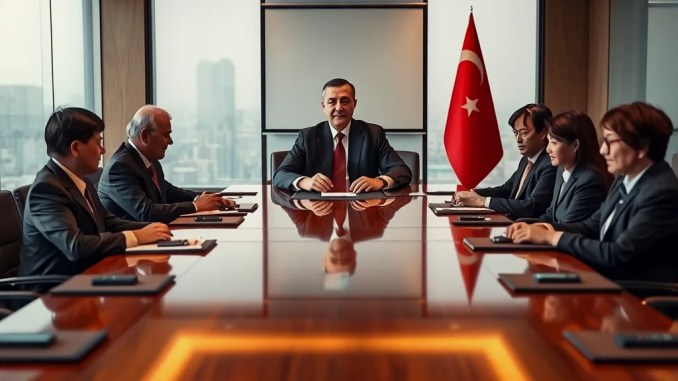
Erdoğan convenes top South Korean tech and industrial executives in Seoul
President Recep Tayyip Erdoğan hosted senior executives from leading South Korean companies at his Seoul hotel during an official visit, focusing discussions on technology transfer, joint ventures, and scalable industrial partnerships. included CEOs and board chairs participants from LG Electronics, Samsung, Hyundai Motor Group, Celltrion, SK Chemicals, SK Plasma, Chemtronics Wits, and Korea Electric Power Corporation (KEPCO). Turkish ministers and senior advisors joined to align commercial priorities with national strategy and to accelerate project execution timelines.
Who attended and what were the immediate outcomes?
Delegations from both countries brought commercial and technical teams to the table: LG Electronics’ CEO Lyu Jae-cheol and Samsung CEO Roh Tae-moon represented consumer electronics and component manufacturing; Hyundai Motor Group CEO Chung Euisun addressed automotive electrification and supply chain localization; Celltrion’s Seo Jin-seok and SK Chemicals’ Jaehyun Ahn covered biopharma and specialty materials; KEPCO’s Chan-hyuk Chun discussed grid-scale cooperation. From Turkey, Energy and Natural Resources Minister Alparslan Bayraktar, Industry and Technology Minister Mehmet Fatih Kacır, AK Party deputy Halit Yerebakan, and Investment and Finance Office head Ahmet Burak Dağlıoğlu participated, enabling direct minister-to-CEO pledges on incentives, pilot projects, and regulatory fast-tracks.
Which sectors were prioritized and why they matter
The meetings prioritized five strategic sectors with clear bilateral value:
Electronics and semiconductors: Turkey seeks to reduce import dependence by attracting fabs, testing, and packaging lines. Practical proposals included targeted incentives for component assembly hubs near Izmir and pilot R&D centers co-funded by Turkish ministries and Korean firms.
Automotive and EV supply chains: Hyundai’s engagement centered on battery supply, local parts sourcing, and shared R&D on hydrogen mobility. Concrete actions discussed: supplier development programs, joint procurement for batteries to lower unit cost, and feasibility assessments for EV assembly lines in Turkey.
Biotechnology and pharmaceuticals: Celltrion’s presence focused on biosimilars and contract manufacturing capacity. Turkey emphasized streamlined GMP approvals and partnership models where Turkish contract manufacturers would scale under Celltrion quality oversight.
Chemicals and specialty materials: SK Chemicals and SK Plasma offered collaboration on advanced polymers and plasma-derived bioproducts. Proposals included technology licensing and pilot plants to convert feedstock into higher-value specialty chemicals for local industries.
Energy and grid integration: KEPCO and Chemtronics discussed joint work on smart grid pilots, renewable integration, and cross-border transmission studies. Turkey highlighted grid modernization tenders and invited joint bids aligned with decarbonization targets.
What practical agreements and next steps were proposed?
Participants agreed on a stepwise implementation framework to convert discussions into projects. Key elements:
1) Immediate task forces: Industry-specific working groups with Korean corporate leads and Turkish ministry liaisons to draft memoranda of understanding (MoUs) and technical scopes within 60 days.
2) Pilot projects: Fast-track approvals for pilot manufacturing and R&D facilities tied to measurable milestones—job targets, local procurement ratios, and technology transfer clauses.
3) Investment facilitation: Turkish investment authorities offered tailored incentive packages, land allocation near industrial zones, and streamlined permitting for strategic projects to reduce time-to-first-production.
4) Finance and risk-sharing: Exploration of blended finance using Turkish public investment vehicles, Korean corporate equity, and multilateral development bank instruments for large-capex items such as fabs and battery plants.
How these talks affect Turkish industrial strategy
By engaging industry leaders directly, Turkey is signaling a shift from passive market access to active industrial partnering. The approach aims to capture higher value chains—manufacturing, R&D, and export hubs—rather than remaining a low-value assembly market. Examples include co-located R&D centers where Turkish universities and Korean corporate labs will run joint PhD programs, and supplier development initiatives to qualify local SMEs into the Korean OEM supply chains within 18–24 months.
Risks, mitigations and success metrics discussed
Executives and ministers acknowledged typical risks—permitting delays, workforce skill gaps, and supply-chain bottlenecks—and proposed mitigations: guaranteed one-window permitting, government-backed upskilling grants, and logistics improvements near ports. Success metrics established for each pilot will include initial investment thresholds, employment numbers, localization ratios, export volume targets, and technology licensing milestones to be reviewed quarterly.
Concrete examples and timelines
Two illustrative project outlines emergence during meetings:
EV components hub (example): Hyundai-led supplier park with three anchor suppliers to be operational within 24 months. Milestones: site allocation by month 3, construction start month 6, first-phase production month 18.
Biosimilars contract manufacturing pilot (example): Celltrion partnership with a Turkish contract manufacturer to produce two biosimilar candidates under tech-transfer agreements. Milestones: GMP gap analysis completed month 2, validation batches month 12, regulatory filing month 16.
How stakeholders can follow progress
Officials committed to quarterly joint progress reports and a bilateral industrial council to institutionalize follow-up. Companies were asked to submit detailed project plans within 45 days to enable fast-tracking. Observers, investors, and suppliers can monitor official releases from the Turkish Presidency and ministry portals, where MoU texts, announced investments, and joint task-force membership lists will be published.
Why these matters for investors and regional supply chains
These engagements lower entry barriers for Korean firms and create predictable pathways for Turkish suppliers to integrate into higher-value global chains. For investors, defined pilot projects, government-backed facilitation, and cross-border corporate commitment reduce execution risk and create clearer exit or scale-up strategies. For the region, deeper Turkey–Korea industrial links can diversify supply sources for Europe and the Middle East while accelerating technology diffusion into Turkish manufacturing.





Be the first to comment