
Overview of the Tender and Contract Structure
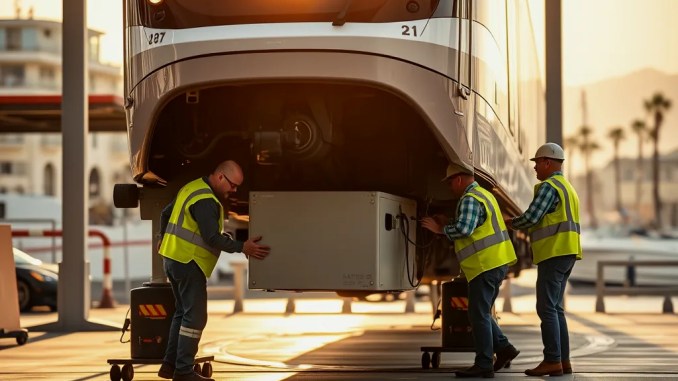
Régie Ligne d’Azur launched a public tender on 26 October 2026 to procure and maintain ADETEL traction batteries used on tram lines 2 and 3 in Nice. The authority set the submission deadline at 12:00 on 9 November 2026. The contract will run for an initial one-year period and may be renewed up to three additional times in one-year extensions, for a maximum total duration of four years. The tender specifies an annual maximum contract value of €500,000 excluding VAT and does not impose a minimum guaranteed spend.
Exactly What the Tender Covers
The contract combines supply and lifecycle maintenance for traction batteries, including spare parts provisioning, on-site intervention and remote diagnostics. The procurement follows European public procurement rules and uses a negotiated procedure with prior publication, run as a framework agreement to allow multiple call-offs without re-opening competition for each order. Interested suppliers will need to demonstrate technical capacity in high-power lithium traction cells, battery management systems (BMS), integration to tram on-board systems, and fast-charging interoperability with existing wayside chargers.
Why Lines 2 and 3 Now Need a Separate Procurement
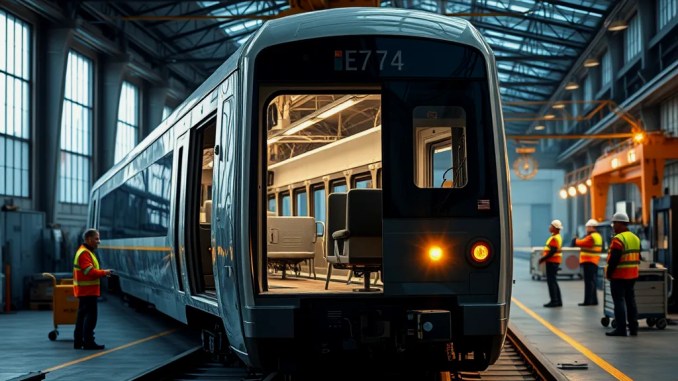
Lines 2 and 3 both operate Alstom Citadis X05 trams fitted with onboard battery systems that remove the need for continuous overhead contact lines in sensitive or historic urban sections. The 2026 procurement expands on earlier activity: a 2020 package covered spare parts and maintenance but placed ADETEL traction batteries only under a dedicated lot for line 2. The current tender explicitly extends battery coverage to line 3 as well, reflecting fleet expansion and the need to harmonize spares, diagnostics, and charging behaviors across both lines to minimize dwell-time impacts and simplify depot logistics.
Technical specifics: batteries, charging points and operational profile
The rolling stock uses battery systems that allow trams to traverse non-electrified street segments by storing energy from brief top-up charges at wayside rapid chargers. Typical operational requirements for these systems include:
Energy and power targets: sufficient stored energy to cover the longest catenary-free run between charging points plus reserve margin for delays and degraded battery performance; peak power capability to support acceleration from stations after a charge event.
BMS and diagnostics: real-time cell monitoring, state-of-health estimation, predictive failure alarms, and remote firmware update capability so operators can reduce unscheduled removals from service.
Charging interoperability: compatibility with Alstom-supplied overhead-free charging stations installed during the Citadis X05 deliveries and subsequent station rollouts, including electrical, communication and cooling interfaces.
For example, in a sample duty cycle a Citadis X05 may receive a 20–60 second high-power pulse at station stops spaced 800–1,400 meters apart; Batteries must accept that charge repeatedly without rapid capacity fade. Tender evaluation criteria typically include cycle life at that duty profile, usable energy at specified C-rates, thermal management effectiveness, and maintenance interval forecasts (mean-time-between-failure and mean-time-to-repair).
Supply-chain and historical context
The battery systems trace their lineage to technologies developed under the Centum Adetel Transportation (Holiwatt) brand; Forsee Power acquired Holiwatt’s assets in July 2021. Forsee Power and other European traction battery suppliers often supply modular packs built from prismatic or pouch lithium-ion cells with redundant monitoring layers to meet safety and continuity requirements of urban light rail operators. The 2015–2017 Alstom Citadis X05 procurement for Nice included 19 trams in an initial order and a later add-on that funded six more vehicles plus 22 wayside chargers; those chargers and the onboard battery systems operate together to enable catenary-free segments.
What bidders must submit and how evaluation will proceed
Bidders should prepare a technical dossier and an offer that addresses:
1) Technical compliance: datasheets for battery modules, full BMS architecture, integration notes for Citadis X05 platforms, thermal management drawings and test reports demonstrating cycle-life under representative rapid-charge duty cycles.
2) Maintenance proposal: scheduled maintenance tasks and intervals, spare parts availability, repair vs replacement policy, remote diagnostic tools, SLA response times for depot and on-track failures, and training for operator maintenance teams.
3) Commercial and legal: unit and framework call-off pricing, optional extension rates for renewal years, warranty terms (including calendar and cycle-based warranties), financial standing and references from comparable tramway projects.
Evaluation will likely weight technical performance and lifecycle cost heavily: robust cycle-life and low life-cycle cost per kilometer can offset higher initial unit prices. The negotiated procedure allows contracting authority and bidders to clarify or refine technical approaches before final award, which can accelerate integration planning.
Operational and maintenance examples that reduce risk
Operators commonly reduce lifecycle risk via three practical measures:
Standardize modules: using identical module families across both lines simplifies stocking spares and cross-depot interchange when vehicles rotate during service.
Implement predictive maintenance: deploy analysis on cell voltage, impedance and temperature trends; route maintenance before performance loss triggers vehicle removal.
Use staggered replacement pools: maintain a rotating set of modules that can be swapped quickly in depots, minimizing tram out-of-service time while preserving warranty conditions for used modules.
When applied, these measures lower mean-time-to-repair and keep vehicle availability high during the framework period.
Timeline and expected next steps
After the 9 November 2026 submission deadline, contracting authority staff will shortlist compliant candidates and enter negotiated exchanges where bidders can refine technical offers and pricing. Following final bids, Régie Ligne d’Azur will award the framework to the selected supplier(s) and publish the outcome. The award notice will include the identity of the winning bidder(s), contract duration, and estimated delivery timetable for first call-offs; successful suppliers will then plan integration testing with depot teams and coordinate first deliveries to align with service windows.






Be the first to comment