
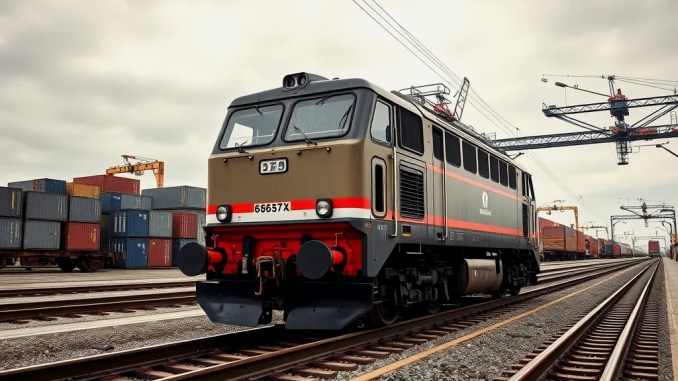
FS Logistix Expands EffiShunter 1000 Fleet with New Six-Unit Order
FS Logistix has ordered six additional EffiShunter 1000 diesel-electric locomotives from Czech manufacturer CZ LOKO, increasing its dedicated shunting and non-electrified-route traction capability. The new units bring the company’s EffiShunter 1000 fleet to 18 locomotives, strengthening yard operations, terminal shunting and regional transfer duties across Italy. The contract announcement did not disclose price or delivery dates.
Why FS Logistix Chose the EffiShunter 1000
The EffiShunter 1000 combines high tractive effort and flexible operation modes that suit mixed-duty logistics operators. CZ LOKO rates the model at up to 895 kW of installed power and a maximum service speed of 100 km/h, enabling both heavy shunting and medium-distance transfer runs. FS Logistix highlighted the model’s ability to perform in electrified and non-electrified corridors, to rescue failed trains, and to work in multiple-unit pairs for heavy freight moves.
Operational Performance and Specs That Matter
Key performance details influence how operators deploy these locomotives:
Power and speed: 895 kW and 100 km/h (manufacturer).
Tractive effort: FS Logistix cites a maximum of 267 kN, while CZ LOKO’s published data lists 262 kN; In practice, fleet managers plan layouts using the lower published figure and treat any higher value as performance margin for specific duty cycles.
Use cases: container terminal shunting, depot and port operations, inter-terminal transfers, rescue duties for stalled consists, and double-heading for long/heavy freight turns.
Practical example: pairing two EffiShunter 1000s on a heavy transfer service yields combined tractive effort sufficient for standard 1,200–1,800 tonne freight consists on mixed-gradient regional routes, reducing the need for mainline diesel-electric replacements for short transfers.
Fleet History and Deployment Across Italy
FS Logistix (and its subsidiaries such as as Mercitalia Shunting & Terminal and Terminali Italia) first procured EffiShunter 1000s following a 2016–2017 tender. The initial five units entered service in mid-2018 and operated as class 744.1 across Ravenna, Padua and Milano Smistamento. A second batch entered service in 2021, expanding coverage to Veneto, Emilia-Romagna, Lombardy and Piedmont. Two more units acquired in 2022 increased the fleet to 12 before the current six-unit order raises the total to 18.
How the New Units Fit the 2025–2029 Renewal Plan
FS Group’s strategic investment plan for 2025–2029 allocates €2.16 billion to modernize logistics assets. Targets include 110 electric traction locomotives, 25 hybrid/alternative-fuel shunters, and over 2,000 next-generation freight wagons. The six EffiShunter 1000s augment the company’s shutter pool, though FS Logistix has not explicitly stated whether these six count toward the 25 shutter target within the program.
Maintenance and Lifecycle Management
CZ LOKO Italia handles maintenance for FS Logistix’s CZ LOKO-built locomotives, enabling shorter turnaround times for scheduled servicing and rapid troubleshooting for in-service issues. Proactive lifecycle practices in use include:
1) Predictive condition monitoring: vibration and engine-parameter telemetry identify wear trends and allow planned interventions before failures.
2) Modular component swaps: standardized traction modules and control electronics speed depot repairs and reduce out-of-service days.
3) Fuel and emissions calibration: optimizing engine maps and after-treatment service schedules reduces fuel use and maintains regulatory compliance.
Operational Benefits: Costs, Emissions, Reliability
FS Logistix expects multiple measurable benefits from the expanded EffiShunter fleet:
Lower operating costs: modern diesel-electrics often deliver improved fuel consumption per ton-kilometer in Shunting compared with legacy units, and paired-unit operation avoids unnecessary mainline diesel assignments.
Improved reliability: newer platform commonality reduces spare parts variety and shortens mean time to repair.
Emissions reductions: improved engine efficiency and after-treatment systems lower NOx and particulate output per service hour; combined with route optimization, this reduces fleet-wide emissions even if units are diesel-powered.
Real-World Deployment Example and Step-by-Step Move Planning
Example scenario: a port-to-terminal transfer within a 60–90 km corridor using an EffiShunter 1000 pair.
Step 1: assign two locomotives and calculate required tractive effort for the gross train mass and gradients along the route.
Step 2: run pre-departure diagnostics and fuel/DEF checks; ensure telemetry link to operations center is active.
Step 3: plan crew change and timing to avoid peak terminal congestion, using speed profile to minimize fuel peaks while meeting slot windows.
Step 4: monitor in-service performance; if adhesion loss or excessive temperatures appear, reduce power and request a relief unit if necessary.
Step 5: on arrival, perform post-run walkaround and upload diagnostic logs for maintenance planning.
Geographic Use and Regulatory Approvals
According to CZ LOKO, the EffiShunter 1000 operates in eight European countries under various national approvals. The model holds the necessary authorizations to run on the Rete Ferroviaria Italiana-managed national network and major regional lines, enabling FS Logistix to deploy units beyond terminal limits for short transfers and rescue missions.
What This Order Means for Market Position
By standardizing on the EffiShunter 1000 for shunting and short transfers, FS Logistix gains operational flexibility across mixed-infrastructure networks and simplifies training, spares logistics and maintenance. The procurement supports a shift toward fewer, more-capable locomotives that can replace several specialist units while offering the capacity for paired operation on heavier moves.
Key Takeaways and Expected Timeline
FS Logistix’s six-unit order increases the EffiShunter 1000 fleet to 18 locomotives, strengthens terminal and transfer capabilities, and aligns with a broader renewal fleet investment program. While price and delivery dates remain undisclosed, the units will enter service across major northern Italian logistics hubs where Mercitalia and Terminali Italia operate.






Be the first to comment