
Sale details and the auction process
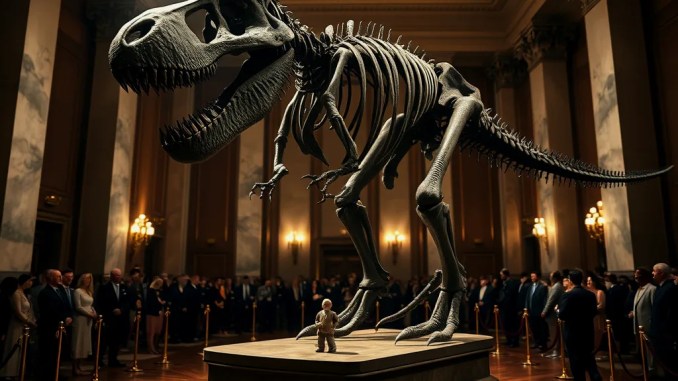
Sotheby’s in New York sold the skeleton known as “Jodi” for $47.3 million after a roughly 12-minute bidding contest that drew six active bidders. House staff reported fast, successive raises as the lot drew competitive interest; The winning buyer’s identity remains private. The auction emphasized provenance, preparatory conservation, and museum-readiness—three practical selling points collectors and institutions use to justify high bids.
What the skeleton includes and which parts are original
Sotheby’s catalogued Jodi as composed of approximately 191 fossilized bone elements. Conservators described a nearly complete skull with well-preserved sutures and dental series, intact vertebrae through the cervical and dorsal column, and largely articulated limb elements. Those preserved surfaces—patination, microfracture patterns, and joint morphologies—retain the anatomical signals scientists need for taxonomic and growth-stage studies.
Why the taxonomic debate matters: Nanotyrannus vs. juvenile T. rex
Two rival hypotheses shape current discussion. One treats Nanotyrannus as a distinct small-bodied tyrannosaurid genus with consistent adult morphologies; the other interprets specimens classified as Nanotyrannus as juvenile or subadult Tyrannosaurus rex individuals showing ontogenetic features. Jodi’s well-preserved skull and postcrania let researchers quantify traits such as skull proportions, snout-to-orbit ratios, tooth count and serration density, and histological growth markers—data that can support either hypothesis depending on results.
Factors that pushed the price to $47.3 million
Collectors and institutions weighed multiple clear value drivers:
Rarity: Sotheby’s noted Jodi represents one of only three specimens attributed to Nanotyrannus in museum and commercial records, dramatically limiting supply.
Exhibition readiness: Extensive preparatory work reduced the need for immediate stabilization or reconstruction, cutting short-term costs for buyers and increasing display value.
Research potential: A near-complete skull and associated skeleton provide morphometric and histological targets—measurements and thin-sectionable bones—that yield publishable data.
Marketplace dynamics: Recent headline sales for high-profile theropod skeletons set a comparable range; Jodi landed near the top of that band because it combined scarcity with scientific usefulness.
How Jodi compares to other specimen specimen headlines
Compare practical metrics and outcomes rather than sensational headlines:
Gus (T. rex) — Sold previously for $50.1 million, represented a large, mature T. rex with museum-grade completeness and a long display-ready restoration history.
Jodi (this sale) — Cataloged as Nanotyrannus, $47.3 million, nearly complete skull offering data critical to ontogenetic studies.
Apex (Stegosaurus) — Sold for $44.6 million; unique in morphology but less directly relevant to tyrannosaur taxonomic debates.
Immediate scientific steps after purchase
New ownership typically triggers a sequence of scientific and curatorial actions. Expect these steps:
1. Legal and ownership transfer: Clear title and customs paperwork if crossing jurisdictions.
2. Condition assessment: Detailed conservation report documenting existing stabilization, consolidants, and any modern repairs.
3. High-resolution imaging: Photogrammetry, micro-CT of skull elements, and surface laser scanning to create a 3D archive for morphometrics and virtual sharing.
4. Histology and microstructure sampling: Targeted thin sections from long bones or ribs to determine growth rings, vascularization patterns, and age estimates.
5. Morphometric analysis: Geometric and linear metrics comparing skull shape, tooth counts, and limb proportions against known juvenile and adult T. rex datasets.
6. Peer-reviewed publication: Jointly authored papers that present the imaging, histology, and morphometrics; data deposition in public repositories where possible.
What researchers can learn from the skull and teeth
Jodi’s skull preserves characters used in formal diagnoses: premaxillary and maxillary tooth counts, interorbital breadth, and basicranial structure. Teeth provide wear patterns and serration densities that indicate feeding mechanics and ontogenetic dietary shifts. With histological age estimates from cortical bone, researchers can place Jodi on a growth curve and test whether observed skull proportions match juvenile T. rex trajectories or represent a distinct adult morphology.
Public access, museums, and ethical considerations
Buyers range from private collectors to museums. If a private owner loans Jodi to a museum, scientific access usually continues; If the specimen remains privately sequestered, access can become sporadic. Ethical practice that preserves scientific utility often includes long-term loans, data-sharing agreements, and permitting qualified researchers to sample destructively for histology under controlled conditions.
How this sale affects fossil market and research
High-profile transactions like Jodi shape both demand and research priorities. They signal to collectors that rare, well-documented specimens command premium prices and they motivate museums to secure funding or partnerships. Simultaneously, scientists accelerate requests for imaging and sampling to capitalize on preserved anatomical information before potential restrictions arise.
Frequently asked questions answered directly
Is Jodi definitively Nanotyrannus? Sotheby’s listed it as Nanotyrannus, but scientists will test that claim using morphometrics and bone histology; The sale itself does not settle the taxonomy.
Will the specimen be available for study? Availability depends on the buyer’s policy; Many high-end buyers collaborate with institutions to produce publications and exhibits, but access is not guaranteed.
Does high sale price harm science? It can restrict physical access if the specimen enters a private, inaccessible collection; however, imaging and data-sharing agreements often mitigate that risk and advance research regardless of ownership.
Concrete research questions Jodi can answer
Researchers can use Jodi to test measurable hypotheses:
– Does skull allometry follow juvenile-to-adult T. rex trajectories or cluster separately when plotted against long-bone histological age?
– Do premaxillary tooth counts and serration patterns match juvenile T. rex ontogeny or indicate a stable adult condition consistent with a separate taxon?
– What do bone microstructure and growth rings reveal about maturation rate and life history compared with documented T. rex specimens?
What to watch for next
Look for publication of a conservation report, CT datasets released to repositories, and a peer-reviewed taxonomic or histological study within 12–24 months. Public exhibition or long-term loan announcements also typically follow after ownership and conservation steps conclude.








Be the first to comment