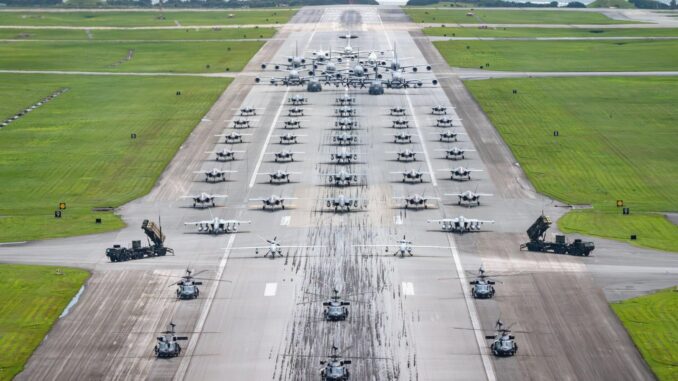
As the US Air Force focuses its modernization goals on cost-effective operational sustainment and replacement systems, it must respond to Congressional demands for infrastructure protection and operational capability security. This process is not limited to the retirement of legacy platforms, but includes significant decisions, mainly in critical fleets such as the A-10, F-15E, RQ-4 Global Hawk and KC-46A. In particular, the fiscal year 2026 budget proposal restricts the retirement of existing aircraft and may delay some planned operational plans.
A-10 Restrictions on Retirement
Congress has taken a clear stance against the reduction of A-10 Thunderbolt II (Warthog) aircraft. The bill explicitly prohibits the use of fiscal year 2026 funds to retire these aircraft or downsize the fleet. It also includes a provision requiring Congress to be notified at least 30 days in advance before any aircraft is removed from service. The aim of this regulation can be summarized as preserving the air support capability and not compromising the existing capacity.
The Air Force remains on target to retire a total of 162 A-10s, but Congress has ensured that at least 103 aircraft will remain in service through September 30, 2026 at the latest. However, 93 of these aircraft are planned to continue to serve as main mission aircraft. A-10s still play a critical role in indispensable missions such as refueling and air defense support, and so the timing of their retirement is being carefully monitored.
Restrictions on the Retirement of F-15 Aircraft
Initially, a faster downsizing of the F-15E Strike Eagle fleet was envisaged. However, in line with new decisions, the planned retirements in 2026 have been halted and these numbers have been postponed to 2027-2028. It can be summarized as follows:
- 2026: Retirement will not materialize
- 2027: Up to 21 aircraft
- 2028: Up to 30 aircraft
These adjustments are aimed at preserving the operational capability of next generation fighters such as the NGAD (Next Generation Air Dominance) and the F-15EX. In addition, the integration of the number of F-15E fighter aircraft carrying the AGR-20 laser-guided rocket and other advanced systems is underway. This approach focuses on guaranteeing continuity of technological updates and a multi-layered force structure.
Limitation on Retirement of UAVs
Congress has decided to postpone the retirement of the RQ-4 Block 40 Global Hawk UAVs until 2030. Despite the design of space-based intelligence and surveillance systems, the use of these platforms continues due to current operational needs and regional missions. UAVs are critical for vertical operational requirements and shadow operations, providing flexibility in fleet age and redundancy capacity.
UAV policy shifts include reallocations for transport and refueling aircraft due to aging aircraft and UAV fleets. Delays in deliveries of the KC-46A Pegasus mean that the KC-135 should remain the primary mission aircraft, requiring realignments to ensure that the wings have sufficient personnel and training capacity. At the same time, the fleet balance is being maintained by setting new minimum levels in the inventory of C-130 transport aircraft.
New Arrangements in Transportation and Support Capabilities
The aging fleet structure and the goal of combined operational capacity require a careful balance across platforms such as the KC-135, C-130 and KC-46A. Delays in KC-46A deliveries have forced some missions to be rescheduled in the face of age-related risks. In this context, minimal safety margins are maintained for transport and refueling capacity; keeping aircraft in operations for their analyzed functional duration is a priority.
Established objectives include retiring some aircraft for high-demand operations and ensuring continuity of global operations. These decisions are critical to ensure a coherent fleet for long-range operations and first-responder capacity for regional and global missions.
NGAD and Transition Plans to be Sustained
Next-generation aircraft such asthe NgAd and F-15EX offer a transition scenario focused on maintaining superior combat superiority, avoiding decisions to retire existing aircraft. In this process, inventory management, utilization intensity and training capacity stand out as central issues. The minimum in-service periods set for critical platforms such as the A-10, F-15E and RQ-4 support operational security and global continuity of operations objectives.
Operational Security and Capacity Balance
While aiming to increase operational security and available capacity, the US Air Force is updating its decisions by leaving wiggle room for the aging fleet. This strengthens the ability to react quickly to internal and external threats, while strengthening the training and logistical support network required for the integration process of the renewed platforms. Thus, a coordinated force structure is being created in the areas of transportation, air support and intelligence gathering.
Strategic Outcomes and Future Scenarios
restrictions between 2026 and 2028 may slow the pace of modernization to some extent, but the integration of systems such as NGAD and F-15EX provides a strong framework for maintaining air superiority. The 30-day Congressional notification requirement for the A-10 stands out as a critical control mechanism for operational flexibility and smart fleet management. This process requires a serious focus in terms of human resources, training and supply chain.
US Air Force Modernization and Retirement Policies
Current budget discussions aim to simultaneously strengthen modernization goals and operational capacity security. Decisions on the A-10, F-15E, RQ-4 and transport aircraft bring together the integration of advanced technologies and balancing fleet management.
A-10 Restrictions on Retirement
Congress has taken a clear stance against the reduction of the A-10 and is not using the budget flow in this direction. the 30-day advance notice requirement and the requirement to keep at least 103 aircraft in service preserve the planability of retirement. However, the target of 162 aircraft indicates limited downsizing.
Restrictions on the Retirement of F-15 Aircraft
the 2026 plans have been postponed, with a maximum of 21 F-15E retirements in 2027 and 30 in 2028. The integration of NGAD and F-15EX ensures that operational capability is maintained during these years.
Limitation on Retirement of UAVs
TheRQ-4 Block 40 Global Hawk retirement has been extended until 2030, while operations continue due to space-based solutions and regional missions. The UAV restriction provides fleet balance in the face of aging aircraft and UAV fleets.
Regulations for Transport and Refueling Aircraft
Risks from critical delays favor the combination of KC-46A and KC-135. Decisions to retain the KC-135 as the primary mission aircraft and maintain adequate staffing and training capacity allow for flexible reallocation of transport aircraft. Operational safety is also being enhanced by setting new minimum levels in the C-130 inventory.
Future Perspective and Strategic Implications
Integration of platforms such as the NGAD and F-15EX ensures air superiority is maintained. The limited retirement of the A-10 and planned deferral of the F-15E support fleet management focused on operational security and global continuity of operations. Training, logistics and human resource requirements play a critical role in this process, while the integration of upgraded sensors, laser-guided munitions and space-based intelligence solutions strengthens the multidimensional operational capability of the forces.