
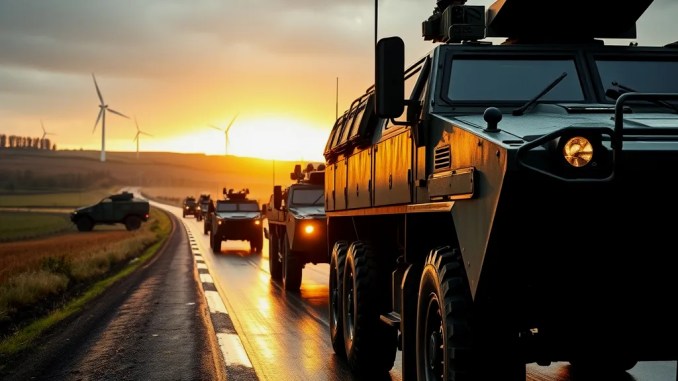
Germany and the Netherlands have exercised a procurement option to add 69 Boxer RCT30 (Schakal) vehicles to their joint program, bringing the combined order to 291 vehicles. OCCAR used the option included in the 2025 framework contract to place an additional order with ARTEC, the Rheinmetall–KNDS Deutschland joint venture that manufactures the Boxer family. The follow-on contract splits 35 vehicles for the Bundeswehr and 34 for the Royal Netherlands Army, with deliveries scheduled between May 2032 and November 2033.
Program background and how the option was used
The original OCCAR contract signed in October 2025 covered 222 vehicles: 150 for Germany and 72 for the Netherlands, with a headline value of roughly €4.7 billion and Rheinmetall’s scope representing about €3.4 billion. That master contract explicitly included options for up to 200 additional vehicles. On 24 June 2026 the German Budget Committee approved the first of those options; Both governments publicly confirmed the additional 69 vehicles later in August.
Why this tranche matters for production planning and industry
Rheinmetall reported that its share of the new workload corresponds to “hundreds of millions of euros,” giving suppliers and sub-contractors earlier production visibility. Dr. Björn Bernhard, head of Rheinmetall’s Vehicle Systems division, said exercising the option signals customer confidence in the system and stabilizes medium-term industrial planning. Practically, the new order smooths production rate ramps, lets suppliers commit capacity and materials earlier, and reduces the risk premium in long‑lead procurements such as turrets, fire control electronics and missile integration.
Delivery schedule and logistics implications
Deliveries will occur between May 2032 and November 2033. That phased window lets ARTEC sequence final assembly, test firing, acceptance trials and army handover in batches to mitigate bottlenecks Each delivered vehicle will undergo acceptance testing with customer‑specified checklists (mobility, communications, armor integrity, weapon system performance). Fielding plans will likely include staged unit training and integration of logistics support packages: spare parts kits, maintenance training for workshop crews, and software updates for mission systems.
What Schakal (Boxer RCT30) combines and why it appeals
The Schakal design pairs the Boxer eight‑wheel modular platform with the Puma infantry fighting vehicle’s 30 mm turret concept, yielding a wheeled IFV with robust firepower and strategy mobility Key components include Rheinmetall’s 30 mm MK 30‑2/ABM automatic cannon and the MELLS anti‑tank guided missile (ATGM) system, the German designation for missiles in the Spike family. The vehicle carries a crew of three plus six dismounts—nine personnel total—enabling the Schakal to move infantry quickly and then provide direct fire support once troops dismount.
Combat capabilities: weapons, protection, and mission roles
The MK 30‑2/ABM automatic gun fires programmable air‑burst munitions as well as conventional rounds, allowing engagement of infantry behind cover, light vehicles and some low‑flying aerial threats. The MELLS/Spike LR suite extends the vehicle’s reach against armored threats. Modular Boxer protection and add‑on armor packages permit tailoring to threat levels — from mine and IED protection for patrol roles to enhanced ballistic arrays for high‑threat manoeuvre operations. Roles encompass mechanized infantry transport, urban and open‑country fire support, reconnaissance in force, and convoy escort.
Operational and tactical impacts for Germany and the Netherlands
Adding 69 vehicles raises Germany’s planned Schakal fleet to approximately 185 and the Netherlands’ to about 106. This increases unit availability for brigade‑level formations and enables broader standardization across multinational NATO exercises. On tactical doctrine, the Schakal supports doctrines that emphasize rapid road‑marching with heavy fire support on arrival: wheeled mobility reduces strategic lift needs and improves operational reach along Europe’s road networks compared with tracked IFVs, while the turreted 30 mm provides sustained direct fire capability.
Procurement economics and program timeline to full capability
The initial contract and options structure spread investment over time, letting ministries align budgets while protecting industrial capacity. With deliveries extending to late 2033, full operational capability across the enlarged fleets depends on concurrent training pipelines, depot upgrades and logistics stockpiles. Realistic timelines for achieving unit readiness typically trail final delivery by several months to a year, because of formation training, combined arms integration and live‑fire certification of crews and maintenance staff.
Common questions users search about Schakal and Boxer RCT30
How does Schakal differ from the base Boxer? The Boxer family uses interchangeable mission modules on a common wheeled chassis. Schakal (Boxer RCT30) integrates a heavier, turretted 30 mm weapons suite and ATGM capability tailored for the mechanized infantry role, while many Boxer variants serve logistics, command, ambulance and direct support roles.
Is the 30 mm cannon effective against modern armour? The 30 mm MK 30‑2 is effective against lightly armored vehicles, combat engineering threats and personnel; combined with ATGMs like MELLS/Spike LR it gives the vehicle credible anti-armour capability against main battle tanks’ flanks and lighter AFVs at operational ranges.
Will the order spur further European cooperation? Yes — exercising options and increasing unit counts reinforces the industrial base, encourages shared logistics standards and typically leads to further interoperability work across partner armies for maintenance, training and spare‑parts pooling.
Conclusions and what to watch next
Exercising the option for 69 additional Boxer RCT30s strengthens the German‑Dutch Schakal program by increasing fleet size, stabilizing industrial workloads and accelerating fielding plans Watch for follow‑on developments: detailed delivery schedules from ARTEC, training and unit conversion announcements from the Bundeswehr and the Royal Netherlands Army, and any additional national options or export interest that could push orders beyond the 291 total.







Be the first to comment