
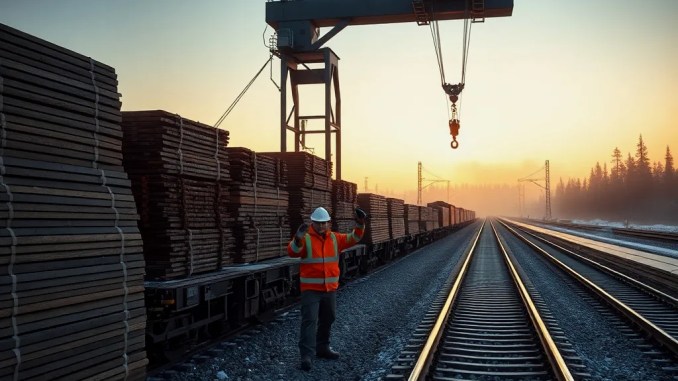
ONT C issues two separate tenders for rails and hardwood ties
Ontario Northland Transportation Commission (ONTC) published two distinct procurement notices on 29 October 2026 to secure materials required for its 2027 track renewal program: continuous welded rail (CWR) and hardwood railroad ties. The commission split the purchase into a rail package and a tie package compete so bidders can price to focused scopes and to allow suppliers with specialized production or logistics capacity to effectively.
Key quantities, delivery windows and conditional maximums
ONTC set financed baseline quantities intended to be delivered in 2027, and also defined budget-dependent upper limits that would be purchased only if additional funding is approved. Baseline and maximum quantities include:
Baseline (financed) quantities: 96,000 ft of CWR (115 RE), 21,120 ft of 80-ft 115 RE rail, and 60,000 eight-foot hardwood ties. Suppliers must deliver baseline rail quantities by 30 April–30 June 2027 depending on package; baseline ties by 30 June 2027.
Budget-dependent maximums: up to 192,000 ft of CWR, up to 52,800 ft of 80-ft rail, and up to 100,000 eight-foot hardwood ties. ONTC will only exercise these increases through formal contract amendments or other authorized mechanisms once funds are available.
Procurement schedule, submission rules and evaluation
Both tenders share a submission deadline of 30 November 2026 at 14:00 EST. Questions are due by 23 November; ranking of bidders is expected 7 December; contracts targeted for signature by 31 December 2026.
Evaluation uses a 110-point scale: 60 points for technical proposal and 50 points for price. Proposals that score below 30 technical points are eliminated from price consideration. Local benefit and knowledge account for five technical points. Bidders must submit Ontario Purchasing Act compliance forms and fully disclose manufacture and export countries plus tariff classifications. Estimated customs duties, tariffs and import fees must be included in the bid price; discretionary exemptions are not excluded from the calculation.
Technical requirements for rails and delivery logistics
Rails must meet AREMA Section 4 standards and be new 115 RE high-strength steel with approximately 370 HB hardness. ONTC expects CWR to arrive in long welded strips (~1,600 ft). The supplier must provide a CWR train with an empty discharge car at one end to facilitate unloading at ONTC facilities.
The rail package also includes factory-made insulated rail assemblies and insulated frog/guard components where specified. Although baseline funding covers mostly 115 RE material, the tender defines budget-limited upper quantities for 136 RE rails and related fittings to allow flexibility if works require different rail sections.
Hardwood tie specifications and preservative treatment
Ties must be boxed heart (7 x 9 in) hardwoods—acceptable species listed as beech, maple, ash, oak and birch. Treatment must be either 50% creosote/50% oil by 7 lb/ft3 retention or pressure-treated with Kopper creosote-oil solution. Any ties treated with ACZA require ONTC written approval. Each tie must be stamped with manufacture year and railroad ID for traceability.
Contract structure, options and term limits
Each award begins as a one-year contract with ONTC holding up to four one-year extension options (maximum total term of five years). ONTC does not guarantee purchase of total quantities and reserves the right to procure like items from other suppliers if necessary. Contract flexibility allows ONTC to stagger purchases against the financed baseline and to expand quantities if additional funds become available.
How these procurements map to ONTC’s 2027 renewal program
The 2027 track renewal plan allocates 96,000 ft of new CWR and approximately 59,880 eight-foot mainline hardwood ties across several subdivisions — Temagami, Ramore, Kirkland Lake and Island Falls — which closely matches the tender baseline amounts. Additional ties are earmarked for Englehart and Moosonee staging areas. By aligning baseline tender quantities with the renewal program’s estimated needs, ONTC aims to reduce procurement-to-install timing while retaining the ability to scale up with budget approvals.
Regional deployment estimates and example allocation
ONTC estimated tie allocations by area for 2027 mainline work: Temagami ~15,900; Ramore ~10,980; Kirkland Lake ~15,000; Island Falls ~18,000; total mainline ~59,880. Depot and siding tie reserves include Englehart ~7,000 and Moosonee ~2,500. These allocations illustrate how baseline procurement will be distributed across field crews and staging yards during the renewal season.
Practical considerations for bidders — production, export and customs
Bidders should match production schedules with ONTC’s delivery windows and anticipate rail shipping in long welded lengths requiring rail-unloading equipment. For international suppliers, clearly identify the country of manufacture and export, provide tariff classifications for each line item and include all estimated import-related charges in the bid. ONTC may act as the registered importer for shipments when operationally necessary.
Why splitting tenders benefits ONTC and suppliers
Splitting the procurement allows ONTC to: control financing and risk across distinct material streams; let specialist manufacturers bid the rail package without tie-production complexity; and enable tie producers with local drying and treatment capacity to compete. For suppliers, targeted tenders reduce scope ambiguity, let them propose optimized logistics and lower the risk of cross-subsidizing unrelated deliverables.
Immediate actions for interested suppliers
Interested firms should:
1. Verify technical compliance: confirm AREMA 115 RE metallurgy, hardness and welded-length capability for rail; verify boxed-heart hardwood species, dimensioning and preservative retention process for ties.
2. Confirm logistics: ensure ability to load and ship long CWR strips, supply a CWR train with an empty discharge car if required, and meet ONTC delivery windows in April–June 2027.
3. Prepare customs and tariff documentation: list manufacture/export countries and tariff codes; calculate and include foreseeable duties and fees in the price.
4. Build pricing for optional expansion: present unit prices that scale if ONTC exercises the budget-dependent maximums, and demonstrate production ramp capacity to meet larger orders within the same delivery timelines.
Summary of critical dates and bidder obligations
Key dates: questions by 23 November 2026; proposals due 30 November 2026 at 14:00 EST; rankings 7 December 2026; contracts signed by 31 December 2026. Bidders must score at least 30/60 on technical criteria to remain in contention and include import costs and compliance forms as required by Ontario procurement rules.
These tenders provide a clear pathway to source the rails and ties ONTC needs for its 2027 track renewal, while preserving flexibility for the commission to expand purchases as funding allows. Suppliers that align production, treatment, stamping and export documentation with the tender’s technical and logistical requirements will present the most competitive offers.







Be the first to comment