
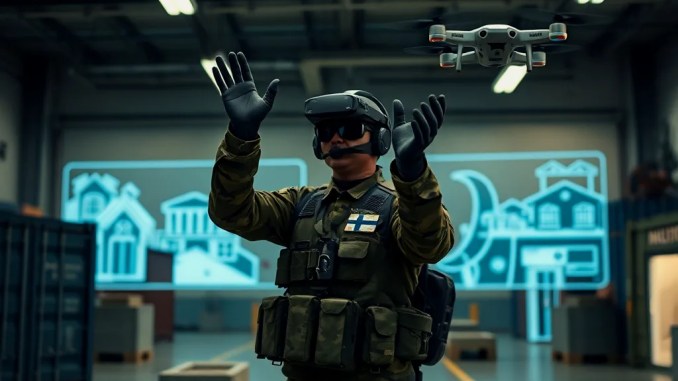
Overview of the Finland–Varjo Pilot for Drone-Response Training
Finland’s Defense Forces launched a pilot program with Helsinki-based Varjo to train soldiers to detect and respond to small FPV drones and loitering munitions using mixed reality (MR). The program uses Varjo’s XR-4 series headsets to overlay high-fidelity virtual threats onto real training ranges. Project planning began in February, and the pilot was publicly announced on 29 October. Officials have not declared the unit involved, headset quantities, contract value, or exact pilot duration.
Why MR Is the Right Tool for Small-Drone Threat Training
Small FPV drones are difficult to spot until they are close; the human visual system and standard optics struggle with size, speed and angular motion at distance. MR addresses those limitations by:
1) presenting virtual targets at photorealistic resolutions and contrast so trainees learn realistic detection cues;
2) enabling repeatable scenarios that replicate approaches, strafing runs and loitering patterns without risking live munitions or expensive hardware;
3) integrating with real terrain and cover so soldiers practice tactics, movement and communications under realistic conditions; and
4) allowing rapid adjustments to threat parameters (size, speed, visual signature) and immediate, measurable feedback on detection timelines and engagement decisions.
How the XR-4 Hardware Reproduces Realistic Drone Visuals
Varjo’s XR-4 headsets combine outward-facing cameras with extremely high-resolution displays and low-latency rendering. That combination lets virtual drones appear at realistic distances and sizes inside a trainee’s real view. For example, Varjo claims the XR-4 resolution supports realistic detection scenarios for 5-inch FPV drones at typical engagement distances. In practice this means trainers can set approaches where a 5-inch drone only becomes visible at a realistic range, forcing soldiers to practice scanning patterns and team coordination rather than relying on obvious, oversized targets.
Designing Repeatable, Measurable Training Scenarios
Effective MR training designs follow step-by-step scenario construction:
Step 1 — Define learning objectives: detection thresholds, communication timelines, counter-drone maneuvers, and safe-recovery procedures.
Step 2 — Map the environment: capture the training ground geometry and common cover positions; use that map to place virtual approach corridors.
Step 3 — Calibrate visual signatures: tune virtual drone size, contrast and motion profiles so the simulation matches measured visibility ranges for real systems.
Step 4 — Instrument and record: log time-to-detection, head orientation, and team communications to provide objective after-action review (AAR) metrics.
Step 5 — Iterate: increase scenario complexity (multiple simultaneous drones, loitering munitions, degraded visibility) and measure learning transfer into live drills.
Examples and Use Cases from Europe and Ukraine Engagements
Varjo has deployed XR systems with European militaries and defense firms. In March, Varjo and Fynd Reality supplied 39 XR training systems to Ukrainian forces—targeting Leopard 2A4 tank crews and armored vehicle teams. By June, Varjo added an anti-drone simulator to those systems. Rheinmetall integrated XR-4 headsets into deployable ground training simulators as well. These real-world integrations demonstrate MR’s utility across platforms: crewed vehicle gunnery, dismounted small-arms teams, and specialized counter-UAS units.
Measurable Benefits for Units Training Against FPV and Loitering Munitions
Units that adopt MR-based training can expect measurable improvements in multiple areas:
Detection performance: earlier and more reliable visual detection of small targets;
Decision-making: faster, more consistent target identification and escalation protocols;
Tactical coordination: improved communication patterns and sector scanning routines during assaults or defensive postures;
Cost and safety: fewer live-drone sorties, lower equipment wear, and safer practice of risky countermeasures.
Technical and Operational Considerations for Adoption
Implementing MR training at scale requires addressing technical and operational constraints:
Calibration: correlate simulated visual signature to measured contrast and angular size of real drones under varying light conditions.
Latency and tracking: ensure head-tracking latency stays below human-perceptible thresholds to prevent motion sickness and maintain cue fidelity.
Integration: connect MR systems with AAR tooling, range instrumentation and comms so instructors can inject scripted events and capture performance data.
Doctrine and syllabus: codify scenarios into unit training plans and certify instructors to run safe, standardized MR exercises.
How Trainers Should Structure an MR Anti-Drone Module
Design a progressive module spanning classroom, MR range, and live verification:
Phase A — Classroom: sensor signatures, FPV etc. autonomous behaviors, and countermeasure options.
Phase B — MR range: repeated detection and response drills with increasing complexity; team roles and casualty-driven interruptions.
Phase C — Hybrid live verification: limited live-drone flights or tethered systems to verify transfer of MR-learned detection and engagement procedures to real hardware, monitored with objective metrics collected during MR phases.
Potential Metrics to Track for Training Effectiveness
Track objective, actionable measures:
Mean time to first detection (MTFD): average seconds between drone appearance and trainee acknowledgment.
Detection probability vs. range: percent of detections binned by distance.
Communication latency: time from detection to command relay and action.
Error modes: false positives, missed detections, incorrect engagement choices; use these to refine scenario difficulty and teach pattern recognition.
Limitations and How to Mitigate Them
MR is not a perfect replacement for live drills. Known limitations and mitigations include:
Visual-sensory mismatch: lack of acoustic or aerodynamic cues—mitigate by adding synthetic audio, limited props (fans, wind) and hybrid live verification phases.
Environmental fidelity: weather effects and glare may differ—collect empirical visibility data across light conditions to tune the simulation.
Overreliance risk: physical trainees may learn to expect perfect simulation parameters—counter by injecting randomized sensor noise and scripted failures.
What the Finland Pilot Could Prove and Next Steps
The pilot will test whether MR can deliver repeatable, measurable improvement in small-drone detection and response at brigade/brigade scale. Useful outcomes include validated metrics for MTFD improvements, syllabus templates for rapid scaling, and integration methods for instructor-led and automated scenario injection. If successful, expanding MR into battalion-level training and embedding MR modules into national counter-UAS doctrine will follow.
Keywords and Search Terms That Match This Coverage
Use these targeted search phrases to surface content in featured snippets and People Also Ask: “mixed reality anti-drone training,” “FPV drone detection training,” “Varjo XR-4 military use,” “mixed reality counter-UAS scenarios,” “mean time to detection drones,” and “hybrid MR live drone verification.”







Be the first to comment