
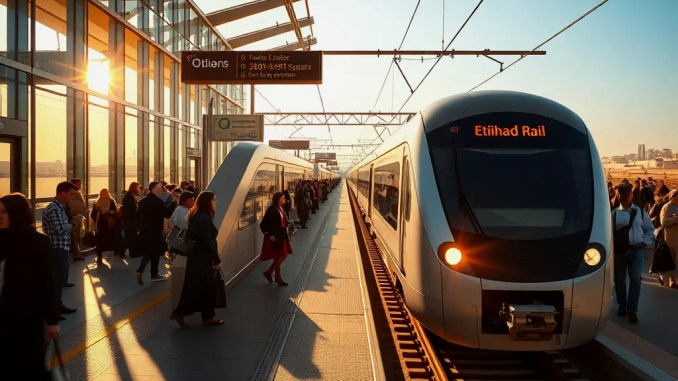
Etihad Rail reports 120,000 tickets sold in first 30 days after four-station launch
Etihad Rail sold 120,000 tickets between 30 September and 30 October 2026 after opening Dubai Al Yalayis and Sharjah’s Al Dhaid station, extending passenger service from two to four stations. The company clarified the figure refers to tickets sold, not completed journeys or unique passengers; ticket sales were not broken down by route or class.
How the 120,000 figure compares with earlier sales
The initial passenger services began 30 June 2026 on the Fujairah–Abu Dhabi route. Before the opening day more than 10,000 tickets had been sold, and by 3 August Etihad Rail reported cumulative sales exceeding 70,000 for the two-station period. Those earlier totals cover a different calendar span and a different station count, so direct daily-sales comparisons with the 30-day figure would mislead. For clarity:
Timeline snapshot: 30 June — Fujairah–Abu Dhabi services start; pre-launch sales surpassed 10,000. August 3 — cumulative sales for the two-station service topped 70,000. 30 Sept–30 Oct — four-station sales tally: 120,000 tickets.
Why ticket-sold counts differ from passengers carried and why that matters
Counting tickets sold inflates raw demand signals relative to carried because one passenger may buy multiple tickets, change or cancel journeys, or buy advance and return tickets. Operators may also count promotions, partner-sold inventory, and multi-leg QR-ticket transactions once rather than per boarding. Etihad Rail did not publish conversion metrics (tickets sold → trips completed), so analysts must treat the 120,000 figure as a sales-volume indicator rather than evidence of ridership or modal shift.
Connections and first-mile/last-mile integration that drive ridership
Integration with local transit boosts the practical value of the rail service and likely contributed to sales growth. Examples of operational integration and passenger convenience include:
Dubai — a 375‑metre pedestrian bridge opened on 16 October linking Al Yalayis station with Dubai Metro Red Line’s Jumeirah Golf Estates station, creating an easy five-minute walk transfer. Nol integration allows single QR-code ticketing for combined metro and train trips.
Abu Dhabi — feeder shuttle services connect Mohammed bin Zayed City Station with Reem Mall, ADNEC, Corniche (ADNOC HQ), and Yas Island hotels and attractions.
Sharjah / Al Dhaid / Fujairah — intercity and local bus links, including routes to Al Madam, Al Sajaa and central Sharjah, provide additional access to rail stations.
Planned network growth and key opening dates to watch
Etihad Rail’s published rollout schedule targets phased openings that will expand the network from the current stations four to an 11-city/regional passenger network when complete. Notable planned dates (company timetable):
30 November 2026 — planned opening of Liwa and Madinat Zayed stations in Al Dhafra region, timed to align with regional events and festival season.
30 December 2026 — further Al Dhafra stations scheduled to enter service.
30 March 2027 — Sharjah station planned to open, completing next phase of network expansion.
What the sales numbers imply for daily demand and operations
The 120,000 tickets recorded over 30 days average roughly 4,000 tickets per day. That average provides a baseline for operational planning—train frequency, staffing, cleaning cycles, and station crowding management—but only if adjusted for seasonality, one-off events, promotions, or advance-bundle ticketing that distort daily patterns. Operators typically convert ticket-sale averages into capacity plans by modeling peak vs off-peak load factors, expected no-show rates, and modal-split shifts driven by last-mile integration.
Practical examples and scenarios operators may use to convert sales into operational decisions
Step-by-step approach to translate ticket sales into service adjustments:
1) Segmentation — separate advance purchases (return/season tickets) from single-trip sales to identify likely same-day load. 2) Peak detection — analyze hourly sales and station-origin data (where available) to assign additional trainsets to morning/evening peaks. 3) Feeder coordination — align shuttle and metro timetables with scheduled train arrivals to shorten transfer penalties and reduce no-shows. 4) Dynamic pricing and capacity allocation — open additional capacity on high-demand services and use targeted fares to smooth peaks. 5) Post-launch feedback loop — collect on-board and station passenger counts and reconcile with ticket scans to calibrate carried-passenger estimates.
Limitations of the public data and recommended data points to publish next
Publicly reported ticket-sales totals provide early commercial signals but leave critical questions unanswered. For better transparency and planning, Etihad Rail could report:
– Tickets redeemed (actual boardings) etc. tickets sold
– Breakdown by origin–destination pairs and ticket class
– Daily or hourly sales series to identify peaks and event-driven spikes
– No-show/cancellation rates and volume refunds
– Modal transfer uptake (how many passengers combine train + metro/bus under the QR workflow)
Short-term outlook and what to watch
Expect near-term demand to respond to: festival-season travel in Al Dhafra after the planned late-November openings, targeted integration campaigns (Nol QR joint sales), and any promotional bundles tied to hotels or events on Yas Island and Abu Dhabi. Watch for follow-up releases from Etihad Rail that separate tickets sold from journeys carried, and for operational indicators such as added train frequencies, new shuttle contracts, or changes in fare rules that confirm sustained ridership rather than short-term sales spikes.
Key data summary
Reported ticket sales (30 Sep–30 Oct 2026): 120,000 (tickets sold; not equal to trips carried)
Earlier two-station cumulative report (to 3 Aug 2026): more than 70,000 (covers different period and station count)
Average implied sales per day (30-day window): ~4,000 tickets/day (before adjustments for seasonality, bundles, or cancellations)









Be the first to comment