
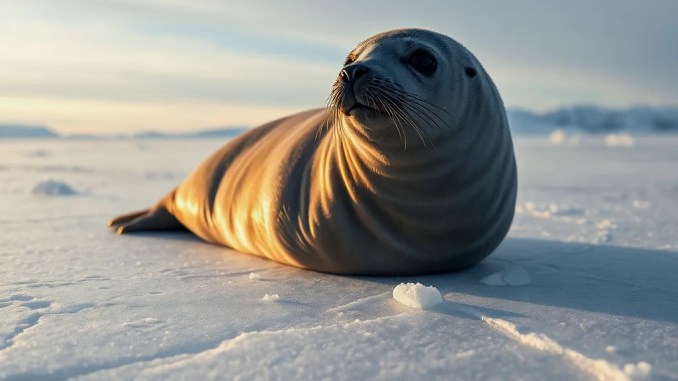
Lake Baikal hosts a unique population of approximately 100,000 freshwater seals whose origin and persistence reveal a remarkable story of migration, isolation, and specialized adaptation.
How did Baikal seals reach the lake?
Genetic analyzes show Baikal seals (Pusa) sibirica) descended from a common ancestor with Arctic ringed seals roughly 400,000 years ago. Rather than being relics left by an ancient sea, their ancestors migrated inland during glacial periods. The most plausible route follows the Yenisei river system and associated meltwater corridors that temporarily linked the Arctic Ocean drainage to interior basins. As glaciers reconfigured landscapes, seals exploited freshwater pathways and advanced upstream; subsequent climatic shifts and the disappearance of connecting channels stranded a founder population inside Lake Baikal and initiated genetic isolation.
What evidence supports the river-migration scenario?
Multiple lines of evidence converge on this scenario: mitochondrial and nuclear DNA place Baikal seals as a sister lineage to Arctic ringed seals; paleohydrology reconstructs episodic river connections and proglacial lakes facilitating faunal movement; and the timing inferred from molecular clocks postdates Lake Baikal’s initial formation, consistent with migration during Pleistocene glacial cycles. Together, these data explain how a cold-adapted, marine-origin seal established in a remote freshwater basin.
How are Baikal seals adapted to deep, cold freshwater?
Baikal seals show physiological and behavioral adaptations for deep dives and cold conditions. They routinely dive to about 400 meters and can remain submerged for up to 70 minutes. Key adaptations include high myoglobin concentrations for oxygen storage, a compact body shape that reduces heat loss, and thick blubber that insulates in near-freezing water. Behaviorally, they time foraging dives to exploit dense layers of prey and use under-ice breathing holes seasonally. These adaptations parallel those of marine ice-associated seals but have specialized around a freshwater prey base and the unique vertical structure of Baikal’s water column.
What do Baikal seals eat and how does the lake’s food web support them?
Baikal seals rely heavily on endemic fish species, with the transparent golomyanka (Cottocomephorus spp.) comprising more than half of their diet in many studies. Golomyanka lives in deep, cold layers and is unusually lipid-rich, offering high energy per catch. Seals also consume omul (Coregonus migratorius) and various sculpins. The lake’s oligotrophic surface waters and deep, oxygenated basins create vertical prey distributions seals exploit: daytime descent to feed on deep-dwelling prey and periodic surface activity to rest and breed. This trophic specialization binds seal survival to Baikal’s intact food web and stable populations of endemic prey.
What are the main threats to Baikal seals today?
Industrial pollution and agricultural runoff in the Baikal watershed threaten water quality and bioaccumulate in top predators. Tissue analyzes report contaminant burdens in Baikal seals comparable to those found in seals from industrially impacted marine systems, indicating persistent organic pollutants and heavy metals are present at ecologically meaningful levels. Local paper mills, agricultural chemicals, and legacy pollutants from upstream industry contribute to this load. Additional threats include localized habitat disturbance, entanglement in fishing gear, and potential disease outbreaks worsened by contaminant-impaired immunity.
How can conservation action be targeted effectively?
Conservation should prioritize three evidence-based actions: (1) reduce pollutant inputs by improving wastewater treatment and regulating agricultural runoff in the lake basin; (2) protect critical foraging and breeding areas through spatial management and seasonal restrictions on disruptive activities; (3) expand long-term monitoring—combining population censuses, contaminant biomonitoring, and prey-stock assessments—to detect trends and guide adaptive management. Example step-by-step measures: implement riparian buffer zones upstream to trap agrochemicals; upgrade effluent controls at pulp and paper facilities; establish no-fishing buffers around known haul-out and puppy sites during breeding season; and institute routine seal health screenings tied to contaminant and pathogen panels.
What data gaps remain and how to fill them?
Key knowledge gaps include precise migration timing during glacial episodes, long-term contaminant trends in both prey and seals, and demographic responses to environmental change. Address these gaps by integrating ancient DNA and sedimentary records for paleoecological context; conducting coordinated, multi-year contaminant and prey abundant surveys across the basin; and applying telemetry to quantify diving energetics, habitat use, and individual foraging success. Combining genomics, telemetry, and ecosystem monitoring will clarify resilience thresholds and inform targeted protection.
Why does Baikal seal conservation matter beyond the lake?
Baikal seals offer a living case study of rapid adaptation and specification following freshwater colonization by marine mammals. Protecting them preserves genetic, ecological, and behavioral diversity and maintains the integrity of a globally unique freshwater ecosystem. Because they occupy a high trophic position and bioaccumulate pollutants, seals serve as sentinels for human and ecosystem health—improving outcomes for them improves conditions for people who rely on Baikal’s water and fisheries.
Snapshot: Baikal seals arrived from Arctic ancestors evolved via Pleistocene freshwater corridors, unique deep-diving and cold-adaptive traits, feed predominantly on endemic golomyanka, and now face pollution and habitat threats that require coordinated basin-scale management and long-term monitoring.







Be the first to comment